
“Day after day zhiyan comes forth in harmony with natural diversity, flows over spontaneously with no-mind, this is how one completes his life. There is equality [of nature] when there is no word, word and equality are not equal, equality and word are not equal, this is so called no-language (wuyan, 无言). ‘Natural equality is no other than the natural diversity’” (Zhuangzi, chapter 27)
As Zhuangzi explains in the second chapter of his book , Qi Wu-lun “Equalizing or Identifying Opinions on Things,” common knowledge (zhi) is based on words, and merely generates “opinions of things” (wulun). “True knowledge” (wuzhi, 无知) is no-knowledge, to be achieved “through realization of Dao.” In order to realize Dao, one must overcome one’s enslavement to “words.” Ge Ling Shang writes: “Language, according to Zhuangzi, is what constructs and fixes our thinking so that it opens a gap between man and nature and suppresses our spontaneity and freedom. With his religiosity in mind, Zhuangzi tried to overcome limitation by language, as he did with knowledge, and obtain emancipation from being manipulated by language. We will also see how Zhuangzi experimented to transcend language through language itself and thus enabled a religious or ecstatic play, or xiaoyaoyou, with the flux of life.”
“For Zhuangzi what we talk about is still what humans talk about, and is never a kind of universal talk or truth-reflecting discourse that can capture nature as a whole”
Words were invented to meet a practical need for communication between people living and working together. As Ludwig Wittgenstein understood after writing his Tractatus, based on the correspondence theory of language, in the second part of his life, he no longer believed that language reflected the structure of reality. In his Philosophical Investigations, he writes: “Think of the tools in a tool-box, there is a hammer, a pliers, a saw, a screw-driver, a ruler, a glue-pot, nails and screws. The functions of words are as diverse as the functions of these objects.”
For Zhuangzi, in addition to the issue of “freezing the course of changing nature” by constructing a “fictitious or linguistic world ‘grammatically’ … to talk is to convince others that ‘I am the truth’. The aim is to be victorious over others and to appropriate different discourses under ‘mine’. Thus, the fight for right (I) over wrong (other) has been brought up into human life. Through the power of language one seeks the authority to interpret the world and life in a privileged way—an exclusive truth to which all others should be subjugated. Language is no more a game within itself but a power struggle.” Though Shang does not bring up Wittgenstein’s Philosophical Investigations in his presentation, Wittgenstein also described language as a game where “words” are either “created,” or altered by the ‘rule’ of a particular “game” dictated by what their actions are meant to accomplish, and insisted that they do not arise from a platonic contemplation on “what is.” Zhuangzi adds a socio-political dimension to the use of words, where the game escalates into a power struggle. He was rather annoyed by the endless disputations he saw taking place among the Confucians, Mohists (which he spells Moists), Sophists, Legalists and other schools of his time. Shang says that “Zhuangzi relentlessly pointed out they were just abusing the use of language for the purposes of winning the battle of right and wrong.”
Yet, Zhuangzi did not reject language as the means of expressing Dao. He believed that it was possible to use language in a new way. This is what he called “speaking of what cannot be spoken of ” or “speaking without language (yanwuyan, 言无言).”
“There are three types of discourse that characterize Zhuangzi’s writing: allegory (yuyan, 寓言), double words (chong- yan, 重言), and goblet words (zhiyan, 卮言).
Shang writes: “For Zhuangzi, language could become a twofold means to approach the ultimate Dao of liberation: (1) by deconstructing language through and within language itself, (2) through the recognition that language as an instrument to express things is indispensable, so long as we are aware of its limitations … It is even possible that we can use language to reveal some kind of meaning that may help us in achieving enlightenment.”
For details about what “speaking without language” (while still using words), can be achieved, Shang turned to chapters 27 (Yuyan / Imputed Words), and 33 (Tianxia / The World) of the Zhuangzi, two chapters which were written by disciples of Zhuangzi, rather than Zhuangzi himself. Note that chapter 33 is the last chapter of the Zhuangzi, an indication that Guo Xiang, who compiled Zhuangzi’s texts into a book, felt it was fit to stand as the conclusion of the book.
Based on these two chapters, “there are three types of discourse that characterize Zhuangzi’s writing: allegory (yuyan, 寓言), double words (chong- yan, 重言), and goblet words (zhiyan, 卮言). Later in the book, however, Shang writes: “The whole discourse Zhuangzi applied in his teaching, including yuyan and chongyan, can be characterized by the name of zhiyan … It is zhiyan that comes forth like new days, completely in harmony with the natural diversity (tianni, 天倪)” (27/1). Zhiyan is the real secret of Zhuangzian discourse, which does not differ from but includes chongyan and yuyan.” So, the word zhiyan is used here both as including chongyan (dual discourse) and yuyan (allegory), and in a more restricted sense as describing a particular form of language.
I will start with a few words on yuyan and chongyan before getting to a presentation of zhiyan, the word traditionally translated as “goblet word”.
Yuyan (寓言) – Allegory
Shang writes: “Yuyan has been translated as ‘metaphorical language’ by Creel, ‘imputed language’ by Watson, and ‘metaphor’ by Mair. They all sensed the multiple meaning of yuyan in the Book of Zhuangzi, so they used different English words to translate it. These translations are not wrong, but neither are they wholly accurate. First of all, yuyan is commonly used in Chinese as allegory, as found in fables and parables. The application of allegory has been popular since the Zhou Dynasty in Chinese literature.”It is used to “make arguments in an indirect and non-prescriptive way.”
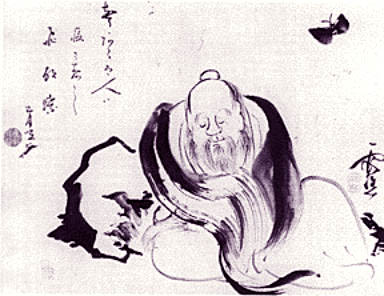
The famous story of the butterfly is regarded as an allegory which Harold Roth explains as follows: “When Zhuangzi dreams he is a butterfly in the famous story, he is totally experiencing being a butterfly, and he has none of the conceptual categories of Zhuangzi the man. Then when he wakes up, he is again the man who remembers the sensation of being a butterfly. His question about his own identity arises from his total lack of attachment to any one way of looking at things, even to the standpoint of his own self. This is a perfect demonstration of the total fluidity of conceptual categories that is one of the essential defining characteristics of the yinshi mode of consciousness.” Zhuangzi differentiates the yinshi mode of consciousness from the weishi mode. In the latter, one rigidly applies a pre-established way of looking at the world to every situation whereas in the yinshi mode one lets the unique circumstances of the situation determine one’s understanding and approach to it.
In chapter 27 yuyan is said to mean “to say something by borrowing others” (jiwailunzhi 籍外论之), in other words, quote from another author. This, Shang says, was Guo Xiang’s understanding of the reason why Zhuangzi borrows many names (Confucius, Jian Wu, Lian Shu and others), but he disagrees with this interpretation, because he feels that “Zhuangzi would not worry about whether people would accept his thought or not, so he needed not rely upon anyone’s power or authority. To this extent I think Legge and Mair are right to think of yuyan as metaphorical language or metaphor, for that is what Zhuangzi meant by jiwailunzhi. Metaphorical and symbolic language are what Zhuangzi ‘borrows’ to overcome the limitation of ordinary language.”
“Thirdly,” Shang adds, “yuyan is the inclusive language that speaks but never imposes any personal judgment upon what it talks about, nor excludes anything that is commonly thought of as wrong …Because Dao is all-inclusive … the language used to access Dao must be inclusive as well. Many stories told in the Zhuangzi are not prescriptive but suggestive; no actual assertion is made in a traditional way … Through yuyan, language deconstructs itself and thus opens up our minds to the vivid or vital nature of things.This is why in the Book of Zhuangzi the most important thing is not what he says but how he says it, because what he intends is to reveal the nature of language itself. Only after one has realized the nature of language is one able to overcome the limit of language.”
Chongyan (重言) – Paradoxical language
Shang writes: “Chongyan means double words or dual discourse. The interpretation of chongyan is still controversial. Guo Xiang explains chongyan as zhongyan (zhong means heavy or weighty alluding here to respectful words said by elders or sages): ‘They are the words from the elders that everybody has respected. Seven tenths of them are truthful” (Guo). Wang Fuzhi opposes such a reading. He argues that chongyan means the repeated, or duplicated words of elders (Mair translates it as “quotation,” and Watson “repeated words”). Most interpreters follow one or the other of these interpretations.”
Shang, along with other contemporary scholars, rejects both interpretations. He argues that “according to Zhuangzi, words are just dead corpses of spirit or meaning, the words of old sages are ‘the chaff and dregs’ of them (23/8). So why should Zhuangzi repeat ‘the words of the elders’? He suggests that “Chongyan, dual words or double discourse, could be understood as paradoxical language as well. Chong refers to dual, overlapping and double, so chongyan contains dual or opposite meanings and might also be spoken in a paradoxical manner. For Zhuangzi, paradox or duality is a trait of language … So he created his eccentric discourse to follow the nature of language, which is also the manifestation of Dao.The meaning of a word can vary easily into its opposite when the context is changed. Take the word qiai as an example. Qiai refers to respected or trustworthy elder.” But, an old man who is not in some way ahead of others has not grasped the Way of man, and if he has not grasped the way of man, he deserves to be looked on as a mere stale remnant of the past. (27/1, Watson, 304). Here the same word qiai could mean both the ‘respected’ and ‘disrespected’ … In the entire Book of Zhuangzi, especially in the Inner Chapters, chongyan appears most frequently in association with yuyan. Zhuangzi often defines a conception by its negation: “When it is born it is dead, when it is dead it is born; when it is positive it is negative, when it is negative it is positive; it is right because it is wrong, it is wrong because it is right (2/3)”… He constantly makes this kind of dual and contradictory statement which is called chongyan.”Chongyan is a special discourse in which language speaks by and for itself. It does not signify anything but the process of signifying in which there is no identification of the object as signified … Chongyan has deconstructed the language that has been commonly trusted as the only vehicle that conveys Dao, though speaking it paradoxically. We get frustrated by reading those chongyan and may suddenly be awakened from the nightmare of language. Only then are we able to detach or liberate ourselves from language, with a language that has freed itself from the argument of right/wrong, from the mentality of differentiation.”
Zhiyan (卮言) – Goblet words in the restricted sense
“Zhiyan or goblet words,” Shang tells us, “is the name for Zhuangzi’s special discourse as a whole. Goblet (zhi) in the past was a sort of container or cup for liquor, which would remain upright when it was empty and would turn upside down when filled. Guo Xiang says that it has no uprightness of itself but depends on the one who drinks. In reference to language, it describes the words that change in accordance with the change of things, renewing themselves every day (Guo, 947). Yuyan are goblet words because they can never be filled with fixed meaning.” Shang also accepts another interpretation by Chen Xuan-ying who says that “zhiyan is dismembered and irrelevant words.” As noted above, “The whole discourse Zhuangzi applied in his teaching, including yuyan and chongyan, can be characterized by the name of zhiyan. So in the Zhuangzi, “Nine tenths are yuyan, seven tenths are chongyan. It is zhiyan that comes forth like new days, completely in harmony with the natural diversity (tianni, 天倪)” (27/1). Zhiyan is the real secret of Zhuangzian discourse, which does not differ from but includes chongyan and yuyan. This discourse is different from any other discourse.”
While most readers are rather perplexed when first opening the Zhuangzi, Shang insists that Zhiyan is the way that, “Day after day zhiyan comes forth in harmony with natural diversity, flows over spontaneously with no-mind, this is how one completes his life. There is equality [of nature] when there is no word, word and equality are not equal, equality and word are not equal, this is so called no-language (wuyan, 无言). In modern parlance, it is how reality arises from the standpoint of the right brain (experientially and even existentially) when the layers of abstract concepts stored in the left brain that are now concealing reality are lifted. Zhuangzi says: “We should speak without words.” In fact, “One may speak all his life, and may have spoken nothing; one may speak nothing all his life, and yet have spoken something. ”In an attempt to convey what it means to perceive reality non-metaphysically, Shang switches to a very concrete evocation of what it feels like: “It is the self that makes one say “okay” (ke, 可); it is the self that makes one say “not okay” (buke, 不可); it is the same reason for saying “so” (ran, 然) and “not so” (buran, 不然). Why it is “so”? It is so if it is so. Why “not so”? It is not so if it is not so. Why it is “okay”? It is okay if it is okay. Why “not okay”? It is not okay if it is not okay. Things have their own “so”; things have their own “okay.” Nothing is not okay, nothing is not so. Without zhiyan coming forth and harmonizing with natural diversity, therefore, how could it [language] last long? Myriad things are [equally] One, only passing on in different forms, coming and going like circles, yet nothing could be traced as their principles, this is called natural equality (tianjun). Qi wu lun, “Natural equality is no other than the natural diversity (27/1, Watson 304)
To sum up:
1. Zhiyan comes forth from spontaneity … It speaks as nature speaks (tianlai, 天籁) by and for itself, solely according to the diversity and equality, or simply the dao, of nature. Such discourse reflects perfectly upon the Dao, which creates and transforms all by itself.
2. Zhiyan does not rely on words (wuyan, 无言) …This is what is called speaking “with no words,” which means words have no fixed definition and thus grip no poles of duality. Zhiyan does not speak, in a conventional sense, and yet has spoken everything.
3. It takes no stand regarding right/wrong, permissible/impermissible, and so on … Zhiyan makes no assertion of right/wrong, but stays in the middle with no demarcation of the world, harmonizing itself with the natural equality and diversity of things.
4. Zhiyan as the Dao discourse is also the discourse of the sages, the liberated persons who have no attachment to language and do not argue. They simply follow the way of nature … forgetting time and righteousness, hovering around the realm of infinity, and abiding in the unlimited universe” (2/6).
Shang concludes: “zhiyan, including yuyan and chongyan, is how Zhuangzi was speaking and writing, which transcended the boundary of common sense or conventional language. Like Laozi he realizes the limitation of language, yet he speaks without and simultaneously within language. In Chinese terms, one would say: “Zhiyan is such a language that leads to this edge and consequently makes words the sound of Heaven.”
Illustrative Examples of Zhiyan
Chapter 7 of the Zhuangzi provides a few examples of the use of zhiyan language. In the chapter he contributes to China-West Interculture, Kirill Ole Thomson quotes a few: a dialogue between Zhuangzi and his sophist friend Huizi, a comment by Confucius on his disciple Zheng Shen, a dialogue between Yancheng Ziyou and Ziqi, and a dialogue between Penumbra and Shadow, which he comments as follows: “The Penumbra … asks about Shadow’s various motions.” Shadow’s reply illustrates the responsive activity characteristic of goblet words: “Things just happen in a sequence, in a context, in an unfathomable larger nexus; one just follows them in conduct: ‘I’m the shell of the cicada, the skin of the snake – something that seems to be but isn’t. In firelight or sunlight I draw together, in darkness or night I disappear … If those things come, then I come; if they go, then I go with them” (Watson). One lacks self-identity, but reflects a larger concatenation of phenomena that conditions one’s very presence (you) and absence (wu).”
“Language is only a means that may help us to realize the Dao of true life. Its performative, not prescriptive function, provides suggestions or “traces” of access to what is meant by the word Dao but not the Dao itself”
Shang regards Zhuangzi and his school as “the pioneers of philosophy of language and linguistic study” in China and asserts that “through the deconstruction of language, Zhuangzi has destroyed the foundation of all kinds of dogmatism and authoritarianism which are dependent, foolishly, upon words.” Still, words have a function, and, to be honest, we could not live without them, but, as Buddhists also taught, when told that once they have crossed the river to the other side, they can, and should, leave behind the raft they have used to get there, Daoists are similarly invited to forget the words, in the following story: “The fish trap exists because of the fish; once you’ve gotten the fish, you can forget the trap. The rabbit snare exists because of the rabbit; once you’ve gotten the rabbit, you can forget the snare. Words exist because of meaning; once you’ve gotten the meaning. you can forget the words. Where can I find a man who has forgotten words so I can have a word with him? (Watson, 302). To forget language here means to forget the word as truth or reality itself. This is what Zhuangzi meant by ‘language without words’.”
Once again, this is how Zhuangzi may have presented it to a traditional Chinese audience. “Neither language nor silence are capable of expressing the difference between the Dao and things. Only non-language and non-silence ( feiyan and feimo, 非言非默) may speak of the ultimate (25/11). Language and Dao are no longer two; they are one resounding of the ‘music of heaven’ (tianlai), the melody performed by myriad things with their own different voices (2/1) … Zhuangzi plays it as perfect music (zhiyue or zhile, 至乐) … In the performance of such music of heaven, all human prejudices and anxieties that have stemmed from language and senseless debates on metaphysics, truth, and knowledge have ceased; we return to our home of nature. Now we clearly see how Zhuangzi’s religiosity manifested in his deconstructing and reconstructing language and what kind of liberation his dealing with language was leading to. For him, freeing language from its traditional function of fixation, differentiation, and prescription amounts to freeing human spirit.”
Sources:
Ge Ling Shang – Liberation as Affirmation: The Religiosity of Zhuangzi and Nietzsche (2006)
Ludwig Wittgenstein – Philosophical Investigations (1958)
Harold D Roth – The Contemplative Foundations of Classical Daoism (2021)
Kirill Ole Thompson – Zhuangzi and the Quest for Certainty in China-West Interculture: Toward the Philosophy of World Integration – Essays on Wu Kuang-ming’s Thinking, edited by Jay Goulding (2008)