
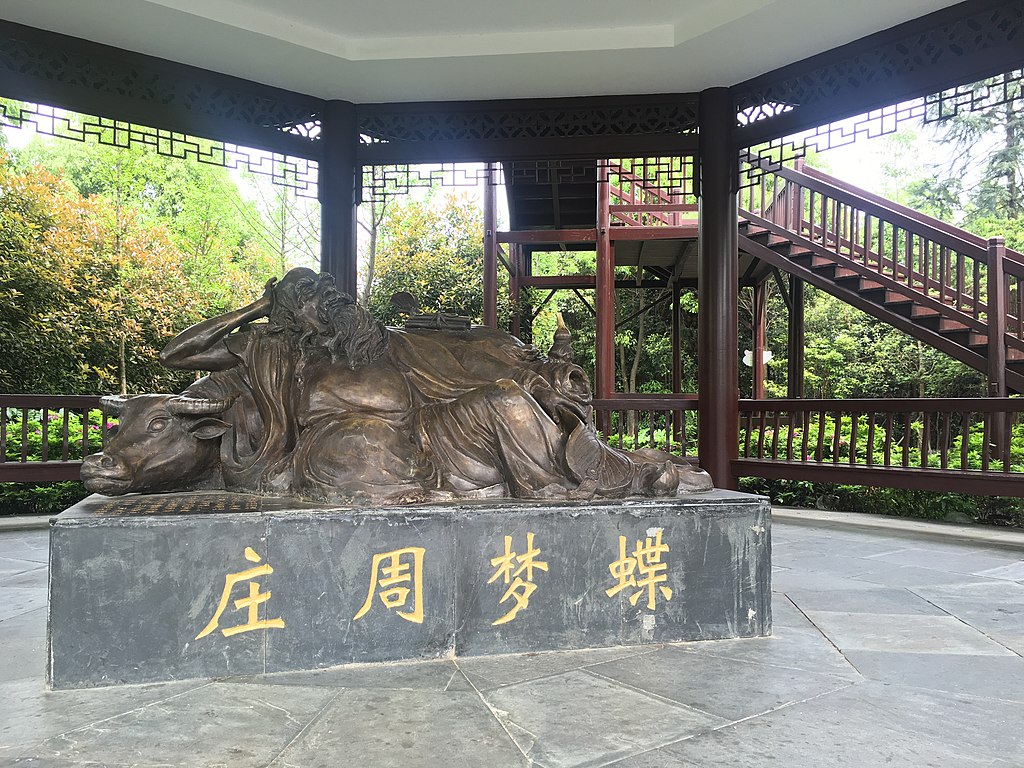
“In the last chapter, Tianxia or “The World” of the book of Zhuangzi, Zhuangzi is carefully separated from Laozi’s Dao as symbols of two different schools. In comparison with Laozi’s Dao as nonbeing, Zhuangzi’s Dao is described as “Obscure, boundless, and without pattern; changing and transforming without constancy. Is it birth or is it death? Is it a virtue of heaven and earth? Is it where is the spirit goes? Never clear where to go, never decisive what to be? Even if all the ten-thousand-things things are counted, there is still no clue to locate it. These few words successfully bring out the uniqueness of Zhuangzi’s position on Dao” (Ge Ling Shang – Liberation as Affirmation p 15-16).
In Liberation as Affirmation, Ge Ling Shang argues that “many have construed Zhuangzi as merely a follower or successor of Laozi who made the first metaphysical utterances, and hence have failed to detect or understand what original and subversive moves Zhuangzi made in his philosophy.” Specifically, Zhuangzi’s book amounts to a deconstruction of Laozi’s concept of the Dao as a cosmological, hence, metaphysical, entity, a substantial ground. Similarly, Friedrich Nietzsche fired the first shot that led to the deconstruction of metaphysics during the past century, in particular in the postmodern movement. Before moving on to his comparison with Nietzsche, Shang needs to shed light on the difference between Zhuangzi and Laozi’ understandings of the Dao.
Little is known about Zhuangzi’s life, but mention of his life in Sima Qian’s Historical Record indicates that he was indeed an influential man who lived in 4th century BCE, even though he worked as a low-ranked clerk in a small town.
Ge Ling Shang says that he “was a contemporary of King Hui of Liang or Wei, King Xuan of Qi, and Mencius though they never met each other.” Zhuangzi was a resident of Meng, which belonged to Chu State, now probably somewhere in Anhui Province near Long River in mainland China.” The Anhui Province in Eastern China is well-known for its superb Huangshan mountains. According to Sima Qian, “Zhuangzi wrote more than one hundred thousand words, most of them allegories.” King Wei of Chu State heard Zhou’s reputation and wanted him to be the prime minister of Chu. “Zhou laughed at this and told the messenger, ‘Go away, don’t insult me! I shall never be a politician. I just want to enjoy my free spirit. The first seven chapters of the book referred to as the Zhuangzi, entitled “Inner Chapters”, are generally considered to be the writings of Zhuangzi himself.
Even less is known of Laozi who is said to have lived in the sixth century BCE, which would make him a contemporary of Confucius with whom he is often represented in paintings, but then the Buddha is also represented next to the two Chinese sages! Laozi means “Old Master,” but he is also referred to as Lao Tan and Li Er, born in the state of Chu, and having worked as a librarian at the Zhou court. A well-known story shows him leaving his job to walk westward to a mountain pass where an official asked him to put his insights into writing, which we now know as the Daodejing. There is also a story which adds that he was later reborn as the Buddha. The Daodejing was definitely written some time before the 4th century BCE, since several copies have been found in tombs, with the oldest manuscript dated to 300 BCE. But scholars generally agree that it was composed by a lineage of sages, rather than a single individual, and it could well be that some of its passages indeed go back to the 6th century BCE!
It would be safe to say that Dao has been the basic conception and central theme of early pre-Qin China
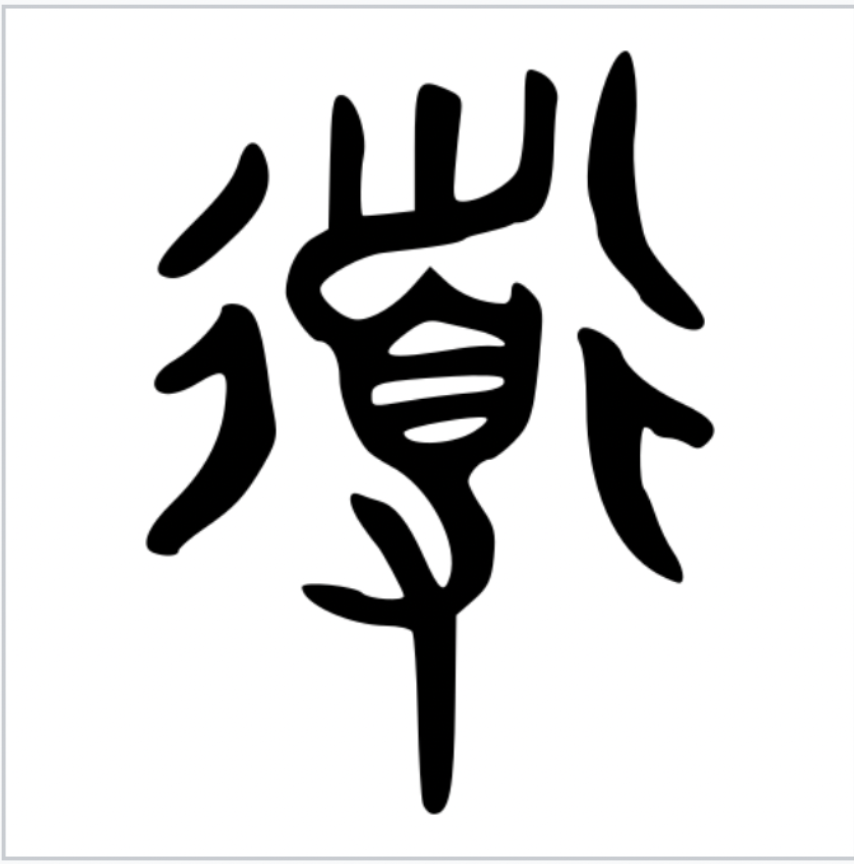
Archeological evidence for the origin of the concept of Dao may be traced to the early Zhou bronze age inscriptions. The sinograph for Dao (道) is made up of two parts: at the top a word shou (辶) meaning head, and underneath another word zou (首) representing a person who is walking. Shang writes: “The message conveyed by the image is obvious: Dao stands for the path, road, or way by which people can walk.” But Shang then adds, quoting an 18th century author – Dai Zhen – that “Dao used to be a synonymy of “xing” (going or action) and lu ( road) for the early Chinese.” In fact, the Shijing (Book of Poetry) which is one of the five Classics said to have been written by Confucius) often uses ‘xing’ in place of the word ‘Dao.” And, “Since walk (xing) , the same word for action, conduct, behavior and practicality, is not idle wandering but always to go somewhere (or to reach a goal), the way could certainly be necessary and essential.” Shang also quote Zhu Xi (12th century) as commenting that “Men and things go with their own intrinsic natures, therefore they must follow respectively their own paths in routine occurrences. This is what is called Dao (Zhu Xi).”
Shang further explains: “To walk is to go somewhere along a path that can lead to one’s destination. In the same respect, natural phenomenon move or change in a way that leads the ten-thousand-things to exist in an ordered and harmonious universe; societies unite and develop in a way that leads to the promise of peace, prosperity, and happiness … This way or Dao could be conceived of as principle (li). Dao is li, says the Book of Zhuangzi. In other words, when Dao is spoken, it always refers to the principle of necessity in things, the principle all men should follow. Ancient Chinese like to speak of Dao as a principle of things both in nature and society, such as tiandao, (the way of heaven or nature), nendao, (the way of human beings), wangdao, (the way of princes), daoshu, the art of Dao, or the strategy or technique of the Dao), etc. Many believe that an overall or ultimate Way or Principle must exist, for without such a Principle the world would be in a state of chaos.” Yet, the head of a person in the graph of Dao points to a “meaning of guidance.” Shang says that in Confucius’ Doctrine of the Mean (Zong Yong), it is stated that ‘To guide our nature is called the Dao’. Another meaning of the word shou is initiation or beginning … It is quite likely that the word Dao could have a kind of sense of origin or originator of things, for nothing could be completed or achieved without a Dao or way of becoming. Perhaps this is why early philosophers such as Laozi, for example, had used the word Dao to signify the origin or root of the universe.”
“When Dao is used as a verb it usually means “to speak” or “say.” By speaking, Dao gives things names and puts them in a proper order, therefore, “having name or named is the mother of all things” (Daodejing).
According to Charles Fu, there are six philosophical dimensions or meanings of the concept of Dao
Quoting Charles Fu, Shang sums up: “There are six philosophical dimensions or meanings of the concept of Dao: (1) Dao as Reality (daoti, designating the essence, or being/nonbeing in the Western terms of the world; (2) Dao as Origin (daoyuan of all things); (3) Dao as Principle (daoli); (4) Dao as Function (daoyong; (5) Dao as Virtue (daode); Dao as Technique (daoshu). The five first dimensions according to Fu, combine in the Dao as Manifestation or Form (dao xiang).”
These six philosophical meanings of Dao developed during the dark age of the politically turbulent Spring and Autumn (c. 770 – c. 481 BCE) and Warring States (c. 475 – 221 BCE) periods that marked the decline of the Zhou dynasty. These two periods, however, are also regarded “the age of a hundred schools of thought” (600-221 BCE) and the golden age of intellectual creativity to which belong most of Chinese Classics. Even though China had relatively few contacts with the West before the opening of the Silk Road, dated to the second century BCE, the age of a hundred schools coincides with the Axial Age that saw similar developments in Greece, Persia, and India. In all cases, it seems, these amounted to a reification of the conceptual frameworks underlying the socio-political order of new empires. So, even though Chinese culture is now regarded as having eventually resisted the temptation of metaphysics, during the Chinese age of the hundred schools, the tendency was toward the reification of its worldview into a cosmological order.
By the time of mid Zhou Dynasty, the word Dao began to refer to the ultimate reality, cosmological origin, or universal principle
Shang writes: “It is hard to trace when, in the history of Chinese thought, the word Dao first became a cosmological or “metaphysical” term, designating the cosmological origin or “metaphysical reality” that determines the form, meaning, and being of everything.” Not that the Dao was the first move that led a trend. In fact, Dao followed a trend that started with “tian (heaven), tianming (mandate of heaven), and di (Lord). These are concepts associated with the imperial authoritarian regimes of the Shang, whose divine protector was Shang-di and the Zhou, who had skilfully rearticulated divine protection as the mandate of Heaven. “In the Book of Guanzi,” Shang tells us,“it is recorded that Guanzi (died 645 BCE) had used Dao and tian-dao to represent the universal truth or principle.” By the time of mid Zhou Dynasty (ca 600 BCE), the word Dao began to refer to the ultimate reality, cosmological origin, or universal principle by various schools.” So Laozi in no way initiated the belief in a Dao conceived as a cosmological concept, he merely inherited this belief and thought that “it was the Dao that produced (sheng) the vicissitudes of the universe, vitalized the whole world of lives, and legislated and justified patterns of human life and social relationships.”“For Confucius too,” Shang continues, “the term Dao takes on its extended abstract and general meaning. As Benjamin I Schwartz remarks, the Dao is the Dao of “an achieved universal” and the word tao (Dao) would thus be Confucius’ inclusive name for the all embracing normative human order (Schwartz). Once the Dao was ignored, denied, or devastated by any cause, nature or society would lose their harmony and peace, and people would suffer all kinds of disasters. Most early Chinese thinkers agreed that the meaning of human life, the content and purpose of true knowledge, the advance of morality, and the success of governance were simply manifestation of the Ultimate Reality or Order that they called Dao.
In Disputers of the Dao, A. C. Graham also addresses the question of the Dao in ancient China from a sociopolitical perspective. The Zhou dynasty was disintegrating, with dukes vying to increase their power and expand their territories. It was therefore logical to interpret this political chaos as “the inevitable consequence of the loss of the Dao.”
As explained in chapters 27 and 33 of the Zhuangzi, Shang notes, “their whole thinking is a response to the breakdown of the moral and political order which had claimed the authority of Heaven; and the crucial question for all of them is not the Western philosopher’s “what is the truth?” but “where is the Way?”, the way to order the state and conduct personal life.”
The One Hundred Schools as one hundred theories about the Dao
The rise of the One hundred Schools must be understood from this perspective. They must be viewed “as diverse studies or teachings of the Dao (zhidaoshu).” By definition then, each school presented its own interpretation of the Way, and heterogeneity, including outright contradiction, prevailed over commonalities. “What they shared was one goal, which was to explore, to learn, and to practice the Dao, the Truth or the Way. In his essay ‘On the Essentials of the Six Schools’, historian Sima Tan (died 110 BCE) says: ‘In the “Great Appendix’ of The Book of Change (Yi), there is the statement: ‘In the world there is one purpose, but there are a hundred ideas about it; there is a single goal, but the paths toward it differ.” This is just the case with the different schools of thought.” (Shi Ji, ch 130)
Source:
Ge Ling Shang – Liberation as Affirmation: The Religiosity of Zhuangzi and Nietzsche (2006)
#Ancient Chinese Philosophies
#Daoism
#Zhuangzi
#Nietzsche