
“Now, from this highest stage of human liberation, looking back over those aforementioned discrepancies between Zhuangzi and Nietzsche, we have found that they are no longer as incompatible as they once seemed. Both advocate instinct and spontaneous activities beyond good and evil and all human-made boundaries. Zhuangzi favors disengagement from human competition because he thinks this is the best way to overcome competition, which is conceived as the real victory of all competition. On the other hand, Nietzsche often talks about innocence and the child as the highest state of self-overcoming in which all fighting will be over.” (Ge Ling Shang – Liberation as Affirmation p 132)
Ge Ling Shang set out to compare Zhuangzi and Nietzsche because both had engaged in a deconstruction of metaphysics, despite operating within radically different geographical, historical, and cultural contexts. Ultimately, however, his book has turned out to be a comparison between two paths toward human liberation. Zhuangzi conceived this quest in terms of what Asian cultures have traditionally called “awakening,” whereas Nietzsche carried out a radical questioning aimed at a critical deconstruction that opened the way for existentialism and postmodernism. For both thinkers, human liberation did not mean freeing oneself from an innate human nature, but rather from the layers of concepts and habits that “civilisation”- through language, knowledge, and morality – had superimposed upon human existence, thereby preventing us from living authentic lives. Both articulated their ideas in terms of the flourishing of “life.” Zhuangzi approached the issue from the perspective of the individual, urging a process of self-cultivation before even thinking of changing society. Conversely, Nietzsche—emerging from a culture where the very possibility of transforming consciousness had been stifled by the Church—could only theorise about the need to jettison Christian morality, and the need to replace it by new values, rooted in the natural dynamism of the world (“will to power”), possibly shaped by his lifelong quest to find a cure for his deteriorating health. Nietzsche was only thirty five when he had to resign from teaching at Basel university, and forty-five when he collapsed from what has now been diagnosed as a slow-growing tumor behind his eye. Shang emphasises that “both have used the metaphor of the child to describe the person who reaches the ultimate state of liberation—the true person and Übermensch.” Zhuangzi sees the (pre-literate) child as naturally spontaneous. Nietzsche states at the very beginning of Thus Spoke Zarathustra: “Zarathustra has become a child, Zarathustra is an awakened one.”
Zhuangzi’s true person (zhenren 真人)and Nietzsche’s ideal of the Übermensch
Shang writes: “Zhuangzi’s true person has the following traits: she does not rebel against want, does not show off success, and does not deliberate about her doings; thus, she cannot be frightened by height nor drowned by water nor burnt by fire; she has no discrimination against either life or death, letting it come and go as natural course of transformation; her mind forgets, her face calms, her forehead widens, she is chilly like autumn and balmy like spring; her delight and fury go along with the four seasons; she can fly like Kun-peng thousands of miles up in the air and be carefree like little birds easing down to the field; she is perfectly one with heaven and earth, she is heaven and earth (6/1).”
Shang’s use of the pronoun “she” when referring to a Zhuangzi’s ideal person reflects his wish to balance Nietzsche’s neutral Übermensch said to include women (even though the word Mensch is grammatically masculine). Übermensch, however, was translated as “superman” or “overman” at a time when the “human” was referred to as “man” in Western texts, and this translation at least contributed to the assumption that it only referred to men. My own copy of Thus Spoke Zarathustra, translated by Graham Parkes, well-known in the field of East Asian studies, uses the word “overhuman.”
Shang explains: “The word ‘over-man’, as the designation of a type of supreme achievement, as opposed to ‘modern’ men, to ‘good’ men, to Christian and other nihilists—a word that in the mouth of a Zarathustra, the annihilator of morality, becomes a very pensive word – has been understood almost everywhere with the utmost innocence in the sense of those very values whose opposite Zarathustra was meant to represent – that is, as an ‘idealistic’ type of a higher kind of man, half ‘saint’, half ‘genius’.” (Ecce Homo, “Why I Write Such Good Books,” 1).”
Shang continues: “The Übermensch is the person who has overcome him or herself as an alienated human-all-too-human being; she puts behind every highest value and creates his or her new values merely by following his or her instinct of freedom and his or her will to power; she is an immoralist and goes beyond good and evil; he is strong physically and mentally and capable of destroying and creating; she is a Dionysian artist who enjoys, affirms, and says Yes to everything and becomes and dies in the world of appearances; she laughs, dances, ascends high, and goes under ecstatically as a drunken god; and after all, she is ‘the meaning of the earth’.”
Zhuangzi and Nietzsche share the same sense of non-self as true self
What we normally call the “self” is the ego-self, an image of who I am supposed to be from the standpoint of ordinary “objective” consciousness, shaped by cultural tradition, including authoritarian ideologies. “Only if we overcome or forget such a self can we discover our real nature.”This is a statement that practitioners of Zen will immediately recognise.On the other hand, Shang adds, “Zhuangzi’s forgetfulness of self is the way to regain the sovereignty of a genuine self. Such a self never compromises with rulers and the crowd of marketplaces, but creates a free and unique individual who can even swim in filthy water without being contaminated.”In other words, this genuine self is not just a sense of coalescence with the world, as it is traditionally described in Buddhism. It also had the “political dimension” Nietzsche focused on. So, Shang can say: “Nietzsche seems to have a similar sense of the self. He remarks in Zarathustra’s teaching on the Übermensch: “I love him whose soul is overfull so that he forgets himself, and all things are in him: thus all things spell his going under (“Prologue,” 4).
Both Zhuangzi and Nietzsche celebrated the natural process
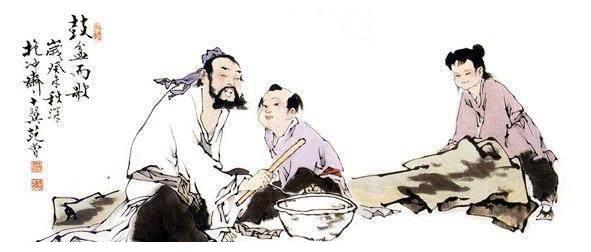
Shang brings us the story of Zhuangzi’s seemingly outrageous behaviour at his wife’s funeral: Huizi finds him “sitting with his legs sprawled out, pounding on a tub and singing. ‘You lived with her, she brought up your children and grew old’, said Huizi, it should be enough simply not to weep at her death. But pounding on a tub and singing—this is going too far, isn’t it?” To this, Zhuangzi responds: “You are wrong. When she first died, do you think I didn’t grieve like anyone else? But I looked back to her origin but saw no birth, not only did I see no birth but no form either, not only did I see no form but no breath (qi) either. It was in the midst of the chaos of wonder and mystery that a change took place and a breath was risen; then a change of the breath brought forms into being; then a change of forms brought my wife’s birth. Today there was another change and she died. It is just like the progression of the four seasons. Now she is going to lie down peacefully in a vast hall [of nature]. If I were to follow after her bawling and sobbing, it would show that I don’t understand anything about the nature of life. So I stopped” (18/2, Watson, 191–92).
Shang interprets this as an overcoming of the opposition between life and death. He says: “I see in him, rather, the Dionysian frenzy or tragic spirit that Nietzsche came to celebrate. Moreover, Zhuangzi did not ask us to eliminate human desires, but rather to restrain them so that we can regain our suppressed spontaneity and naturalness.”
“From the appearance of the words “true person” and Übermensch we may get the impression that Übermensch seems more aggressive and transcendent, while true person sounds more down to earth and spontaneous”
Shang disagrees with this view. He says: “Zhuangzi’s “returning” and Nietzsche’s “overcoming” are neither contradictory nor opposite but compatible and reciprocal, for the true person and the Übermensch are the persons who have returned to their nature and thus have overcome the unnatural humanity. So returning is overcoming and vice versa; they are not heading in opposite directions but one: to be “the meaning of the earth” or “one with heaven and earth,” and ultimately, to reach the state of liberation and freedom which lies in an unconditional, childlike, Dionysian affirmation of life as it is. Returning is overcoming. Liberation is affirmation. Liberation or freedom is not a negation of this world nor a rejection of life and nature. It is, rather, a divine affirmation and a sacred saying Yes to this world and this life. What is this world? What is this life? What is it that Zhuangzi and Nietzsche wants to affirm?”
The natural world includes the blue skies, the growth of plants and the breeding of animals, and it must be affirmed. But, Shang argues, it also includes “instinct, body, will to power, and everything spontaneous. To be natural and spontaneous is to open up oneself completely to nature with no human regulation whatsoever. What should be overcome are not sensual desires, passions, and affection, but human-all-too-human ressentiment which has tried by all means to suppress everything spontaneous in us. To be one with heaven and earth (ziran), to be one with the flux of becoming (Dionysus), that is freedom and liberation for Zhuangzi and Nietzsche.” Here we are apparently moving far away from the Buddhist view of the world: no mention of life as suffering, no need to control sensual desires. We are even moving away from Laozi’s first chapter where it is said that “those constantly with desires, by this means, will see only that which they yearn for and seek.”
Shang, however, insists that “it is this life, no matter how terrible, how difficult, how tragic it is, that must be affirmed.” In the case of Zhuangzi, “this process is called ming or fate. A true person never bothers to know what or why fate is as it is, but simply accepts and affirms what is happening to her. Nor does she have any preference for what fate or destiny brings to her, even with the situation of life and death.” Isn’t it what we normally call “fatalism,” which was forcefully discredited by science which presented itself as the search for solutions to improve our lives? It is not, affirmation is also the opposite of denial. It includes being prepared “to do something about it.”
Likewise, Shang says, “Nietzsche’s affirmation of life is ultimately tested by his love of fate—Amor Fati—and the idea of eternal recurrence. Everything that happens in one’s life should be affirmed and willed to happen again, once more, and numerous times more. With such an affirmative mind, one is able to say: ‘All days shall be holy to me’ (Z, II, ‘The Dancing Song’) and becomes a free dancer, wanderer, laughter, and creator of himself.”
Shang cannot claim, as Laozi often did, that one must negate the self “in order to” gain whatever it is we are looking for. Our relationship with the world cannot be transactional in nature. Self-negation must be unconditional; it must not aim to secure any sort of gain. As such, self-negation constitutes an affirmation of everything that occurs in our lives. There will always be two ways of viewing the world: we perceive it as imperfect from the standpoint of ordinary objective consciousness, and as a unique, undifferentiated world when we intuitively merge with it within our “vacant” self. This perspective has been described as viewing the world through a “double aperture.” Although we can only “experience” our belonging to the world from the enlightened standpoint of the vacant self, the fact remains that we are part of the world at every moment even while we perceive ourselves as separate. How could we not be an integral part of this world, where every part contains the whole, interconnected as it is with all other parts? This is what Ueda Shizuteru, a philosopher of the Kyoto School, means when he speaks of a “dialectical process between self-negation and self-affirmation.”
As noted before, Ge Ling Shang was not the first scholar to see a resonance between Zhuangzi and Nietzsche. In Japan, Kyoto School philosopher Nishitani Keiji who grew up at a time when Japan was undergoing a rapid process of westernisation, first turned to Nietzsche when, as a teenager, he went through a distressing period of depression. This led him to write a book titled The Self-Overcoming of Nihilism largely based on his study of Nietzsche. It is only years later that he went back to his native Buddhist tradition and embarked on a lifelong Zen practice. He does not mention Zhuangzi, but the following perfectly encapsulates Shang’s book: “The double negation of things and self results in a restoration of both things and self on the field of emptiness, which could be called ‘the field of ‘be-ification’ or, in Nietzschean terms, the field of the Great Affirmation, where we can say Yes to all things.”
Sources:
Ge Ling Shang – Liberation as Affirmation: The Religiosity of Zhuangzi and Nietzsche (2006)
Bret W Davis – “The Contours of Ueda Shizuteru’s Philosophy of Zen” in Tetsugaku Companion to Ueda Shizuteru (2022)
Nishitani Keiji – Religion and Nothingness (1961)

Wen Zhengming (1470-1559)