
Zhuangzi: “Many in history, who had devoted their lives to saving the world from decadence, either failed or aggravated the situation, because they fought against what they had not overcome inside themselves. Therefore, Zhuangzi teaches us that if you want to help others help yourself first; if you want society to be just be yourself first“ (Ge Ling Shang – Liberation as Affirmation p 129).
“Nietzsche: “I preferred to question and try out the ways themselves. A trying and questioning was my every move; and verily, one must also learn to answer such questioning. That, however, is my taste—not good, not bad, but my taste of which I am no longer ashamed and which I have no wish to hide. ‘This is my way; where is yours?‘—thus I answered those who asked me ‘the way’. For the way—that does not exist” (Thus spoke Zarathustra. (Z, III, “On the Spirit of Gravity,” 2).
Zhuangzi writes: “When asked: ‘What is heaven (tian)? What is human?’ North Sea Ruo replied: ‘Horses and oxen have four feet—this is called heaven; Putting a halter on the horse’s head and piercing the ox’s nose—this is called human’ (17/1).” Ge Ling Shang comments: “According to Zhuangzi, human beings originally were part of nature (tian) and came into being by natural transformation (wuhua, 物化). To a point, we have no choice: we need to use natural resources in order to survive. But, as we do this we cause animals to suffer and, increasingly ravage nature. This was already the case in Zhuangzi’s time.
Both Zhuangzi and Nietzsche are nostalgic about an early – preliterate – period of our past when “people enjoyed their peaceful and spontaneous lives,” precisely because writing had not been invented, and spoken language was still closely tied to everyday practical lives. But, as Shang says, “with the development of so-called civilization, with the inventions of politics, morality, knowledge, and technology, human beings began to lose their identity with nature. The oneness of the world fell apart, the original harmony of chaos and differences evolved into jostlings and wars.” This was also the view of Jean-Jacques Rousseau in contrast to Thomas Hobbes who described life in the “state of nature,” i.e., without a government, as “solitary, poor, nasty, brutish, and short.”
“Man is something that must be overcome!”
It is in Thus Spoke Zarathustra, said to have been his preferred book, that Nietzsche developed his concept of the Übermensch, which is often translated as “superman” or “overman,” both rather awkward words since “Mensch,” though grammatically masculine is meant to include both women and men. My own copy of Thus Spoke Zarathustra, translated by Graham Parkes, uses the word “overhuman.” Note that Graham Parkes is the author of Heidegger’s Hidden Sources: East-Asian Influences on his Work and other works on East Asian philosophies, and parallels in the West, an indication that he too saw echoes of Daoism in Nietzsche’s thought.
As early as the third page of the Prologue, Nietzsche writes: “I teach to you the Overhuman. The human is something that shall be overcome.” Zarathustra presents himself as a sage figure who had left his home ten years before to go into the mountains, and is now coming down from the mountains, another Moses, who unlike Moses, is not bringing down God’s Ten Commandments, but instead the insights he has gained from his immersion in nature, what he refers to as “going under.” A sage he meets on the way describes him as “Clear is his eye, and around his mouth no trace of disgust. Does he not walk like a dancer? Zarathustra is transformed. Zarathustra has become a child, Zarathustra is an awakened one.”
This is of course a far-cry from the popular image of the Übermensch, which is based partly on the distortion of Nietzsche’s ideas by his sister, who published his works after his death and, even more sadly, the use of two of his key concepts – the Übermensch as “superman” in a patriarchal sense, and “will to power,” to promote the authoritarian views of Nazi ideology.
When Nietzsche traced back the origin of morality to humans’ slave mentality, he was not blaming humans as such, he was rejecting the corruption of people by fixed rules imposed on their minds and behaviours which robbed them of their genuine nature. Shang says: “Human nature and freedom cannot be regained or obtained until men and women have overcome themselves. Zhuangzi and Nietzsche not only have provided the most acute criticism and profound diagnosis of the problems of humanity but also prescriptions to cure them.”
Yuasa Yasuo, a scholar known for his studies on the role of the body in spiritual practices, has pointed out that in the West scholars base their studies of the human on the average (undeveloped) human – as it were, the man or woman in the street. They do not think in terms of what humans could achieve through self-cultivation. In Yuasa’s words, they assume that “the connection between the mind and body must be constant, (not developed) and universal (not variable among different people). Since they do not consider exceptional personal achievements, the body-mind unity remains for them a theoretical possibility rather than a state actualized by exemplary individuals such as religious and artistic masters.” It is sad that Nietzsche’s overhuman, as a rare exception to this rule, was so tragically misunderstood, though it is not surprising since the practice of self-cultivation is sorely missing in the Church.
For Zhuangzi, self-cultivation (xiu or xiu-yang) can be applied both spiritually and practically
Even in Zhuangzi’s time, regaining spontaneity was not regarded as an easy endeavour. Zhuangzi’s seemingly lighthearted “wandering without a destination” can be misleading, even as a real walk through town, but even more so as a metaphor for one’s way of life. As Wu Kuang-ming put it, one has to try hard to be “not-trying.” A practice of self-cultivation – xiu or xiu-yang in Chinese – is strongly recommended, if not required. Shang says that “Zhuangzi has created some special ways of xiu which are very influential in Chinese culture because they can be applied both spiritually and practically. The whole work of Zhuangzi, the seven inner chapters, can be understood as the Dao of xiu which leads to the ultimate state of transformation or self-overcoming.” For a detailed study of the first chapter of the Zhuangzi, see page titled Xiao Yao You.
Nietzsche’s Dao of achieving the “Dionysian spirit” is somehow different
Shang writes: “To be a person of xiaoyaoyou is to be one with ziran and to dance with the rhythm and flow of life in an absolute affirmative state of mind.This is very similar to Nietzsche’s Dionysian spirit, the ultimate will to power, which says Yes to life as it is. However, Nietzsche’s Dao of achieving this state is somehow different. His self-overcoming is achieved through being stronger, through being master or commander, noble or great, creator and legislator, this is to say, to be Kun-peng.” Yet, as noted above, Nietzsche also compared the actualisation of awakening to becoming like a child. When Zarathustra meets a sage on his way down the mountain, Nietzsche says “Zarathustra has become a child, Zarathustra is an awakened one.” This is an excellent image, and also one found in Matthew 18:3: “And he said: ‘Truly I tell you, unless you change and become like little children, you will never enter the kingdom of heaven.’” Given Nietzsche’ strong rejection of Christianity, the sharing of that image is remarkable. Shang notes that this is “an image that is often forgotten or overlooked by his readers.”
In Chapter 2 Qi wu lun Zhuangzi proposes the concept of sangwo (losing-self or forgetting-self) as a key step toward the mind of wudai (無待)
“Wudai,” translated as “nondependence, unconditioned mind, or nonduality of one’s mind,” is “the ultimate state of xiaoyaoyou, because in this state one has overcome the consciousness of the self.” It is the forgetting of the self which Zen teachers later put at the very centre of their practice. Dogen said: “To know the self is to forget the self” echoing Zhuangzi. “Only if the self is overcome and forgotten are we able to make our mind transparent, through, and enlightened (yiming 以明), accepting all the differences without prejudices or differentiation. For the purpose of overcoming self, one should try to forget language and the ideas of right and wrong, which is called ‘guyi’ (滑疑) a state of mind that remains uncertain and ambiguous—this is the real light of heaven and what the sage steers by (2/4).” This is what is today referred to as a “philosophy of indeterminacy” which is a major field of research. “Liangxing, (两行), ”meaning “walking both ways” or “both will do” (2/4) – in other words, not taking sides – is another practice Zhuangzi taught, that could be categorised as a cultivation of indeterminacy. Avoiding any fixation on a view is paramount for Zhuangzi. Then, Shang says,“Self will be forgotten … and one will become one with nature and be dissolved entirely in the flux of becoming. This, he adds, “is perhaps the implication of that famous story of his butterfly dream:
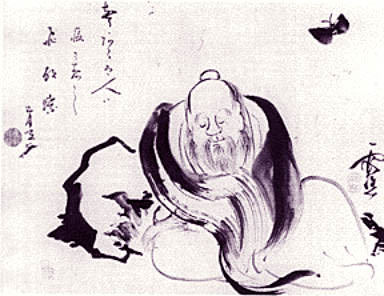
“Once Zhuang Zhou dreamt he was a butterfly, a butterfly flitting and fluttering around, happy with himself and doing as he pleased. He didn’t know he was Zhuang Zhou. Suddenly he woke up and there he was, solid and unmistakable Zhuang Zhou. He couldn’t help wondering whether it was his dream of Zhuang Zhou being a butterfly or the butterfly’s dream of its being Zhuang Zhou. There must be a distinction between Zhou and butterfly! This [distinction] is called the transformation of things. (2/7, Watson, 49).”
Chapter 3, Yang Sheng Zhu (养生主) or the Way of Caring for Life, is about how to keep in good health: To follow nature is the best way of keeping oneself in good health
To be sure, the earliest roots of the Daoist tradition were closely linked to the medical treatises of the Yellow Emperor during what Harold Roth calls the Huang-Lao period. As self-cultivation was understood in terms of “feeding life” through qi, there remained a concern with good health. There is in Daoism a keen awareness of the need to safeguard the qi one was born with. Shang says: “Life is limited, yet knowledge has no end. Chasing the unlimited by the limited is harmful. . . . If you do good, stay away from fame. If you do bad, stay away from illegal things. Follow the central pulse and let [qi] through veins, that can protect body, complete life, stay healthy, and die at the right time” (3/1).
Shang says that “Nietzsche too cares about the physical condition of the human body but he stresses more the strength a body has in its struggle for power, while Zhuangzi concentrates on letting the body work by and for itself with no human interruption. Life is the most precious gift from heaven and we have no reason not to complete it.” To “complete life,” for Zhuangzi, means to “follow nature spontaneously.” In the story of cook Ding, “the ox will be cut without extra effort and the knife (body) will not be broken.” And the duke says: “Excellent! I have heard cook Ding’s words and learned the way of keeping in good health” (3/2).
In chapter 4, Ren Jian Shi or the Human World, dealing with the way of living in a society, Zhuangzi does not attempt to present any remedy for changing the social reality, what he is concerned with is how to live well and happy in the world, especially in a corrupted society
Shang explains: “Many in history, who had devoted their lives to saving the world from decadence, either failed or aggravated the situation, because they fought against what they had not overcome inside themselves. Therefore, Zhuangzi teaches us that if you want to help others help yourself first; if you want society to be just be yourself first.“ Zhuangzi offers yet another practice Xihai (心斋), or “mind fasting’ which is sometimes translated as heart fasting. The Chinese word xin (心) in fact refers to the physical heart, but in ancient China the heart was regarded as the centre of human cognition. The now traditional translation for xin is heart-mind.
In Zhuangzi’s words:
“Xihai, 心斋, or mind fasting, is the practical way of perfecting oneself:
Yanhui said: ‘I dare to ask what xihai is’.
Confucius said: ’Unify your will as such! Listen with your heart instead of your ears; then listen with your breath (Qi) instead of your heart! Let ears stop listening and let heart stop reflecting. Breath is what is vacant (xu) that embraces [but can never be occupied by] things. It is Dao that favors vacancy. Being vacant is xihai’.
Yanhui said: ‘Before I heard this, I was certain that I was Hui. But now having learned this, there is no more Hui. Can this be called vacancy?’
‘Exactly! I now tell you: if you are able to play even in a tyrant’s cage without any perception of fame or success; if you are able to sing when he can listen and keep silence when he cannot; if you are able to have no prejudice nor plot, keep your mind in the house of One and live with what cannot be avoided, you will be close to success.” (4/1, Watson, 58)
Shang comments: “With a vacant mind one is able to live well under all kinds of circumstances and get along with all kinds of people. Different from escapists and ascetics who renounce life in reality, Zhuangzi does not teach us to escape even from bad times or situations, which are conceived as what cannot be avoided (budeyi, 不得已). We are to fast our minds cultivating them to the state of Dao, enabling ourselves to ‘let mind move freely among things and keep the body nurtured within what cannot be avoided’” (4/2).
This concept of a vacant mind is of course reminiscent of the Buddhist concept of “self-emptying,” which itself is close to the Christian concept of kenosis, and has been used to show the elemental commonality of all religions and wisdom traditions. While Daoism has been keen to emphasise its “differences” in the spectrum of spiritual traditions, it should not prevent us from also seeing what it has in common with its counterparts in the rest of the world.
It is also in chapter 4 that Zhuangzi introduces the practice of the “use the useless.” “People only know how to use the useful but don’t know the use of the useless” (4/4). The idea conveyed here is that it is safer to be useless than to be useful as people will leave you alone able to complete your life unhurt. Shang says: “Unlike Nietzsche, Zhuangzi would rather keep himself disengaged from any kind of competition than try hard to be a hero, a master, or someone who dominates and controls others.”
In chapter 5, “De Chong Fu” (德充符) – Virtue Adequate and Conformable – and chapter 6 Da Zong Shi” (大宗师) – Great Principal Model – Zhuangzi shows how a vacant mind allows us to access non-duality and live well whatever your occupation or social rank happens to be.
Shang writes: ”With a vacant mind which no longer knows a distinction between right and wrong, good and evil, I and the other, big and small, finally life and death, one attains ultimate enlightenment and freedom and becomes a person of Dao or true person (6/1) who affirms and embraces everything that becomes, appears, changes, decays, and dies in this world and this life. Finally, this type of person can always do best with no special effort in any position she or he is destined to have, such as a peasant, an artisan, a poet, a cook, a scholar, a hermit, a minister, or a king, an emperor.”
In chapter 7 Ying Di Wang (应帝王), or “Fit for Emperors and Kings,” Zhuangzi gives us his own version of what Nietzsche calls the overhuman, a person who has through self-overcoming transcended the ordinary human, in traditional terms, a sage.
Shang adds that “After the completion of self-overcoming and transformation, everybody is king and emperor herself, or at least, capable of being a sage inside and king outside,” showing that he feels uncomfortable with this apparent qualification of the sage for political leadership. It contradicts Zhuangzi’s own response when he was invited by King Wei of Chu State to be the prime minister of Chu. He “laughed at this and told the messenger, ‘Go away, don’t insult me! I shall never be a politician. I just want to enjoy my free spirit.”
Compared to Zhuangzi, Nietzsche did not provide detailed ways of self- overcoming and self-transforming
Even though Nietzche engaged with the thought of Schopenhauer for over fifteen years, he was not exposed to Buddhism as a practice. Schopenhauer himself claimed to be a Buddhist but does not appear to have followed any particular practice, though his life was rather solitary and ascetic. Nietzsche’s own life was certainly solitary, but not ascetic. He was in fact explicitly opposed to ascetism, as he saw it as the very opposite of an affirmation of life.
Shang states that Nietzsche’s teaching is “more conceptual, more philosophical than practical.” Still, “there are some suggestions for practice here and there. By and large, he saw himself as someone who asked questions. Perhaps, Shang says, “he consider[ed] his thinking merely an experiment, a signpost for future mankind. Perhaps he insists that everybody should try her way all by herself.” Nietzsche himself wrote: “By many ways, in many ways, I reached my truth: it was not on one ladder that I climbed to the height where my eyes roam over my distance. And it was only reluctantly that I ever inquired about the way: that always offended my taste. I preferred to question and try out the ways themselves. A trying and questioning was my every move; and verily, one must also learn to answer such questioning. That, however, is my taste—not good, not bad, but my taste of which I am no longer ashamed and which I have no wish to hide.
“This is my way; where is yours?”—thus I answered those who asked me “the way.” For the way—that does not exist. (Thus spoke Zarathustra. (Z, III, “On the Spirit of Gravity,” 2). This is in fact very close to what Zhuangzi said – there is not one Dao, but as many daos as there are people.
Among the “suggestions for practice here and there,” Shang lists: “to twist free from traditional values; to go back to one’s instinct and body; to be master, noble, and destroyer; to be yourself and a creator of yourself; to be a child—and above all I learn to stand and walk and run and jump and climb and dance.” Shang himself now embraces the stance of the questioner. “At first glance these do not look compatible with Zhuangzi’s teaching and opposites seem at once to appear: for example, passion versus vacancy, competition versus disengagement, the master who commands versus the sage who embraces, being self versus losing self, freNietzschey versus ease, etc. Perhaps such distinctions are inappropriate if we maintain a dualistic, either/or mode of thinking here. They may be contradictions but may not contradict each other; they may be different but may create a similar spirit. If we change our perspectives from the customary one, perhaps we can ascend from them to the height of this affirmation of life.”
Source:
Ge Ling Shang – Liberation as Affirmation: The Religiosity of Zhuangzi and Nietzsche (2006)