
“When we notice what Zhuangzi and Nietzsche try to protect and revive we see that … the ultimate concerns of Zhuangzi and Nietzsche are very similar: both philosophers are destined or determined to overcome the all-too-human and to return to and ultimately affirm the nature of life as it is” (Ge Ling Shang – Liberation as Affirmation p 117).
“In spite of their different conceptions of the origins of morality, they agreed that the origin and development of morality was a sign of degeneration and a symptom of decadence, though their pictures of human degeneration were somewhat different.”
Both Zhuangzi and Nietzsche “relentlessly criticized prevalent morality and values.” In the absence of metaphysics, there is no absolute truth, and therefore no way of knowing what good is, so morality is a human invention shaped by socio-political elements. Shang remarks that “both Zhuangzi and Nietzsche seemed to share the presupposition that in the early societies, those Olympian gods, pre-Yao Chinese, and tragic age Greeks, knew nothing about morality and did not bar themselves from spontaneous or instinctive activities. At some later point during the course of history morality came into existence.”
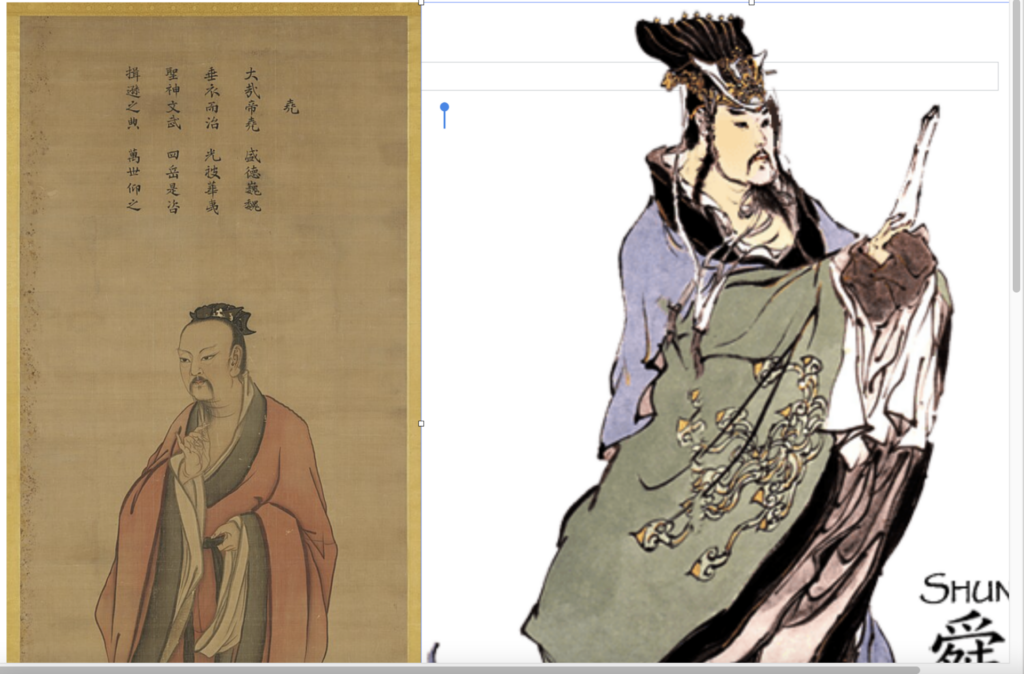
According to Zhuangzi, Yao and Shun, now regarded as legendary emperors having lived ca 2200 BCE, “were the earliest rulers who governed the nation by inventing the moral principle of ren and yi (benevolence and righteousness) based on Yao’s loving heart and ‘good conscience’. Nietzsche, on the other hand, has a very different view with regard to the origin of morality. He says that “morality as it has been till now was actually invented by the herd or slaves with their ‘bad conscience’, representing their hatred or ressentiment toward themselves, their masters, and life in this world.” In other words, the former sees morality as having imposed from the top, the latter as having originated from below, i.e., the masses. Shang says that, “in spite of their different conceptions of the origins of morality, they agreed that the origin and development of morality was a sign of degeneration and a symptom of decadence, though their pictures of human degeneration were somewhat different.” He then adds an important qualification: “When Zhuangzi and Nietzsche critique morality, they are critiquing ‘fixed moral doctrines’,” so their critique falls in the same category as their critique of language. It is not a critique of what is often referred to as the natural ethicality which is said to arise spontaneously from self-cultivation. Shang makes this clear when he says that “in the case of the former Confucian and the latter Christian, which they felt stifle the creative dynamism that allows cultures to grow and develop. Zhuangzi sadly commented that after Yao and Shun, Chinese culture had lost its genuineness and harmony and had undergone catastrophic decline and disintegration … different opinions fought each other for the authority of interpreting what renyi or morality was. In Nietzsche’s eyes, the decadence of European culture began when Socratic rationalism and Christian morality began to prevail and dominate Europe. An original species, who was born to be master and whose ‘work is an instinctive creation and imposition of forms’ (GM, II, 18), had then been domesticated, castrated, and eventually extinguished by herd morality or the ascetic ideal.”
For both Zhuangzi and Nietzsche, the issue with morality stems from its human origin, whether it comes from emperors or from slaves. In Shang’s words: “Both Nietzsche and Zhuangzi agree that there are only plural, different, and changing moral systems brought into existence by different types of people for different ‘utilities’ or purposes during different times. And this plurality of human-all-too-human morality eventually catalyzes the disaster of social chaos and self-dispersion (Zhuangzi), and the advent of nihilism and ‘the death of God’ (Nietzsche). So the final conclusion about morality for both Zhuangzi and Nietzsche is obviously the same: unless we overcome morality and the worldview it embodies, we can never liberate ourselves from alienation and our enslavement to herd consciousness.”
Nietzsche argued for a “revaluation of all highest values,” but did not try to go beyond them
Now, as is well-known, Nietzsche argued for a “‘revaluation of all highest values’ … the notorious names he called himself, such as ‘immoralist,’ ‘anti-Christ’, ‘destroyer’, ‘creator’, and ‘Dionysus’, make explicit his stand against traditional values and his decision to create new values, the twofold mission of revaluation.” This, Shang regards as “fundamentally at odds with Zhuangzi’s. Notwithstanding that Nietzsche kept using the phrase ‘beyond good and evil’ and called himself an ‘immoralist’, what he meant by them seemed more about negating and overturning old values rather than going ‘beyond’ them.” The issue here is that Nietzsche is really negating “a type of morality that has become prevalent and predominant as morality itself—the morality of decadence or, more concretely, Christian morality. (Ecce Homo, ‘Why I Am a Destiny’). Basically, Nietzsche is rejecting values such as the good, the benevolent, and the beneficent. Shang says that “the term beyond in Nietzsche’s usage refers more often to a state of liberty that results from being a ‘destroyer’, ‘legislator’, ‘revaluator’,” or ‘creator’. ‘Beyond good and evil’ can very easily be understood as merely ‘beyond’ Christian morality. He does try harder to replace ‘good’ by ‘evil’, soul by body, slave morality by master morality than to renounce morality completely.”
“Compared to Nietzsche, Zhuangzi is a radical immoralist who denies the need for moral values totally, and tries to devaluate rather than revaluate all values.”
Shang continues, ‘Ironically, since the emphasis on values is at the very heart of the Christian faith, Nietzsche’s project of “revaluation” can be seen as rooted in Christianity, even as he is criticizing Christian values.Therefore, it is not that Nietzche failed to go beyond values, he just did not try, unlike Zhuangzi who, is a radical immoralist who denies the need for moral values totally.”For Zhuangzi, it is because they are “fabricated by humans,” that they “interrupt and violate the natural course of things … What he negates is neither Confucian nor Moist morality but all moral values. A liberated person must be a real ‘immoralist’ who acts completely in accordance with no moral obligation but instead with one’s own nature, which is an immediate manifestation of ‘heaven and earth’.” An ideal society too must act according to its spontaneous dynamism, because contesting moral doctrines can lead only to exactly that, contest, and it is contest that is precisely the most destructive thing for any society.”
So, what did Nietzsche mean by living beyond good and evil?
In Nietzsche’s scheme, revaluation is expected “to enhance life through constant self-overcoming, transforming, and annihilating.” And, of course, the task of revaluation presupposes a breaking of the values it is meant to replace. “Thus,” Nietzsche explains, “the highest evil belongs to the greatest goodness: but this is— being creative” (Ecce Homo, “Why I Am a Destiny,” 2). So, Shang argue, “this is what is really meant by ‘beyond good and evil’.” In the process of continual destruction and creation there can never be any constant good and evil. Striving for the process of destroying and creating values is thereby the nature of Nietzsche’s task of revaluation.
In contrast, Zhuangzi’s devaluation is neither reversing nor creating values but removing them from our mind … so that they can no longer interfere or interrupt the actual course of nature.
Zhuangzi emphatically and deliberately cultivates the idea of wuwei (doing nothing or non-doing), ziran (self-so or spontaneity, also nature), wuyong (useless or no-to-use), and xujing (虚静, void and still), as daos (ways) of reaching the harmony of nature and life. So Zhuangzi’s devaluation is more of an inward transformation of one’s mind and perspective rather than the action (wei) of changing, destroying, and creating things … No values need to be created for an instinctive, natural, and free life.” May I add, no values need to be created, but, with few exceptions, a serious practice of self-cultivation is required.
Nevertheless, “both philosophers are destined or determined to overcome the all-too-human and to return to and ultimately affirm the nature of life as it is.”
At first sight, the gap between the two philosophers seems to be huge. But, Shang says, “when we notice what Zhuangzi and Nietzsche try to protect and revive we see that … the ultimate concerns of Zhuangzi and Nietzsche are very similar: both philosophers are destined or determined to overcome the all-too-human and to return to and ultimately affirm the nature of life as it is. ‘Man is something that must be overcome’, just as language, knowledge, belief in truth and all highest values, must be overcome with him, not because these ideas could or could not find a cogent or perfect proof for themselves but because they are ‘slanders of nature’.” In The Gay Science, Nietzsche writes: “I find those people disagreeable in whom every natural inclination immediately becomes a sickness, something that disfigures them or is downright infamous: it is they that have seduced us to hold that man’s inclinations and instincts are evil. They are the cause of our great injustice against our nature, there are enough people who might well entrust themselves to their instincts with grace and without care; but they do not, from fear of this imagined ‘evil character’ of nature (294). From a more positive perspective, Zhuangzi says: “Once we have removed all moral evaluations we stand right at the middle of the earth and heaven and dance with ten thousand things.”
Source:
Ge Ling Shang – Liberation as Affirmation: The Religiosity of Zhuangzi and Nietzsche (2006)