
“Xiaoyaoyou thus does not encourage any intention to leave or escape from actual life and this world. On the contrary, it affirms life, this life in this world, without denial or rejection.This ultimate affirmation, which has characterized Zhuangzi’s special religiosity, is precisely the secret of xiaoyaoyou, from which derives all Zhuangzi’s work of deconstructing commonsense knowledge and conventional beliefs” (Ge Ling Shang – Liberation as Affirmation p 55)
Shang writes: “Perhaps the best term we can think of in the Book of Zhuangzi to characterize Zhuangzi and his philosophy must be xiaoyaoyou (逍遥游), the thesis of the very first chapter and the spiritual destination of his whole teaching illustrated by a stunning allegory:
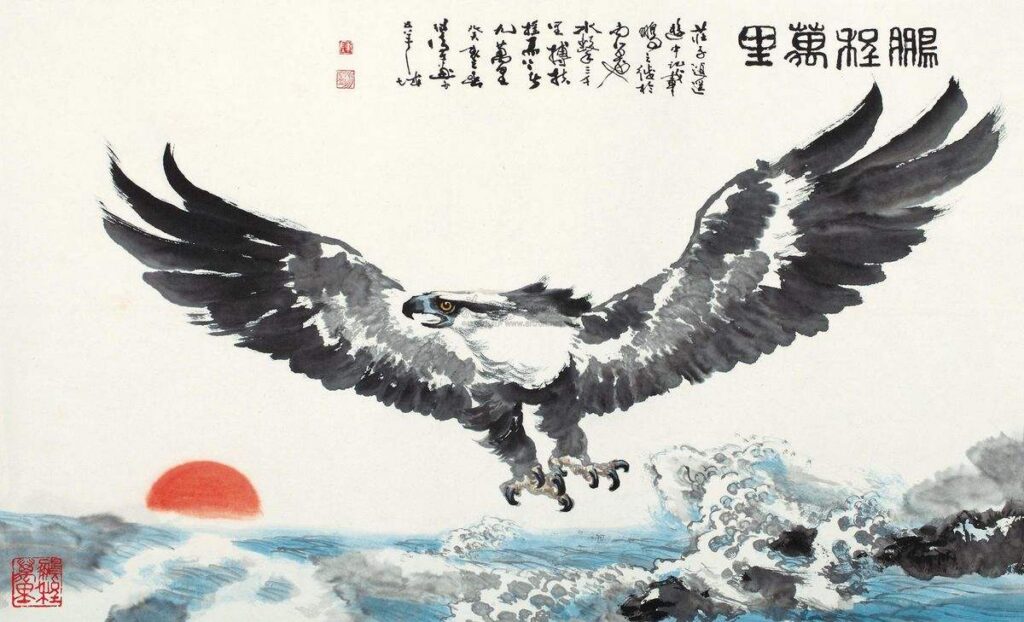
“In the never known Northern sea there is a fish named Kun. The Kun is so huge you have no idea how many thousands of miles she measures. She transformed into a bird named Peng.The back of Peng measures I don’t know how many thousand miles across and, when she rises up and flies off, her wings are like clouds all over the sky. When the hurricane comes to the fore, this bird sets off for the never known Southern sea.”
The cicada and the little dove laugh at this, saying, “When we make an effort and fly up, we can get as far as the elm or the sapanwood tree, but sometimes we don’t make it and just fall down on the ground. Now how is anyone going to go ninety thousand miles to the south!” The one who goes around the green woods nearby needs only three meals to fulfill her stomach. The one who goes hundred miles away must grind her grain a night before. The one who goes thousand miles away starts collecting food three months in advance.What do these two little ones understand? (1/1,Watson, 30)
The first time you read this lighthearted story now represented in cartoons for children, with this rather sweet old man sauntering along, flying over mountains and seas, free as the wind, friendly with animals of all shapes and colours, jumping from pillar to post as he makes the weirdest of comparisons is certainly not the way you had imagined an ancient Chinese Sage to behave. A far cry from the tragic figure of the Christ hanging from a Cross. And you certainly did you suspect the wealth of meaning contained in its images.
For instance, Shang says, “The two kinds of animals symbolize the twofold meaning of xiao yao you. Xiao refers to a kind of carefree mind or detachment, like the cicada and little dove jumping around without worrying at all about their life. Yao means faraway or distance, like great Peng who by flying can even reach the ‘lake of heaven’.” You stands for free movement, wandering, playing, or dancing amidst the world.” Even though xiaoyaoyou is translated as “carefree wandering” or a “wandering without a destination,” Shang says that it is a spiritual “state” of freedom, liberation, and affirmation. I can understand Shang’s wish to use the word “state” which a Western reader can readily relate to. But what strikes me here is precisely that the last part of the word (you) includes a notion of flow. A sitting Buddha locked in the full lotus posture, with a straight back, hands touching is motionless, and will be described as immersed in the “state” of awakened consciousness. Chinese sages are rarely represented in a sitting position. Instead, they walk, they move, they flow with the ten-thousand-things. Shang tells us that “‘xiao’ specifically refers to nondiscrimination and nonattachment to the ten-thousand-things; ‘yao’ means an open and vacant mind whose vision can go through the vastest and remotest space and time without hindrance and difficulty; ‘you’ signifies the way one exists and moves with the spirit of ‘xiaoyao’, like a liquidized body and vaporized spirit flowing in the One, easy and happy.” He further insists that “when capable of ‘you’, one should have both ‘xiao’ and ‘yao’ together in one mind, otherwise the ultimate state will not be acquired. In other words, in order to achieve “full liberation,” one must free ourselves from discriminative thinking and attachment to things, as well as maintaining an open mind.
The problem of human life began when people generated their consciousness of a self and a fixed mind (chengxin), like Peng and the little bird.
In Zhuangzi’s text, “When they started laughing at each other’s disadvantage they lost their natural freedom and became defensive about their own limited and dependent positions … The problem is that our minds are fixed, dependent on, and attached to the conditions and circumstances that limit and restrict our competence. We enslave ourselves in a closed, exclusive, and narcissist realm of the self, fighting, struggling, and protecting it as the only interest, only truth, only good, only Dao in the entire universe. This is why we are living not in a world of ziran anymore but in a human-all-too- human world which has become more and more a battlefield of miserable selves.”
Zhuangzi’s starting point echoes the Buddha’s initial teaching on anatman (lack of self), but whereas the Buddha saw our sense of self as a moral flaw and prescribed a path of practice based primarily onimproving one’s moral conduct, Zhuangzi saw self-consciousness as problematic because it generates a fixed mind (chengxin). While the Buddha taught in a metaphysical Brahmanical context which, like Western religions, was rooted in moral principles, China already had a long cosmological tradition based on “change” when Zhuangzi wrote his book.
“Zhuangzi’s Dao of attaining the state of xiao yao you is twofold, both theoretical and practical.
Many Daoist practitioners today see Daoism primarily as an alchemical practice based on the manipulation of qi energy through mind-body practices such as taiji and qigong, and are quick to dismiss theoretical presentations as irrelevant. I see here that Zhuangzi himself saw the Way “as both theoretical and practical.” Of course, Zhuangzi’s book is a collection of stories rather than what we are used to see in works of Western philosophy. But these stories are still made up of words. Shang writes: “On the one hand, he uses conventional theories of knowledge, language, and logic to deconstruct their finality and universality, which serve as the rational foundation of our self-consciousness and fixed mind. On the other hand, he teaches a series of practical methods such as wuwei, xinzhai (心斋, fasting the mind), zuowang (坐忘, sitting and forgetting), wuyong (being useless), yangshen (养身, maintaining health), xujing (虚静, vacancy and tranquility). Both the theorical and practice exercises will rid us of the consciousness of self and fixed mind, the obstacles that have kept us apart from the world of ziran and the state of xiaoyaoyou.”
Consciousness of self makes one’s mind fixed or dependent (youdai, 有待) on specific forms of existence and styles of life
“Consciousness of self” is Shang’s skilfull phrase to designate what Dogen referred to as “forgetting the self” and Nishitani “the negation of self and things” as it amounts to a dis-identification from our ego, i.e., the mere representation of our self, without denying outright the very existence of a subjective function and therefore our mutual dependence on things and people. The great Peng needs a huge space to fly, and the little birds only have a very limited view of the world. “The problem,” Shang insists, “is that our minds are fixed, dependent on, and attached to the conditions and circumstances that limit and restrict our competence. We enslave ourselves in a closed, exclusive, and narcissist realm of the self, fighting, struggling, and protecting it as the only interest, only truth, only good, only Dao in the entire universe. This is why we are living not in a world of ziran anymore but in a human-all-too-human world which has become more and more a battlefield of miserable selves … Little knowledge cannot reach the broad knowledge; the short-lived cannot come up to the long-lived … For Zhuangzi, therefore, the first and last thing we must do to release ourselves from this condition of enslavement is to dismiss the consciousness of self in order to transcend the limitations and dependence of the self (wudai, 无待). In other words, what is required is a transformation of consciousness leading to an experiential embodiment of reality.
The key for xiaoyaoyou is the state of wudai, nondependence or nonduality (sometime also called du, 独) of one’s mind
Shang writes: “Wudai is the ultimate state of xiaoyaoyou, because in this state one has overcome the consciousness of the self, forgotten all conventional conceptions of knowledge, morality, and argument, renounced dualistic ways of thinking and the fixed mind of dogmatism, disengaged from political, economic, and various social competitions and struggles. With a mind of wudai, one becomes completely natural and spontaneous, having no attachment at all to any humanly desired things (xiao). With a mind of wudai, one also opens oneself to the entire universe, near and far, having no discrimination, boundary, and limit of any thing at all (yao). A new, spiritual, and free life of wandering, playing, and dancing thus starts (you). It transcends the artificial surface of the world and human life, returns to the genuine nature that is believed and experienced by Zhuangzi to be the carefree, harmonious, manifold, as well as one.”
Ziran – Liberation as Affirmation
Zhuangzi’s carefree stroll over mountains and seas, and his encounter with animals of all sizes and colours, is meant to illustrate the relativity of all things. As it shows that there is no truth we can rely on, it can easily be interpreted as an invitation to skepticism. It has in fact been described as a philosophy of “indeterminacy.” In the West, where philosophy is primarily used to determine precisely what something “is,” in order to establish that it exists, thinkers who oppose this reductive approach are regarded as skeptics, people who practice systematic doubt. Yet, this label is at odds with Shang’s comparison of Zhuangzi’s thought with Nietzsche’s affirmation of reality as “amor fati,” love of one’s fate, and “eternal recurrence,” defined as one’s willingness to live the same life over and over again. Shang asserts that what has been interpreted as skepticism in the case of Zhuangzi is in fact an affirmation of life, an embrace of life just as it is.
Shang writes: “Xiaoyaoyou thus does not encourage any intention to leave or escape from actual life and this world. On the contrary, it affirms life, this life in this world, without denial or rejection.This ultimate affirmation, which has characterized Zhuangzi’s special religiosity, is precisely the secret of xiaoyaoyou, from which derives all Zhuangzi’s work of deconstructing commonsense knowledge and conventional beliefs.”
Could it be the case that those who have categorised Zhuangzi as a skeptic have misunderstood Dao as an objective entity with a pre-ordered dynamism one needs to align with, instead of being the teaching of a Sage to guide his disciples as they walk the “Way” through a set of mind-body practices as a self-cultivation of ziran?
Shang asks: “What is the life that Zhuangzi has affirmed originally and ultimately? The answer could be very simple if given briefly: the life of ziran as such.The true person (zhenren, 真人) of xiaoyaoyou must be the person who is able to say, “I was born with heaven and earth; I am one with myriad things!” (2/5). In Zhuangzi’s dictionary, “freedom,” “liberation,” “xiaoyaoyou,” “wudai,” “transcendence,” and “return” all have the same connotation of unconditional and nondependent affirmation of life as ziran. Everything ziran ought to be affirmed.”
The last sentence reminds me of Dogen’s assertion that we should “forget” the self. By definition, we cannot deliberately make ourselves “forget.” Similarly in the Zhuangzi, we cannot deliberately make ourselves be “spontaneous.” The Way to ziran has to be indirect, and this is why Zhuangzi uses goblet words that empty words of their metaphysical content – “what” they refer to – at the same time as they affirm “that” they are experientially real. Chinese Chan also turned this use of doubt into the practice of the Great Doubt and the Great Death which ends “when you are no longer aware of your being completely like a dead man, and are no more conscious of the procedure of the Great Doubt but become yourself, through and through, a great mass of doubt, there will come a moment, all of a sudden, at which you emerge into a transcendence called the Great Enlightenment, as it you had awoken from a great dream, or as if, having been completely dead, you had suddenly revived” (Nishitani Keiji – Religion and Nothingness 20)“
The language is Buddhist as it focuses on the self, or rather the dissolution of the self. Zhuangzi’s language remains focused on “life” itself, as he talks of “affirming ‘life.’ In Shang’s words: “Affirming life as ziran is to affirm Dao-throughs-as-One or the wholeness and togetherness of all things. But unlike other thinkers who believe the Oneness as something absolutely certain, steady, constant, unchangeable, eternal, and unitary, Zhuangzi attributes his concept of One to the nature of impermanence, change, chaos, uncertainty, openness, and diversity. The only thing constant is impermanence; the only real world is the world of becoming or transforming.There is virtually no beginning nor end in this ever-changing flux of life. Again, one’s ultimate affirmation of life is to be one with the flux in a way that she or he is totally through or tonged (通) in this world. And this throughness or tong, according to Zhuangzi, is freedom, is liberation, is xiaoyaoyou.” As affirmation of life in its impermanence, life is embraced as “that” which flows, as the One, which also includes the many phenomena which Zhuangzi encounters in his carefree rambling.
Chapter 14 of the Platform Sutra, the foundational text of the Chan/Zen tradition, echoes this equation of the awakened life with a flow, rather than a state, when it says that “One Practice Samadhi means at all times, whether walking, standing, sitting, or lying down, always practicing with a straightforward [honest, sincere] mind.” And, it is also most likely Zhuangzi who inspired the shikantaza practice Dogen introduced after his years of training in China. Shikantaza (“just sitting”) is still primarily a sitting practice, but it is no longer a sharp focus on one object that would stop the flow of thoughts. Instead practitioners are taught to allow thoughts to arise, pass, and go away without becoming ‘hooked’ by the mind. In other words, thoughts are allow to “flow” past without ever becoming “fixed.” Even though shikantaza is traditionally translated as “just sitting” and is de facto a sitting practice, practitioners are told that “just sitting” is really a metaphor for “just doing whatever you are currently doing,” for instance, during the periods of samu (voluntary practical work) which are a traditional part of a Zen monastic life, as well as sesshins (retreats).” Scholars have remarked that shikantaza is so different from traditional Indian Buddhist meditation that it should not be called a “meditation practice”! Additionally, in Ways of Thinking of the East, Nakamura Hajime describes Dogen’s understanding of Buddhahood as follows: “Impermanence is the Buddhahood … The impermanence of grass, trees, forests is verily the Buddhahood. The impermanence of the person’s body and mind is verily the Buddhahood. The impermanence of the (land) country and scenery is verily the Buddhahood.” In Indian Buddhism, impermanence was regarded as an obstacle to enlightenment! In fact, in India, Buddhist practititioners aimed at cutting the cycle of rebirths, in other words, escape life on earth for good! Zhuangzi’s influence on Chan/Zen Buddhism goes to the very heart of Chinese, Japanese, Korean and Vietnamese Buddhism.
Shang describes xiao yao you further as follows: “A true person of xiao yao you does not fight against her fate but ‘understands that fate is inevitable and therefore follows it as it is at ease’” (4/2). Whatever fate brings forth to one’s life, that is, either fortune or poverty, either luck or pity, either success or failure, either life or death, this fate should not be protested or praised but all affirmed, accepted, and celebrated. Everything that is ziran must be affirmed equally and identically. Such unconditional and undifferentiated affirmation, Zhuangzi believes, will bring about the ultimate state of unconditional and undifferentiated freedom and liberation. In other words, with such an affirmative spirit in mind, one can live and enjoy life xiaoyaoyou.
Based on this perspective of Dao or Dao of no-Dao (xiaoyaoyou), in which a profound and ecstatic religiosity or spirituality abides, Zhuangzi created his own philosophy and teaching of Dao, full of the spirit of uniqueness, openness, and creativity.”
Sources:
Ge Ling Shang – Liberation as Affirmation: The Religiosity of Zhuangzi and Nietzsche (2006)
Nakamura Hajime –Ways of Thinking of the East, India, China, Tibet, Japan (1964)
Huineng – Platform Sutra, translated by Red Pine