
“In my own reading of Zhuangzi and Nietzsche, I have found a unique brand of ‘religiosity’ in their works that emphasizes the need for human liberation from all traditional values in order to affirm life” (Ge Ling Shang – Liberation as Affirmation p 6)
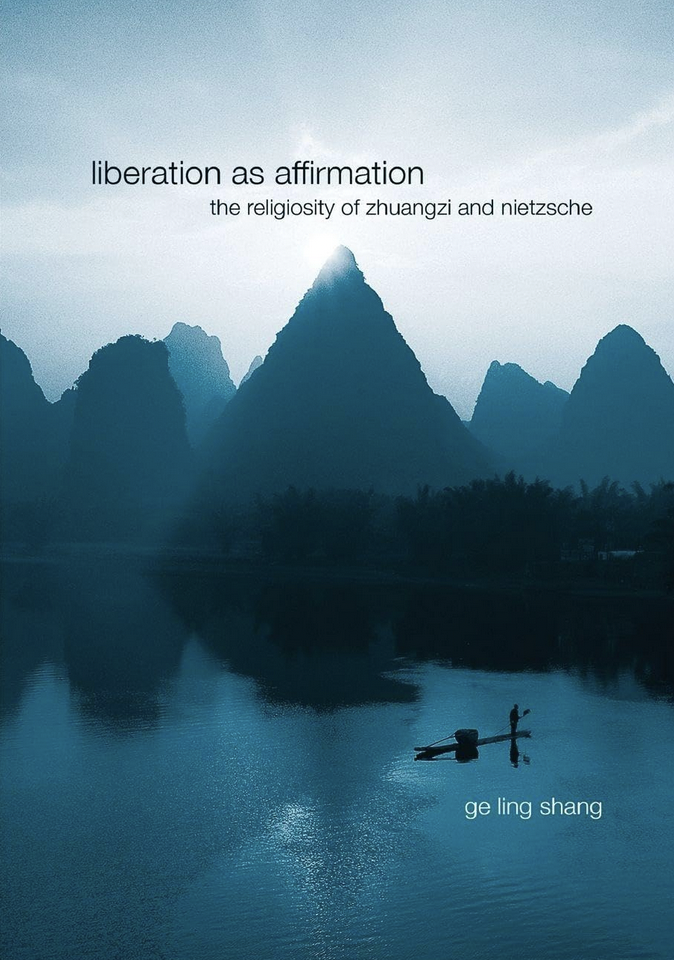
Compared to the more politically oriented Laozi, Zhuangzi has often been described as a mystic, but he has also been characterised by scholars as a pessimist, a relativist, a skeptic, a subjective idealist, a nihilist, and an escapist. Along with many scholars of Chinese philosophy, Ge Ling Shang was struck by this complex figure who has already attracted the attention of many Western scholars as the co-founder of Daoism, alongside Laozi. In his book, Liberation as Affirmation, one of two dedicated to Zhuangzi (the other is Zhuangzi: Dancing with the World), Shang calls on his deep resonance with the “religiosity” of Zhuangzi to reinterpret the writings of another uncategorizable author, Friedrich Nietzsche, even though most Chinese scholars see the two figures as having nothing to do with each other, “except their marginalization.” In Shang’s view, Nietzsche’s radical deconstruction of Western metaphysics, was rooted in a “religiosity” similar to that of Zhuangzi, and that has been missed by most of his critics who did not expect a man having proclaimed the death of God to be described as “religious.”
Religiosity versus religion
So Shang explains: “Here, religiosity is seen as a religious feeling or sentiment characterized by a ‘religiously’ profound and passionate concern for things in life that are believed to be particularly meaningful, sacred, or sublime. I tend to set religiosity or religiousness free from the narrow but prevailing Western notion of religion premised solely on the God-human relation and directed exclusively toward a supernatural being or beings … I define religiosity broadly to include religious feelings that are not necessarily directed toward a god or supreme truth. The feelings or ‘spiritual sensibility’ (Roberts, 5) toward life, totality, infinity, perfection, responsibility, freedom, and liberation, etc., are for me religious in quality. Religiosity as such has existed throughout human history and served as the original inspiration and immanent drive of the development of religion and philosophy. In this respect, religiosity is not something external to philosophy but an indispensable part of it. From the perspective of religiosity, I believe, we can get a better understanding of philosophy including those aspects that may appear nonreligious or even antireligious. I found that both Zhuangzi and Nietzsche exhibited profound religiosity, which is essential for understanding their works.”
The word “religiosity” itself goes back to the 14th century Middle English, and the Old French “religiosité” andobviously derives from the Latin “religiosus” and “religio” (reverence, obligation). In its original sense, it is the strong feeling that binds them to a transcendent God. Today, however, the word “religiosity” is often used in contexts where a belief in God is missing to express similar feelings directed, for instance, at the natural world or life itself. Shang sees it as echoing the pre-literate indigenous spiritualities that preceded the emergence of the texts-based religious systems we now refer to as “religions.” We could say that “religiosity” is the experience of the universe, or life, as sacred, before any word had been uttered.
Reinterpreting Zhuangzi and Nietzsche
The structure of the book is straightforward: after a meticulous presentation of “Zhuangzi’s Dao as the Way of Freedom,” comes a presentation of “Nietzsche’s Philosophy of Life Affirmation” of equal length, followed by a chapter on the “Interplay between Zhuangzi and Nietzsche” and a concluding chapter on their contribution to “Contemporary Philosophy” in both the West and China. Shang is not the first scholar to have “recognized an affinity between these two philosophers. Joan Stambaugh, in her article ‘The Other Nietzsche’, suggested that that Eastern mystical experience, such as the Chan experience, may have been the hidden or the other Nietzsche we have largely neglected in the scholarly literature: the “mystic poet” and “the poetic mystic”.” Stambaugh felt that Shopenhauer’s influence on Nietzsche had stood in the way of recognising these affinities. She writes: “The fact that Nietzsche’s own understanding of Eastern thought was pretty well mutilated by the influence of Schopenhauer does not facilitate seeing or understanding these affinities. In particular, Buddhism gets lumped with Christianity and both pronounced ‘religions of exhaustion’. Temperamentally Nietzsche was perhaps closest to Laozi and Zhuangzi with his rejection of the metaphysical background and his understanding of the world as play (Nietzsche and Asian Thought).” In addition to Stambaugh, Shang notes that “Graham Parkes, Zhou Guo Guoping and Roger Ames did some partial comparisons.”
Comparative studies between Chinese philosophy and several Western philosophers
Quite a few works have been published that explore commonalities between Chinese philosophy and the works of specific European philosophers. Schelling, Heidegger and Hegel are the names most often quoted. In the East, however, because the rapid westernisation of his country had plunged its intellectuals into a deep nihilistic mood, Zen philosopher Nishitani Keiji, had first turned to Nietzsche during his teenage years before reconnecting with Japan’s Mahayana Buddhist tradition.
As a true comparatist, Shang considers both the way Zhuangzi sheds light on an aspect of Nietzsche’s philosophical inquiry that has been neglected in the West, and the way Nietzsche’s philosophy of affirmation helps us make sense of Zhuangzi’s particular writing style based on stories and anecdotes.
Here is how, in his own words, Shang recounts his personal encounter with the two figures:
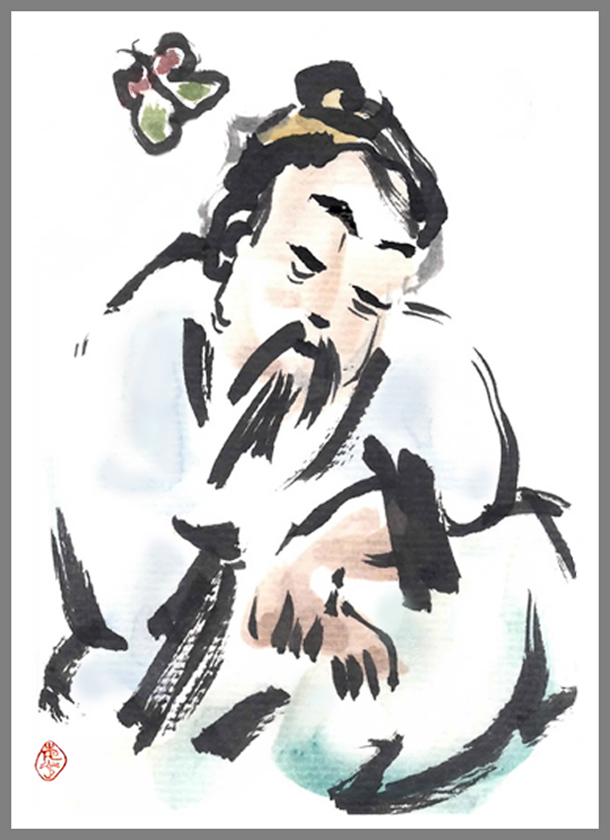
“The most profound meeting point of the two is, as I now put it, their religiosity, their original drives and ultimate concerns for freedom and liberation from traditional values in order to affirm life. More surprisingly, I have found Zhuangzi and Nietzsche to be neither negative nor destructive, as reflected in common perspectives, but positive and constructive : not passive but active, because their concerns for human liberation and freedom ultimately rest upon the affirmation of life as it is, a very special kind of affirmation that is rid of any reservation or calculation. With this conviction the course of my interpretation was set to bring these two philosophers together to explore in each how the route toward human liberation is built and what human freedom might be conceived to be.”
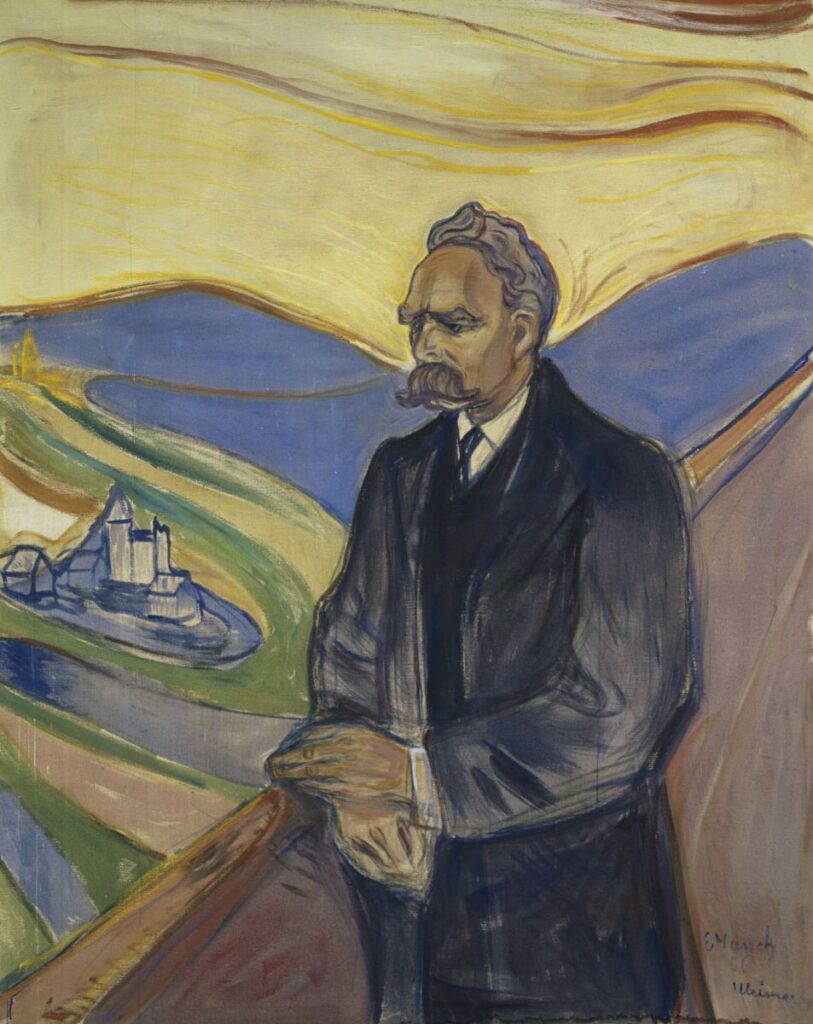
Talking about Nietzsche, Shang writes: “Most critics miss what I believe is the deep religious orientation of his writings, a misunderstanding that derives from the apparently antireligious, especially anti-Christian writings and his outrageous proclamation that ‘God is dead’. This aspect of Nietzsche’s work lures or distracts one’s attention easily away from Nietzsche’s own religiosity as the soul of his philosophy.” On the other hand, “some Western scholars have tended to interpret Zhuangzi as no philosopher at all, but as a mere mystic and rhetorical thinker (Schwartz, Wright, Creel), or representative of religious mysticism in association with Laozi, Nagarjuna, and the late Zen Buddhists (Smart). They had not realised that his many stories were, as such, the expression of a paradoxical view of life, which has been called a “philosophy of indeterminacy.”
Shang’s perspective is that “both Zhuangzi’s and Nietzsche’s attack on traditional values was not so much an attempt to present another system of human values as an attempt to overcome and transcend all traditional values to reach a state of liberation and freedom. For, according to Zhuangzi and Nietzsche, liberation itself is not a value in a customary sense, but the transcending of all previous values.”
Shang disagrees with the scholars who argue that comparative philosophy amounts to an attempt “to draw other cultures and philosophies into European categories and thus necessarily fails to arrive at fair comparisons … In my view, except for the very first philosopher, whose existence is shrouded by time, every philosophy must be comparative because every interpretation originates under the condition of the existence of others … Even within the same tradition people still have difficulty in understanding each other … Western philosophy is itself comparative … Just as two individuals can only hope to understand one another through conversation, two cultures can only hope for mutual understanding through an attempt to communicate.”
Source:
Ge Ling Shang – Liberation as Affirmation: The Religiosity of Zhuangzi and Nietzsche (2006)
#Ancient Chinese Philosophies
#Daoism
#Zhuangzi
#Nietzsche