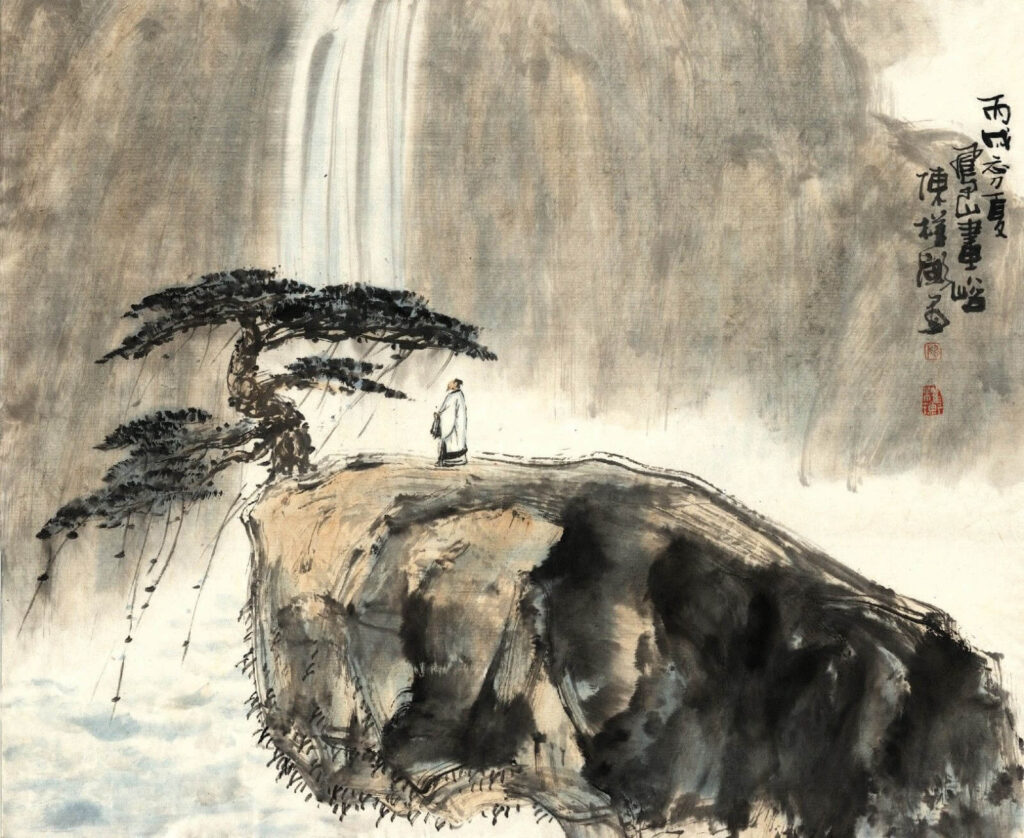
“There is nothing behind the scene of the world of the ten-thousand-things controlling the coming and going of the appearances; it is the ‘thing-as-itself’ (ziji) that moves, changes, lives, dies, presents, and absents all by itself. Therefore, Zhuangzi’s Dao as One does not designate any universal principle or unitary system of the world but refers to the togetherness (Oneness) of all things in the world. This togetherness embraces all existences as they are without distinction” (Ge Ling Shang – Liberation as Affirmation p 27)
Ge Ling Shang holds that Zhuangzi’s understanding of the Dao is different from that of Laozi. Shang argues that “in the Daodejing, Laozi seems to come up with the conviction that, notwithstanding how hesitant or ambiguous his words sound, there is an ultimate reality which is the root (gen), the base of origin (ben) of the apparent world … as the root of the ten-thousand-things, Dao unfolds or manifests itself into things and thus creates the whole apparent world. For Laozi, Dao is logically and cosmologically the origin of all things or beings of the world.” Yet, Laozi also described the Dao as “nothingness” (wu) or non-being (wuyou). Shang says that “some scholars have tried to interpret this wu as his ‘trans-ontological’ or ‘trans-metaphysical’ breakthrough”. Zhuangzi, instead, “advanced the notion of wu into a radical claim of wuwu, a double wu that deconstructs the entire metaphysical account, reflecting what mathematics articulate as “two negatives make a positive.” From the new concept of wuwu, Zhuangzi intended to tell us, nonbeing is not the Being of beings, there is simply no Being in this world.” Shang articulates Zhuangzi’s view as “Dao throughs as One.”
“Things however peculiar, ridiculous, wondrous and mysterious, they are all One as Dao throughs (Zhuangzi 2/4)”
Shang writes: “If read by sentence itself: ‘Dao throughs as One’ – daotongweiyi (Dao 道 tong 通, wei 为 yi 一 ),” translated literally as “the Way goes through (connects or unites) to become (or act as) the One as wholeness, the totality of existence. According to Shang, “many English translations available today have so far misinterpreted this important assertion made by Zhuangzi. They, including most Chinese commentators, have not realized that this sentence contains in Zhuangzi the fundamental understanding of Dao. Two key words ‘tong‘ (throughness, clearing or openness) and ‘yi‘ (One or oneness as togetherness) have been either lost or underrated as if this sentence makes sense only with the previous sentences.” It is “not that the Dao ‘makes’ or ‘connects’ things into one ‘unity’ as Burton Watson, Victor H Mair, A C Graham, Yu-lan Fung” believe. “That would put Zhuangzi back to Laozi’s position as a metaphysician, but that the Dao is One whence through (tong). For Zhuangzi, One is what is while throughness is the positive state of One… Without the connotation of tong, one could not fully understand and characterize Zhuangzi’s distinctive notion of Dao and One. Only if a path is through, I mean tonged, free of blockage, is one able to walk by. This is why Zhuangzi speaks of tong in conjunction with dao as daotong. Whence the throughness is reached, in other words, whence is clear, open or tong. One is realized, or, ten-thousand-thing become One.”
Shang continues: “Without throughness, Dao is no longer Dao, for no one can actually walk through it to get anywhere. By the same token being blocked from each other, things would lose their correlations and connections with each other and hence the totality of themselves. According to Zhuangzi, the way or Dao has to be clear, connected, or through as an ideal condition for the change, transformation, and becoming of all things as a harmonious whole. This is what Zhuangzi meant by ‘Dao throughs as One’.”
Shang points out that “one should always keep in mind that dao, tong, and yi are themselves One; they go together and identify each other as a whole to accomplish Zhuangzi’s reconstruction of Dao perspective (daoguan) and Dao discourse (daoyan). Dao throughs as One; Dao is One that throughs; throughness as One is Dao – that is Zhuangzi’s understanding of Dao, the way of throughness. For Zhuangzi, it is throughness (tong) that makes possible the ways all things become what they are and get together with each other as a harmonious whole.” With “through” and “throughness” Shang applies to the English language the typically Chinese practice of using words as nouns or verbs according to context. Since in English prepositions are often used to express movement, he is using the preposition “through” as a verb. This trick helps us remember that the Dao itself is movement. It is a Way that clears our metaphorical walk of all obstacles so that we can get through.
For Zhuangzi yi – the One – is the togetherness, the inclusiveness, the integration or whole of all things. One is the fact of relationship itself.
Shang says that the word “yi is mentioned and discussed more than twenty times in the Inner Chapters alone,” in fact more often than the word Dao, and that “the yi Zhuangzi uncessantly emphasizes is synonymous and interchangeable with the word Dao.” “Yi in a Confucian context is the ‘harmony’ of heaven and earth (tianrenheyi). When Daoist commentators found yi in Zhuangzi, they often accepted and understood it in the cosmological sense. Shang, however, adds: “The one major exception to this trend was the third-century eclectic commentator Guo Xiang. This successor to the magnificent Daoist exegete Wang Bi rethought the meaning of Zhuangzi’s notion of yi in a very novel way, and the interpretation that follows is in part indebted to him.”
Laozi had “used yi to designate the ineffable Dao as the cosmological origin and thus a metaphysical reality. He said in the Daodejing, “Dao produces one [yi]; One produces two; two produces three; three produces ten-thousand things” (chapter 42). In his interpretation of this verse, Wang Bi explained that, as one is the beginning of all numbers, it is thus the origin of all things (Wang, 105) … When Zhuangzi wrote that Dao throughs as One or Oneness (yi), one could easily be convinced that he was talking about the same thing Laozi had before him.” But, as we have seen, nothing is further from the truth. Shang insists that “For Zhuangzi, ‘one is not a number that initiates numbering, or a single entity that excludes or opposes many; instead, One (yi) is, first of all, a general designation which is parallel to words such as ‘tianxia‘ (the world), ‘tiandi‘ (heaven and earth), ‘yüzhou‘ (universe), and ‘wanwu‘ (ten-thousand-things), designing the togetherness, the inclusiveness, the integration or whole of all things … One as such characterizes nature or ziran as an undifferentiated, all-inclusive, all together totality, which does not produce or unify things but is simply a sum total of things, that is to say, one is the ten-thousand-things put together. Everything that exists relates or is relative to other things. One is not something that determines any particular relationship but the fact of relationship itself. As far as the relationship is concerned, the distinction of self and other is relativized and dissolved into the Oneness of self and/or with others.” Whereas, for Laozi the One undifferentiated One comes first and through differentiation produces the ten-thousand things, for Zhuangzi it is, as it were, the world as differentiated into the ten-thousand-things that comes first in our experience, as Dao, i.e., our practice of the Way, leads us to see the world as One harmonious interaction of all things. This, I venture to say, may be through a kensho-like event that unexpectedly brings about a sense of oneness with the world, to the point that one feels at the same time empty of one’s separate self and coalescing with the Whole. Just as in Soto Zen, this coalescing with the world may also be gained through a steady practice without any dramatic event. In a nutshell, it is not that the Dao creates the many out of the One seen as a substratum of non-being, but rather that the Dao clears our path of the obstacles that block our coalescing with the whole. This would be why Zhuangzi focuses on yi, the One, whereas Laozi focuses on the Dao. The One (yi) is what the Dao takes us to. Thus, Shang can say: “inasmuch as one (yi) is just the totality of everything altogether, it does not dismiss or repress but affirms the existence of every single being. The differences between individuals are not dissolved into some grand and abstracted universal, but are distinguished or characterized by the oneness of their togetherness. This is what Zhuangzi meant by ‘undifferentiated’ Oneness. In this respect, yi is associated with the meaning of zhou (all-around), quan (comprehensive, all included), and he (harmony, combination) is that all have something to do with the meaning of togetherness, wholeness, and the totality of the ten-thousand-things.”
This, of course, is the “affirmation” of all things that led Shang to compare Zhuangzi to Nietzsche’s thought. It is also that which turned Indian Mahayana’s focus on emptiness as the absolute truth underlying the conventional truth of our daily interaction through concepts, (even if it was also said that the two truths “implied” each other) into what is referred to as the phenomenalism of East Asian Buddhism. It started with Zhiyi, the systematiser of the Tiantai school, who invited us to “approach emptiness from the side of phenomena” and flourished into the Huayan doctrine of interpenetration of all phenomena.
Another meaning of yi, however, is tong or “sameness.”
Shang writes: “Zhuangzi does not advocate any notion of ontological Being that represents the truth of all beings. What he called ‘same’ refers to the spontaneous activity that makes all things what they are. What produces, transforms and ‘things’ is not the Being of beings but rather the ‘things themselves’ (zisheng, zihua, zide). Things become, exist, change, and transform all by themselves with no recourse to any super-beings; this is what is called ziran. Within the course of all these particular movements of ziran there underlies the ‘sameness.’ Guo Xing has a great comment on this:
“It is a matter of fact that the stalk is horizontal and pillar vertical; that a leper is ugly and Xishi beautiful. But so called equalizing (qi) cannot be construed as equalizing forms or uniformising norms. Therefore [Zhuangzi] uses the instances such as vertical, horizontal, ugly and beautiful, ribald, shady, grotesque and strange to show that they are all so and all okay by themselves respectively. Though principles (li) are the ten thousand things different, they contain the very same nature (xing). This is what is called ‘Dao throughs as One’ (Comment on 2/4).
“Sameness” in Zhuangzi means “commonness of difference rather than uniformity. All things are different, … this exhibiting of difference is the same for all things. On the other hand, difference itself is not fixed; it changes provisionally according to one’s changing relation to the other. … yi is sameness (analogy) and difference come across into each other and become one, the one (yi) that does not deny, exclude, and condemn either sameness or difference but affirm and embraces both – different things are equally or identifically different.”
The third meaning of yi or One stands for the appropriate way (Dao) of how human beings look at things and the world, or the ideal state of an enlightened human mind.
Shang writes: “A true person (zhenren 真人) or person of Dao always sees and treats ten-thousand-things as one and in virtue of that she can wander around the capricious world, let go within the flux of life and become one with nature by casting off the obsession of the self (sangwao). A mind of yi or oneness is also a mind that has overcome all kinds of attachment, obsession, dualism, dogmatism, prejudice, and discrimination … a mind of yi is a mind of no mind or no-self-mind which finally transcends one’s ego into the harmonious and spontaneous oneness with all things around. Such a mind of yi does not distinguish differences but simply lets difference be, just like cook Ding who has forgotten the differences between himself and an ox, so that his knife can go over different parts and bones with tremendous ease (3/1).” Shang then quotes the well-known story of the cook Ding carving an ox:
“What I care about is Dao, which goes beyond skillfulness. When I first begun cutting up oxen, all I could see was the ox itself. After three years I no longer saw the whole oxen. And now – now I meet it by the spirit of instinct (shen) without my eyes looking at it. My body knows where to stop and the instinct goes wherever it wishes. I go along with the natural make-up, strike the big hollows, guide the knife through the big openings, and follow things as they are (guran) (3/1).”
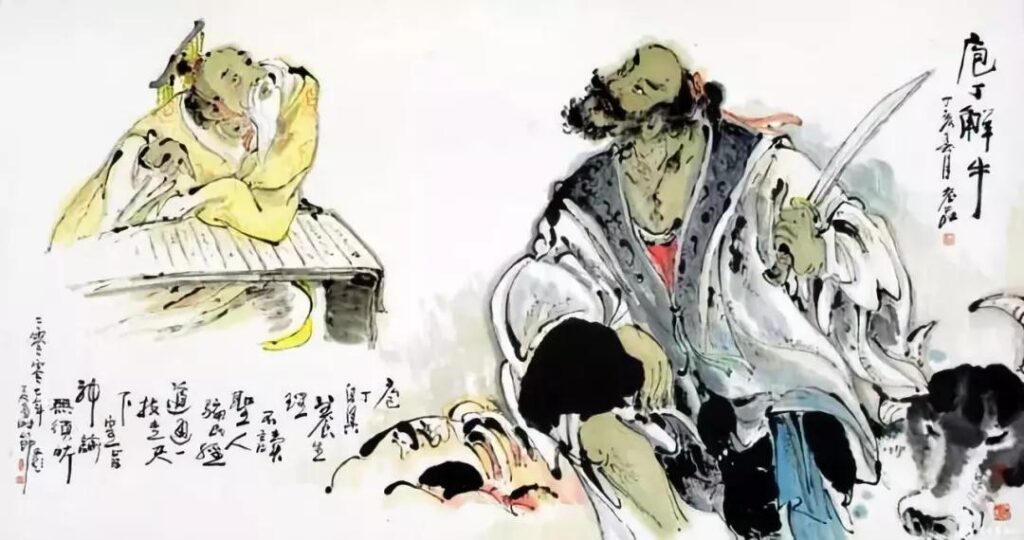
Shang explains: “Here, ‘not seeing the whole oxen’ and ‘seeing without eyes’ imply not having differentiated mind; ‘meeting it by the spirit of instinct’ (shenryu) implies the state of casting self or no-self; ‘following things as they are’ refers to the oneness with nature; and ‘my body knows where to stop and the instinct goes wherever it wishes’ gives an image of the state of tong or throughness, which is the key to understand Zhuangzi’s notion of One.”
“Yi” as human liberation from the bonds of attachment
“Yi as a state of mind is the way of the kind of human liberation or spiritual freedom from the bonds of attachment, obsession, prejudice, dualism, dogmatism, or any form of fixation of one’s mind. In this respect, yi can be read as a verb ‘to yi‘ that is equivalent to qi (to equalize, identify, or not distinguish), tong (to get through, to access, to connect with, to join), he (to harmonize, conciliate, combine, and blend).
Shang concludes: “Finally, yi represents a thorough throughness and openness (tong) between heaven and earth, nature and human beings, self and others, which prevents a mind from being fixed or attached to any metaphysical presupposition, self-centred prejudice, and dualistic mentality. Dao-tong-wei-yi, ‘Dao throughs as One’ (2/4), so that nothing can block the way of anything’s or anybody’s self-transformation, and no prejudice, knowledge, and moral principle will confine one’s spontaneity. As soon as one’s mind opens through oneness, one liberates oneself from human alienation and returns to the natural, instinctive, and healthy life. One can in ‘imagination’ move from one limited perspective to another, while never attached to any … Everything that is right here right now is Dao.” There is nothing behind the scene of the world of the ten-thousand-things controlling the coming and going of the appearances; it is the ‘thing-as-itself’ (ziji) that moves, changes, lives, dies, presents, and absents all by itself. Therefore, Zhuangzi’s Dao as One does not designate any universal principle or unitary system of the world but refers to the togetherness (Oneness) of all things in the world. This togetherness embraces all existences as they are without distinction (wufen).”
Source:
Ge Ling Shang – Liberation as Affirmation: The Religiosity of Zhuangzi and Nietzsche (2006)