In The Book of Beginnings, François Jullien undertakes the huge task of tracing the origins of the oldest texts of the Chinese, Hebraic, and Greek cultural heritages back to their earliest sources, and explaining their divergent worldviews, which continue to shape our lives, both individually and collectively. Specifically, for each culture, he goes back to the very first sentences of their foundational texts. For China, these are the opening sentences of the Yijing, the series of six yang lines symbolizing initiatory capacity, followed by six yin lines symbolizing receptive capacity, which Jullien translates as a process unfolding in phases: “beginning (yuan)/expansion (heng)/profit (li)/rectitude (zhen).“ Or, ‘to begin – to expand rapidly – to profit/to turn to good account – to remain sound (solid)’.” In the Hebraic tradition, it is the first sentence of the Old Testament: “In the beginning, God created heaven and earth.” A presentation of these two “beginnings” is available at the following links:
Here Jullien is setting the three traditions side by side so that he can tease out their divergences and the way they have shaped the cultural history of their part of the world.
“‘Creation’ (in the account of Genesis) says that a subject acts from outside the world and projects his will onto it. ‘Generation’ (in Hesiod’s Theogony beginning with cosmogony) expresses, conversely, that everything is done from within the play of powers that make the world, without intervention from outside being considered, because from what – strictly inconceivable – “Outside” could the world be made? (François Jullien – The Book of Beginnings p 56)
“Of the Muses of Helicon let us begin to sing”
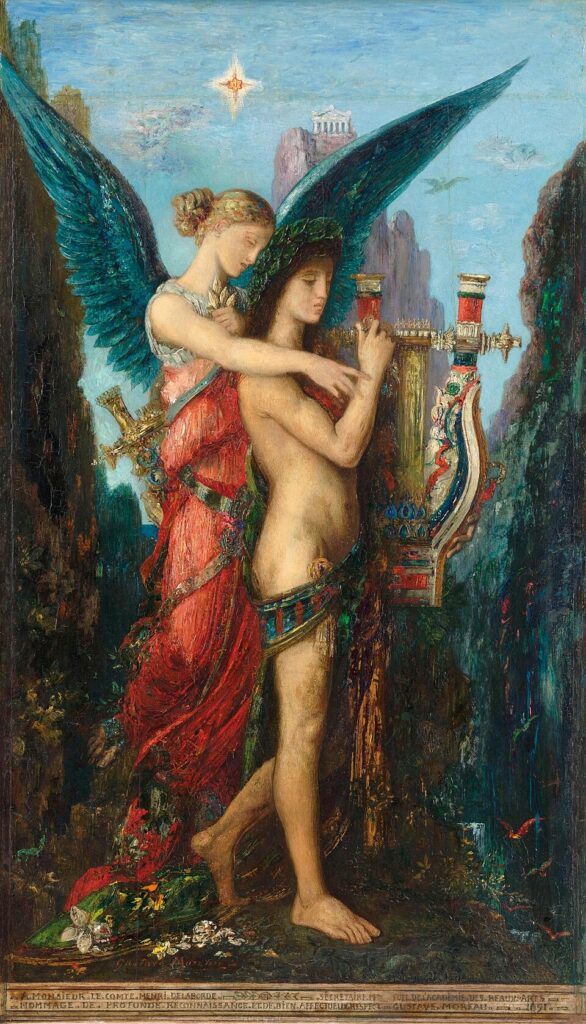
Jullien now turns to the Hellenic tradition, for which he selects the first sentence of Hesiod’s Theogony: “Of the Muses of Helicon let us begin to sing.” He introduces this rather cryptic sentence by contrasting it first with the biblical account of the Beginning which, he says, “announces itself without justifying itself … does not proclaim where it comes from or what authorizes it [and] is uttered without author and without witness.” In contrast, he says, “The Greeks would ask themselves … how to begin; they were conscious of the beginning as a question and even as a challenge for thought. Hesiod (active between 750 and 650 BCE), who is the first among the Greeks to give a systematic account of the origins of the world and the gods, opens his Theogony by evoking the Muses who inspired it. However, Jullien remarks, “because Hesiod does not want to celebrate the Muses in his poem so much as be authorized by them to express himself, he invokes them as both source and support for his statement at the same time as he is aware, from the outset, of the ambiguity belonging to speech: the Muses know how to speak ‘lies exactly like realities’ just as they are able, when they desire, ‘to proclaim truths’ (alethea gerusasthai). For Jullien, this heralded the beginning of philosophy.
A problematic orientation is adopted: how does time (history/generation) arise from an eternal foundation?
“Theogony” means “birth of the gods.” Hesiod’s Theogony, is therefore the genealogy of the Greek gods. Hesiod, in fact “presents not one but two beginnings, considered successively … he begins first by starting from the present and working backward, this side of the Muses and the Olympian gods, to the origin of the world and the first gods. Then he begins by starting from this beginning itself and by evoking what happened ‘at the very first’ and from which the future of the world and the gods, up to the present reign of Zeus, ensued …The return journey to the origin seeks an eternal foundation, whereas the account of the advent of the world follows the temporal development or opens with it. How to articulate them both henceforth, the Being and the becoming, which emerge from divergent planes? (italics added)… Hesiod reports on gods who ‘are forever’ (aei on) at the same time that he has made the account of their begetting successive.” As a result, Jullien adds: “Kronos knows that his fate is to succumb one day to his own son, that is to say, ‘by the will of the great Zeus’, even though this son Zeus is not yet born: so the reign of Zeus exists before Zeus’s coming into the world …philosophy will begin with this difficulty and will be deployed to take it over, which will effectively allow philosophy operating between these planes, to construct in thought (ideate), working to separate the ‘ontological’ from the ‘genetic’, or what is principle from what makes its appearance.” Jullien then asks: “Is this rupture between the temporal and the eternal, as it structured Greek thought, logically necessary (as the Greeks believed)?”
How Chinese avoided the rupture between the eternal and the temporal
The Hellenic dilemma provides us with a tool “to probe further into what ‘beginning’ means in the opening of the Classic of Change.” Jullien explains: “Here we will find a new means, a fresh means, formed this time by the tool of philosophy, to question what Chinese thought does not question – not that this difficulty that the Greeks created is resolved in Chinese thought; rather, it is dissolved there: in this strange bath, it is no longer recognizable.” In other words, the Chinese beginning is not really a beginning. It is a process, and there is no rupture between the eternal and the temporal. In Jullien’s words, “This processive ‘beginning’ that deploys itself, in Chinese thought, into ‘expansion’, into ‘profit’, and into ‘rectitude’ is not principle … But neither is it a factual beginning, an event, one of a first day or a first time, since this discreet initiation of a course of things does not create rupture, as in the biblical account, but is an operation (yong, the Chinese would say) that occurs everywhere at every moment … Even though under the sign of ‘Heaven’, the sum of all process, Chinese thought does not conceive of the ‘eternal’ (what is for ever) but rather conceives of the ‘without end’ (what, in the course of continually renewing itself, never runs dry, wu qiong); nor does it let itself defer to thought of the ‘future’ and its blind course, nor to that of a unique History and its destination.” In place of an eternal that excludes change, the Chinese offer the “‘coherence of regulation’ that … makes a ‘constancy’ of change (chang) through renewal. This processive ‘beginning’ will not let itself be grasped from the temporal-factual (biblical side) or the self-essential, ontological (Hellenic) side, as a function of model and archetypal.” As heirs to the biblical and hellenic cultures, we have become familiar with the tension between Greek philosophy and Christian theology, but “China does not find its place in this debate.”
Hesiod’ second journey of the advent of the world is the return journey, from the beginning to the present reign of Zeus and therefore parallels that of Genesis
As noted above, while the journey from the present to the origin sought an eternal foundation, the return journey follows the temporal development of the world. It is the birth of History.
“It is here,” Jullien says, “that the opposition between those two prospective accounts of the beginnings, Hebraic/Hellenic put side by side, reappears and even becomes explicit.” In fact “there are only four ways of representing the advent of the world: through generation, combat, fabrication, and speech. Someone (some agent) either engenders or fights or fashion or commands – we can thus arrange them, from one operation to the next, according to the activity that is the most external. In this typology by case, the Greek and the biblical accounts perfectly contradict each other.” In Genesis, “God creates strictly by speaking and commanding (there is more fashioning in the Yahwist account and sometimes there is combat in the Psalms); there is never generation. Whereas in Hesiod’s Theogony, everything is made through generation; then those engendered powers turn against one another and come to blows. But there is never fabrication and especially not creation through speech.”
Specifically, here is how Hesiod actually begins: and what is inscribed parallel to the biblical beginning:
“Assuredly, at the very first, came the Abyss, then followed
Earth with its wide bosom, ever sure foundation for all,
As well as Eros, the most beautiful among the immortal gods,
The one who breaks limbs under desire …”
Just as in the Bible, the Abyss comes first, and the advent of the world comes as a rupture. It is not, a rupture by one God who commands things into being, but a rupture by many gods who strangely behave like humans. Jullien comments: “even what comes “at the very first,” the original abyss, Chaos, is also (already) a matter of “becoming” (genato). Even the first physical elements then evoked – after Earth: Heaven, sea and rivers, mountains and stars – come about through engendering. That is why Love, Eros, the one who mingles bodies and “tames hearts,” is the first god to be celebrated. Then the same is true for the gods who succeed one another in turn to the point of threatening the world, both through their proliferation and through their rivalry, until Zeus finally brings good order by definitively establishing his reign and by blocking this becoming, stabilizing it into eternity.”
“What do these two operations signify, dominant throughout but mutually exclusive: creation (Hebraic) and generation (Hellenic)?
Jullien answers: “‘Creation’ (in the account of Genesis) says that a subject acts from outside the world and projects his will onto it. ‘Generation’ (in Hesiod’s Theogony beginning with cosmogony) expresses, conversely, that everything is done from within the play of powers that make the world, without intervention from outside being considered, because from what – strictly inconceivable – “Outside” could the world be made?
But, Jullien argues, it is only because “God” is completely exterior to the world, not contaminated by it, that he can be absolutely good: conversely, as long as the divine remains engaged in the power relationships that make the world, it remains as mixed as it is, marked by its impurity and inclined toward multiplicity.” Hesiod’s gods, like Homer’s, are “greedy, deceitful, perverse, and libidinous as men are.” They “are distinguished only by their immortality and power.” Historically, Western culture has been shaped by both the monotheism of the Hebraic tradition and the polytheism of the Greek tradition.
Furthermore, Jullien notes, if God is absolutely pure, being exterior to the world and separated from it, he can be conceived only in the singular, without the heterogeneity that shapes him …. As soon as Plato himself conceives of the divine as absolutely good, he can then only envision it in a unitary mode (to theoin),” and “conversely, if the divine is as mixed and varied as the world to which it belongs, it is inevitably as diverse and multiple as that world – and then how to stop this diversification and multiplication in which it is carried along? Even if Hesiod finally establishes the reign of Zeus to overcome it, he finished his Theogony in suspension; or rather, he can only leave it unfinished … On the contrary, the sacerdotal account of the Creation is set to close down on itself … leading immediately to its outcome.” One could say that it closes it as a divine creation, but it did not take long for humans to destroy the harmony God had established: already in Chapter 3 we are told about the “fall” of humanity, brought about by Adam and Eve having disobeyed God’s order not to eat the fruit of the tree of knowledge of good and evil. The initiative for this, I’d like to note, was specifically attributed to Eve, the woman who had just been fashioned out of Adam’s rib, rather than been made by God “in his image,” as man had in Chapter 1.
Chinese thinking is free of this contrast between the eternal and the temporal
Jullien writes: “If Chinese thinking on the beginning, as we find it in the opening of the Classic of Change, does not let itself be ordered according to this Hebraic/Hellenic opposition between the accounts of Genesis and the Theogony, that means it escapes the alternatives that the latter have constructed in our mind.”
Since, as we have seen, the unfolding presented in the first line of the Yijing is not a true beginning, as it is viewed as a process of renewal with no beginning and no end, Jullien says, “we will logically be tempted to conceive it according to the opposite model, as a matter of generation.” After all, yin and yang are also used to contrast feminine and masculine energy. But, Jullien adds, “all reciprocal incitement between them nevertheless abstracts itself into polarity: an interaction is continually deployed, sua sponte, between these two opposed and complementary factors, without Eros, the beautiful god of love, having to mingle them, prompting the event of individual desire and its disorder.” In addition, while in Hesiod’s text, the male-female polarity bring about violent conflict, in the Chinese view “harmonious regulation immediately extinguishes the possibility of this personifying drama and conflict.”
Jullien continues: “On the other hand, in the first figure of the Yijing, “yang is still ‘pure’ and ‘unitary’ (chun yang) since, at this stage it is not mixed with any yin element that would create tension or corrupt it … it is only this capacity for incitation and expansion that will be the source of all “good” (shan); notably, as later thinkers will comment, mixing in the Book of Mencius, it is this reaction deep within that prompts our sense that the misfortune of others is unbearable to us, thus establishing the feeling of pity at the origin of all altruism. ”Remember Mencius’s story of the empathy that immediately prompts us to run to stop a child about to fall into a well. “Incarnated in ‘Heaven’ it has absolute moral value; it is elevated to the unconditioned and bears within it the infinite.” Yet, “this goodness engaging every process is without Will; this positivity is without intention. This initiatory capacity is completely internal to the great Process of the world and remains immanent there, developing sua sponte: it calls for no Other, explores no Beyond, implies no Separation. Whereas, it is because the biblical God remains exterior and transcendent to his creation that he preserves his absoluteness and his purity.”
This parallel between the Bible and the Theogony can be endlessly unwound to see how Chinese thought undoes or eludes it.
With regards to the biblical Creation, Jullien notes that, “as soon as the divine goodness enters the world, ‘it is no longer tenable’.” The first pair of humans transgress and are expelled from Eden. To be sure, in a world that starts from perfection, “no other possibility exists for the evolution of the world henceforth but to sink into ruin … the only way out of this de-creation, culminating in the Flood, is to renew our alliance with God and his Word, to work toward a re-creation.” For Hesiod, instead, “chaos is very much the initial stage, void, indeterminate, without possible qualification and purely negative, starting from which the world will come about and organize itself, and, in doing so, progressively determine itself as a function of the Greek postulate that determination alone makes ‘being’.” But there is no plan, and no power to direct this determination, and it is a matter of various gods entering into conflict to win sovereignty. “It requires all the political acuity of Zeus, incorporating Metis, to impose a lasting order, by force or by ruse, neutralizing the oppositions as though holding them at bay.” We know now that order is for ever threatened and forever being reconstructed.
There is no chaos in Chinese thought. Neither is there evil. The initiatory capacity, which is purely yang, is totally positive
And, Jullien explains, “because if the initiatory capacity, purely yang, is totally positive, the capacity that is coupled with it, the receiving capacity, yin (Kun, the second figure of the book), is equally so – at least insofar as it respects its nature, which is ‘to welcome’ and ‘to conform to’ the initiatory capacity that penetrates and directs it.” In a system based on renewal through the rebalancing of yin and yang, “even in the worst situation, it would still be possible to perceive, even if only in a latent state, an ‘initiator’ of renewal (a yang line) through which the initiatory capacity discretely reengages the process (the viability) by re-inciting and getting (itself) under way again. Thus all one must do is make oneself ‘supple’ and receptive enough, which is the yin virtue, to make room for this initiatory factor of renewal and to allow for its full “expansion” to the point of being able to “profit” from it.” And, if there is “no dramatic, agonistic tension at work, there is no longer anything to relate.” As a result there is no narration in the Yijing. Neither crime nor punishment. No tragedy to fear or salvation to hope for.
And this time, facing China’s concept of regulation, the Bible and Hesiod again find themselves very much on the same side
In the biblical account,“the real story opens as soon as evil appears, as soon as the order of the Creation is cracked” with the story of the Fall. “The same is true for Hesiod: since the engendered powers are in ever-renewed conflict for Hesiod, the story is fully developed; hand in hand with the genealogical series, this is what weaves the theogonical web. It is true that the stabilization brought about by Zeus draws the becoming toward Being and consequently tends to make an exit from the story.”
But, Jullien adds, “Chinese regulation … is not stability at all: it does not establish a permanent order but maintains in equilibrium that which must continually transform itself. Thus, instead of exiting dramatic History, it never makes an entrance there …a logic of regulation in and of itself dissolves all possibility of narration.”
Can Chinese thought help us exit the great Narratives heavily criticised by postmodernity?
What began for Jullien as a daring exercise – elucidating the thought of three great world cultures by placing their oldest sacred texts side by side – has confirmed what he now calls a “truism”: “‘to enter’, it is necessary to exit; to penetrate into Chinese thought, it is necessary to leave a ‘home way of thought and let oneself be disturbed. Because when we pass into China, not only do our traditional representations lose their relevance – that is, our representations that oppose Being and becoming, or creation and generation, or monotheism and polytheism – but the contradiction around which Western thought takes shape and which underlies those oppositions is undone as well, the contradiction of muthos and theos: of the theological (promoted by the Bible) and the mythological (deployed by Hesiod).”
But it has also opened for him a new avenue of thinking, as he asks: “What other possibility can we enter, then, that is neither one nor the other – in other words, that escapes their alternative: a possibility of thought that, all told, is perhaps no stranger than the others but that the others have not conceived, according to their enlisted choices, or even just simply imagined.”
Source:
François Jullien – The Book of Beginnings (2015 – original in French Entrer dans une pensée, ou Des Possibles de l’Esprit 2012)