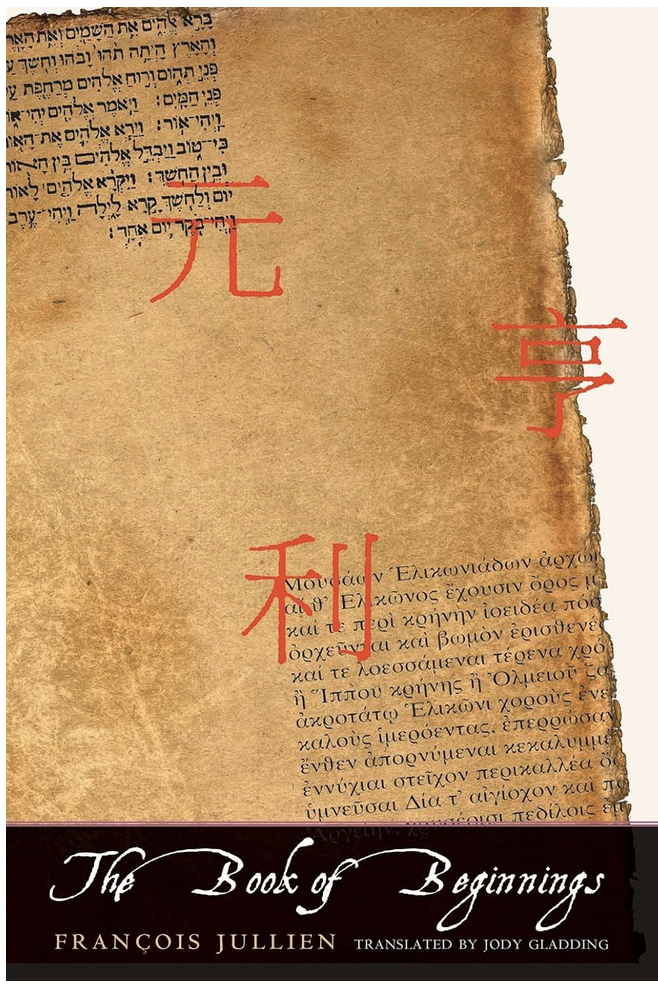
“The first [sentence] embodies what I will translate as the initiatory capacity, Qian, and the second, as the receiving capacity, Kun: as counterparts, they form the double door through which the process of things endlessly passes.” (François Jullien – The Book of Beginnings p 25)
In the Book of Beginnings, François Jullien goes back to the origins of Chinese thought in the Yijing which he later examines in parallel with the origins of the Middle Eastern Hebraic tradition and European thought in Greece. For each culture, he unpacks the first sentence of their foundational book – the Yijing, the Bible, and Hesiod’s Theogony. For now, Jullien focuses on the Yijing.
A beginning that is not really a beginning in a book that is not written in words and sentences
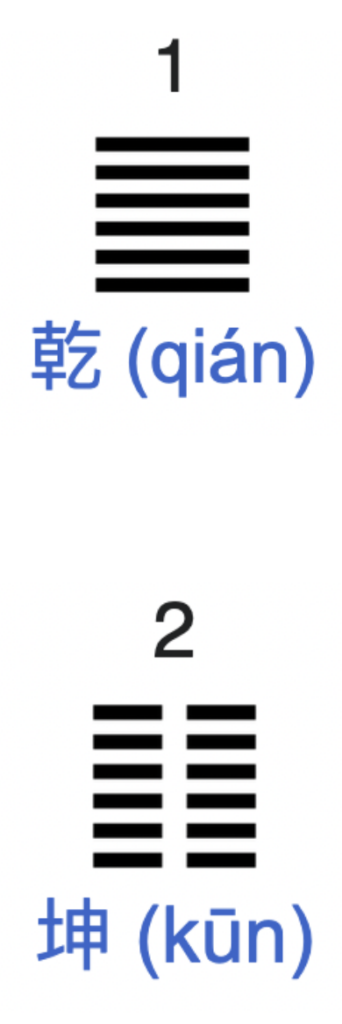
According to Jullien, the first two hexagrams of China’s oldest, and most fundamental “book,” the Yijing (I Ching) encapsulate the Chinese way of thinking, and has shaped its unique worldview. The Yijing is usually translated as the Classic of Change, but Jullien also calls it the Oracle of Change, as it is a divination book), is “a text accumulating successive layers from the beginning to the end of the first millennium BCE,” in the form of hexagrams combining “—“ or “- -“ symbolizing two factors in correlation, yin and yang, simultaneously opposite and complementary and holding all reality,”. This first hexagram “is formed only out of yang lines, evoking the capacity of Heaven; the second is formed only out of yin lines, evoking the capacity of Earth … Forming a pair, with the six yang lines facing the six yin lines, these two initial figures comprise the total stock of the lines composing the series – or the energies invested – and represent the polarity of the whole. The first embodies what I will translate as the initiatory capacity, Qian, and the second, as the receiving capacity, Kun: as counterparts, they form the double door through which the process of things endlessly passes.”
Unlike the first line of the Bible, to which Jullien will later compare the Chinese “beginning,” it is not a “creation” story explaining how the world, including ourselves, came to exist. In fact, it apparently takes it for granted that the world has always existed, so there had really been no beginning! Jullien writes: “It does not teach a Message or claim to deliver a Meaning about the enigma of the world or the mystery of life but presents for examination, from the bottom to the top of each figure and line after line, how this or that situation is deployed and inflected in a positive or negative way, ‘luckily’ or ‘unluckily’, as a function of the tendencies and interactions detected, which continue to evolve.”
Jullien proposes to translate the first hexagram, i.e., initiatory capacity (Qian) as follows: beginning (yuan)/expansion (heng)/profit (li)/rectitude (zhen). “Or, just as good: ‘to begin – to expand rapidly – to profit/to turn to good account – to remain sound (solid)’. Such an opening sentence … does not construct; it is content with simultaneously unbinding and binding. Each successive term takes over from the preceding one and deploys it; it proceeds from it, renews it, and carries it further.” In other words, it is “the successive stages of an unfolding … it less has a meaning, strictly speaking, that it develops a coherence.”
This can be illustrated by the concrete example of the four phases of the seasons: “the ‘beginning’ is spring; the ‘expansion’, summer; the ‘profit’ (harvest), autumn; the ‘rectitude’ (both solidity and tenacity), winter, which allows the capacity to endure, through burial, until renewal. But we can also read the terms two by two, already forming a polarity: to the release of a ‘beginning’ responds the ‘expansion’ that spreads the effect; or (then) the ‘profit’ of the harvest calls for the integrity of the ‘rectitude’ in order not to be exhausted. There, in any case, is the key formula … for that which continually makes reality, in its incessant process, and which nothing can call into question, can neither reduce nor contradict.” (TBOB25-26)
We could even say that it is an ‘immanent process’, as it is also as immanent that it can be contrasted with the biblical creation by a transcendent God positioned not just outside, but above, reality. Jullien wrote a fascinating book about the Yijing titled Figures de l’Immanence, which, unfortunately, has not been translated into English.
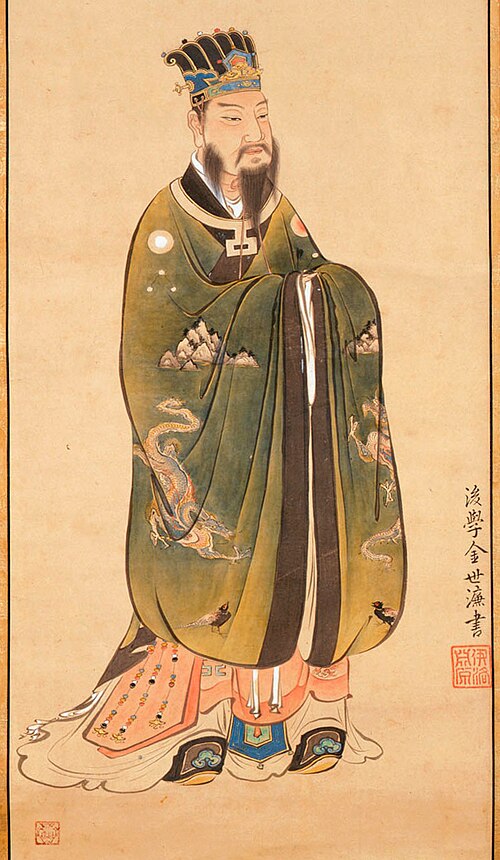
by Kanō Sansetsu
The Yijing indicates “how this or that situation is deployed and inflected in a positive or negative way, ‘luckily’ or ‘unluckily’, as a function of the tendencies and interactions detected, which continue to evolve.” Jullien tells us that it “is … traditionally attributed to King Wen, the civilizing king par excellence, founder of the Zhou dynasty in early Antiquity (turn of the first millennium BCE); and the commentary that follows it was attributed to Confucius but belongs instead to ‘the literati’ of the end of Antiquity (in the fourth century BCE).
The commentary begins like this:
“Vast is the capacity of Qian [the initiatory capacity]!
The ten thousand beings find their resources there to begin:
so that it commands Heaven.”
Jullien comments: “This exhaustive introductory formula is one of celebration.”The arising of the ten thousand things is welcome in China. In the same period in India, incarnated life among the multitude of dharmas/things was deemed by both the mainstream Brahmanical culture and the Buddha’s teachings, to be a source of suffering, and liberation from it was through put an end to the cycle of rebirths.Because there was in China a resurgence of an earlier preliterate culture based on the interaction of yinyang after the collapse of Shangdi, the god that had held together the first two empires of Chinese history – the Shang and the Zhou – China had retained the sort of indigenous attunement with nature – mountains and waters – which India had already lost. Jullien asks:“What exactly is there to start with?Jullien answers: “From nothing other, it is proposed here as if presenting the obvious, than the invested – ‘initiatory’ (Qian) – to which all that exist owes its becoming and its developing.” Now, we may ask: what about the Dao described in the Daodejing as the Mother of the ten thousand things also referred to in Chapter 6 as the “valley spirit” and “mysterious/dark female who never dies?” Could not it be said that yin came first, as the womb, out of which life, as movement, arose. The first sentence of the Yijing has substituted yang as the initiatory capacity to the “fertility of theDao.” When talking about the interaction of yin and yang, don’t we say “yinyang,” rather than “yangyin”?
Still, this “vast,” associated with Heaven, comes across as a positive embrace of the natural world. The horizontal line in the ideograph is said to represent a man with open arms. In Jullien’s words: “That ‘vast’, in a certain way, already says it all … Simply to name this ‘vastness’ in the face of the world, in the face of life, is to keep from awakening surprised panic in the face of what might be, beyond all beyond, infinity: the vertigo that seized Job facing divine Creation’s incommensurability is immediately disposed of. Similarly and conversely, this sufficient, satisfying “vast” dispenses with the need to posit some border or edge; it does not raise questions, as in Greek, with regard to the “limit …this ‘vast’ or ‘great,’ posted first, does not question. This ‘ample’, so generously deployed, but without extending to any boundary and thus to confrontation, already buries any question of why … Throwing this ‘vast’ out at the beginning is enough to create a gap” (TBOB 32-33).
The graph 物 wu, which Jullien could only translate as “beings,” is said to represent a particular kind of ox with a multicolored coat that could be offered in sacrifice
Moving on to the second line of the commentary, “The ten thousand beings find their resources there to begin: so that it commands Heaven,” Jullien acknowledges facing translation problems. He had to find a word that went beyond the ten thousand things to include both things and beings. But the ideograph for 物 wu is is made up of two graphs depicting an ox and ploughing – a sack and bit of earth?” And, “in ancient inscriptions … the word is attested to designate a particular kind of ox with a multicolored coat that could be offered in sacrifice. We can gather at least that reality is approached as living, in its mass and its diversity of appearance, forming a scene and destined for use, perceived in activity.” Thus, “to name what we most commonly call ‘beings’ is just this ‘plow ox’, that the Chinese language graphically employs, making it the medium for a multiplicity” (TBOB, 33). It is clear that the word “beings” feels rather bland compared to this ox with the multicoloured coat!
Jullien further explains: “Because once the perspective is projected … we are not allowed to consider ‘what’ (noun) the beings and things ‘might be,’ nor ‘from what’ they come … They do not leave room for the question ‘What is that?’ (the ti esti of the Greeks) not for an investigation of origin: it will be enough to note that the incitation is constantly at work, on a wide scale, and the course is continually under way. A capacity is invested, in every place as at every moment, that never stops’ providing for, ’pendlessly spreading, promoting, without exhausting itself. That is why it is called ‘vast’ and why it is celebrated. It commands from end to end that continuum of becoming – of flow – that is called “Heaven” (tian, 天, vast). Now such a ‘Heaven’, at the time of this commentary, is no longer deified nor separate strictly speaking, but already serves to name that generous initiatory energy, never running dry, that is found to be involved in every process” (TBOB, 34).
The commentary continues:
“Clouds pass – rain spreads:
the beings, according to their category, flow [into] their actualization.”
The first line here corresponds to “‘the ‘expansion’ (heng) after the ‘beginning’ (yuan) that prompts it and governs it.” The clouds that “pass” are those that “condense diffuse energy into vaporous appearances and begin actualizing it by sketching contours with their swells. And for that capacity to spread throughout and, crossing straight through, to assist in the ripening process, what better to evoke than rain – the fertile rain that does not target or spare anything? (TBOB, 35). The ten thousand things are not really “things.” Clouds pass, rain spreads, the natural world is not a collection of “beings” moved by what would be another “higher” Being. It is ‘life’, as such change, movement, dynamism, to be celebrated and nurtured. The word “process” conveys the same idea in modern times, but it has a dry and cold mechanistic feel that does not invite celebration. In China the sense of wonder triggered in us when watching the phenomena of the natural world was expressed in poetry, because one’s goal was not primarily to use nature to meet our individual needs, but to enhance our receptivity to better capture its beauty.
The Chinese saw no need to add to this pure, simple phenomenality, and in particular no need to posit a Mover or invoke an Agent
Jullien writes: “Indeed, what is life, the world, reality, whatever we call it, if it is not that: the actualization that deploys itself through interaction into specific individuations, each according to its rubric, and that thus flows and follows from itself, without any other pretext? What could be added to this pure, simple phenomenality, the Chinese ask us, that would not weigh it down or coat it? What could be assumed to be behind or beyond it? Why must “something” – being or substance – more (than this continuous passage) exist? And in particular, what need is there to conceive of a Cause for this constant promotion, to posit a Mover, to invoke an Agent? (TBOB, 35).
The commentary continues:
“Vast clarity – end beginning:
the six positions, according to the moment, to mount the six dragons so as to drive Heaven.
The Way of Qian [the initiatory capacity] modifying-transforming,
each renders [holds] correct its nature-destiny.
To retain unity; vast harmony.
From which, profit and rectitude.”
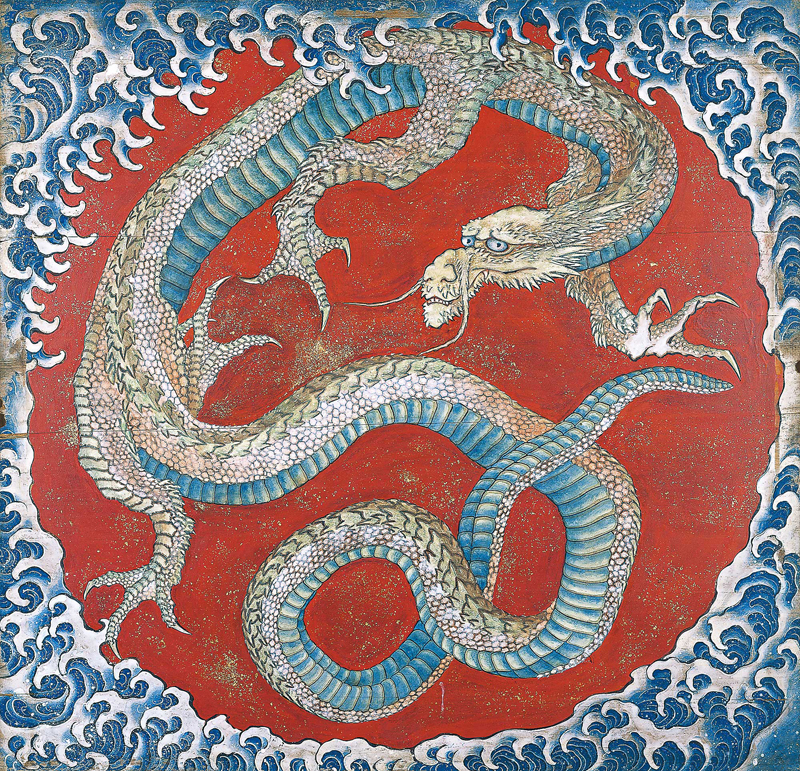
Since the Chinese dragon as the dynamism of life is benevolent, it is best to let him spontaneously work out his way without interfering. Jullien writes: “Each ‘moment’ comes in its time, opportunely, and that is why, after the ‘beginning’ and the ‘expansion’ come the ‘profit (harvest) and the ‘rectitude’. What better image of this dynamism extending from itself and renewing itself than the body of the dragon? … What place is there for worry in what is bound together so well that the possibility of death or interruption, at this level, is inconceivable? It does not even say ‘beginning and end’, but ‘end-beginning’ (which translators often wrongly correct): this beginning is not inscribed in a single moment in time but is at work in all activation, and likewise there is no final end, neither a raising nor a lowering of the curtain. Thus every end is also a beginning; what is completed gives birth again as well. We have only continuous transitions to deal with” (TBOB, 36).
A point that is not usually grasped by a Western reader, for whom religion is the basis of morality, is that, as a life process invested with a capacity, the dragon “could not follow one particular moral code or, conversely, fall outside the framework of this processivity. Harmony (he), the master word of this evocation, in keeping ‘profit’ inseparable from ‘rectitude’, deals with them both: it assumes simultaneously that nothing can intervene from outside the world or secede from within the world. Facing so much coherence, which dissolves all metaphysical surprise at this point – that is to say, makes Heaven spill into the natural at this point – we ourselves are surprised. I cannot help but wonder: Will there never be any place here for the Rupture? Will nothing ever come to break in, to rise up in confrontation?” (TBOB, 37)
The commentary ends with the following lines:
“[From the] head to tower over the throng of beings:
the ten thousand realms are at peace.”
Jullien asks: “Doesn’t such well-regulated order serve as the engine of obedience?”
The Chinese Sovereign was “the medium or the office through which the social order comes to plug into the order of the world, aligns itself with it, and harmony is translated into ‘peace’.” But, Jullien asks: “In fact, in this processive logic, impossible to disturb, is there still a place for a political Subject, unique as he might be? … Can our earlier surprise thus turn finally only to suspicion. Doesn’t such well-regulated order serve as the engine of obedience? … Isn’t it necessary to posit an External to the world, ektos tou kosmou, as the Greeks were already saying, and invent an ideality detached from situations? In other words, if Freedom has servitude as its opposite, as we know, isn’t this in conflict with ‘Harmony’?” In From Being to Living, Jullien argues that, while the Chinese had cultivated their capacity for receptivity, the West had neglected it, focusing instead on Freedom, which the Greeks had established as the basis for the political life of the City. Harmony, based on coherence, strikes him as restrictive, and he’d rather have a Socrates that speaks his mind. Here, Jullien calls on “readers from Europe to organize the protest from without, to make the confrontation arise from elsewhere. With regard to this ‘obvious’ that the Chinese sentence weaves as if it were only unfolding it: we must take a step back to put it into perspective, to take it out of its unthought, to read not only what it does say there but also what it does not say: to disturb it” (TBOB, 38).
Sources:
François Jullien – The Book of Beginnings (2015 – original in French Entrer dans une pensée, ou Des Possibles de l’Esprit 2012)
François Jullien – From Being to Living, a Euro-Chinese lexicon of thought (2020-Original text De l’Être au Vivre 2015)
A study of the Hebraic tradition in parallel with the Chinese Yijing is available on