
“The mushin of Bodhidharma and the mushin of Mazu have very different flavors.” (Nishihira Tadashi)
As Nishihira Tadashi’s survey of the linguistic roots of mushin (no-mind) shows, the word did exist in ancient Japan but its meaning was used as a disparaging term meaning “mindless,” “heartless” or “unrefined.” A slow ascendancy of its positive interpretation as a state of flow took place with the introduction of Chinese Chan, where, as wuxin, it had meant “unmediated thinking and feeling” since the days of Laozi and Zhuangzi.
As Nishihira turned his attention to the Chinese roots of mushin, he quickly realised that, on the East Asian continent too, the meaning of the word had evolved and, as he put it, “the mushin of Bodhidharma and the mushin of Mazu have very different flavors.” In the contrast between the understanding of the semi-legendary founder of Chan, and that of the traditionally recognised father of Japanese Zen lineages, that is, between the 5th to the 8th century, lies the genesis of Chan/Zen – together with that of the meaning of mushin – in the interaction between the indigenous Daoism of China and the Mahayana Buddhist tradition that had been imported from India in the first centuries of the Common Era.
Did Zen start with Bodhidharma?
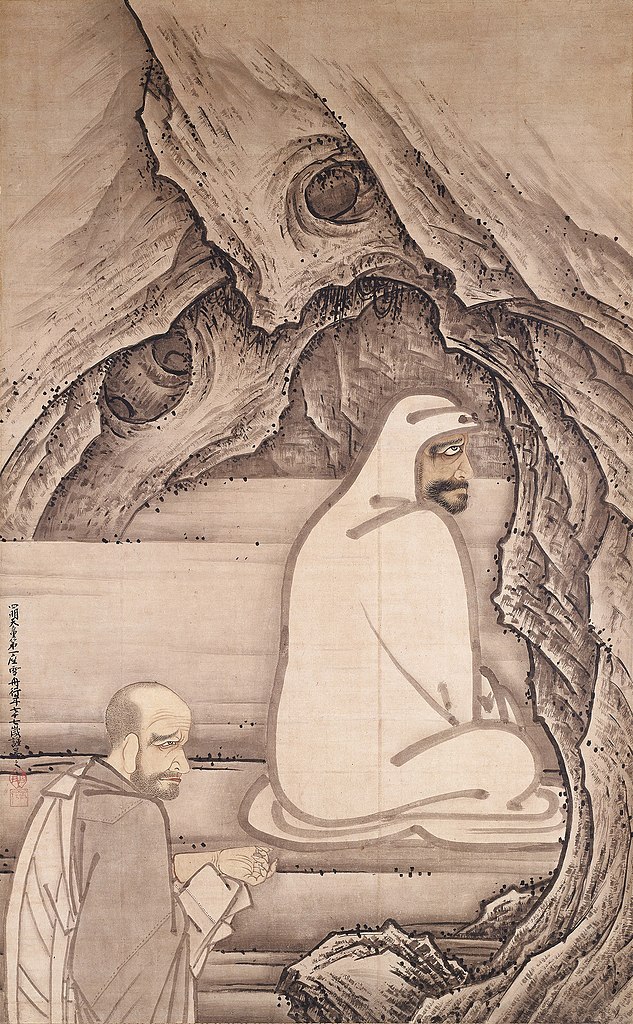
Tradition has it that Zen/Chan was founded by Bodhidharma, “who was born in South India sometime in the 5th or 6th century. He traveled to China and meditated facing a rock wall for nine years. His disciples were said to be Huike (Jp Eno), Sengcan (Jp Sosan), Daoxin (Jp Doshin), Hongren (Jp Konin) and Huineng (Jp Eno – 6th Patriarch). However,” Nishihira notes, “things are not that simple. In the first place, some qualifications are necessary before one can say that ‘Zen started with Bodhidharma’.”
Nishihira continues: “Actually, the discovery of the ‘Dunhuang Zen Registry’ in the beginning of the 20th century completely overturned the commonly held view regarding early Zen. Particularly influential was the Record of Shen-hui, which was discovered by Hu Shi (1891-1962) in 1928. This made it impossible to accept traditional material directly as historical fact.” Among other things, this document shows “that the story in Case 1 of the Blue Cliff Record ‘Emperor Wu of Liang Asks Bodhidharma’ was actually an anecdote made by Shen-hui (Jp Jin’ne 670?-762?).”
At this point Nishihira turns to D T Suzuki, whose study of the history of Zen thought constitutes one of Suzuki’s key achievements. He, however, finds that Suzuki sets aside the historical materials concerning the life of Bodhidharma and the works tradition assigns to him. Nishihira writes that, for Suzuki: “When Zen Buddhists systematized Zen during the Tang Dynasty, it is fine if they took it as being written by Bodhidharma.” As part of the “official” tradition these had shaped the development of Chan/Zen, whoever wrote them.
Bodhidharma’s Theory of Mushin
In the early period “Zen Buddhists focused on Bodhidharma’s “theory of mushin” which he presents in On No-Mind in a question-and-answer format between master and disciple. The disciple consistently takes a commonsensical point of view and asks simple, naive questions related to mushin. Space is lacking here for more than a few quotes of the key points made by the master:
“There is so such thing as the mind. The mind is neither inside nor outside nor anywhere in between. The mind has no substance [jittai]. That is why it is called no-mind … Originally, there was ‘no-mind’, but because of delusion, ‘mind’ came to be, creating karma, and it came about because of our attachment to it. It is the same as looking at a rope, taking it for a serpent, and fearing it. We went through the trouble of creating a ‘mind’ where there was none; and are now bound by it.”
Nishihira comments: “There is no substance, no ‘real reality’, called ‘heart-mind’; there are only its workings. There is the act of recognizing and of being conscious. But behind that, there is no fixed identity. Just because there is something at work does not mean that there is a mind (ushin) … This answer by the master is thought to be the theory of the absence of inherent characteristics in Yogacara Buddhism. Though there was originally no mind, people created ‘heart-mind’ themselves, and in fear, clung to it. That is why fortune and misfortune (sin) came to be. If one confirms that there is originally no-mind, then afflictions (worldly desires) and the cycle of birth and death disappear.”
The point of the text attributed to Bodhidharma is that, “as a substance, the heart-mind does not exist.” Can we say that, in terms of its “contents,” the “things” we see, the heart-mind does not exist? There is no ultimate “ground” of Being beyond or behind the apparently substantial “being” of things. The emphasis on the need to relate to the world in terms of “working” may have arisen out of the understanding that the “hundred thousand things” are understood and related to as dynamic processes in the Chinese cultural sphere, “verbs” rather than “nouns.”
Why Advocate No-mind?
The issue here is not, as such, the theory of the absence of inherent characteristics in Yogacara Buddhism. It is the nearly exclusive focus of Yogacara, also known as the “consciousness (or mind) only” school, on a meticulous study of the structure of consciousness, that includes six layers and a deeper “storehouse consciousness” (the alaya-vijnana), described as an “underlying unconscious level of mind” where the karmic material shaping the way we see the world is stored.
Nishihira explains that [Bodhidharma’s text] “emphasized that there is no mind because during that time, mind was overly stressed. By arguing that there is no mind, against the mainstream Buddhist world that fixated on the theoretical examination of mind, it became possible to clear a path to face mind directly once again … Bodhidharma preached no-mind, emphasizing that there was no mind. It was not that he made light of the mind. On the contrary, he criticized the theoretical search for the mind in order to advocate living the mind directly. In an era when a plenitude of theoretical systems on the mind such as Yogacara and Huayan were flowering in the capital of Chang’an, he opened the way to explore the mind practically by living the mind directly rather than theoretically.” Each person had to face their “own mind directly by hearing about the unique experiences of individual Zen people. To that end, it was necessary to stress that the mind that has been explained through theoretical systems does not actually exist … The philosophy of emptiness preached that all is empty, but did not focus on the emptiness of the mind. Building on that, the early Zen Buddhists refocused the idea of emptiness on the mind – the central theme of the Buddhist world at that time. Mind is empty. There is no mind. Taking that as a point of departure, they preached that people should come face-to-face with such a mind by themselves through practice. By awakening to the absence of mind, one does not seek after propositions but rather lives if afresh, directly.”
The above argument was cleverly encapsulated in the story of Huike, who became Zen’s second Patriarch, found in the Gateless Gate “Bodhidharma Puts the Mind to Rest.” Huike “went to Bodhidharma with a request: ‘Your disciple’s mind is not yet at peace, I beg you, Master, give it rest’.” Bodhidharma says, “Bring your mind to me and I will put it to rest.” Huike starts looking for it and comes back to say: “I have searched for the mind but have never been able to find it.” Bodhidharma then says: “I have finished putting it to rest for you.”
Bodhidharma’s teaching then was a “cry of relief.” What the Yogacara school had taught about the mechanics of consciousness could be forgotten. Was this the teaching of an Indian Mahayana teacher who had rebelled against his native Buddhist tradition and its overemphasis on the karmic contents of the mind, or is it, as some scholars have hypothesized, the argument of a Chinese Buddhist convert who, unbeknown to him, had taught a Daoist version of the mind as empty of contents and merely mirroring Dao?
The Zen of Farming Villages
The following definitely supports the latter view. Nishihira writes: “It is also noteworthy that the early Zen sects developed not in the capital (Chang’an) but in the local rural areas. In contrast to the schools of Buddhism in the capital (Yogacara and Huayan), which were for the aristocracy and were pulpit Buddhisms (kodan Bukkyo) supported by the power of the king, those who supported Zen were the rural aristocracy and farmers.”
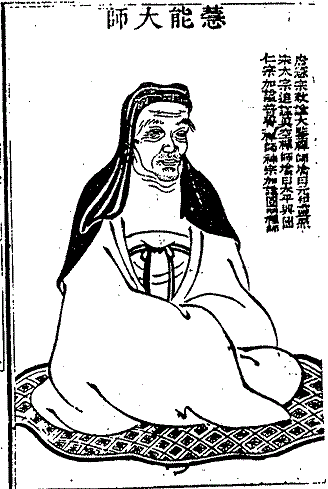
As many scholars have noted, the story of the 6th Patriarch Huineng (638-713) is a giveaway. “It is said that, having been born to a poor farming family, Huineng was uneducated and illiterate. However, he became the student of the 5th Patriarch Hongren, and held his own against the Northern sect led by Shenxiu (Jp Jinshu) by establishing the Southern sect, monumentally deciding the course of Buddhism afterward. While the Northern sect was welcomed by the Buddhist world in the capital, the Zen of Huineng, which flourished in the far South, then regarded as a barbaric place where culture is dead, took root in a rural village life. Earthy, it spread its roots deep into the soil, expressing the essence of the scripture using everyday words. Live everyday life. ‘Just act ordinary, without trying to do anything in particular. Move your bowels, piss, get dressed, eat your rice, and if you get tired, then lie down’. However, it is not absent-mindedly ‘eating your rice’. No matter what fortune brings, live with ease, without even a tremble. Not making a fuss, live according to the way of heaven and earth, following the path of nature. This way of living is tied to the culture of mainland China and linked to the philosophies of Laozi and Zhuangzi. ‘The Zen of China is a splendid joining of the natural non-action (wuwei ziran) of Laozi and Zhuangzi and the true wisdom (prajna) of Buddhism’.”
“Mazu: “Your mind is the Buddha. Your mind, as it is, is the Buddha.”
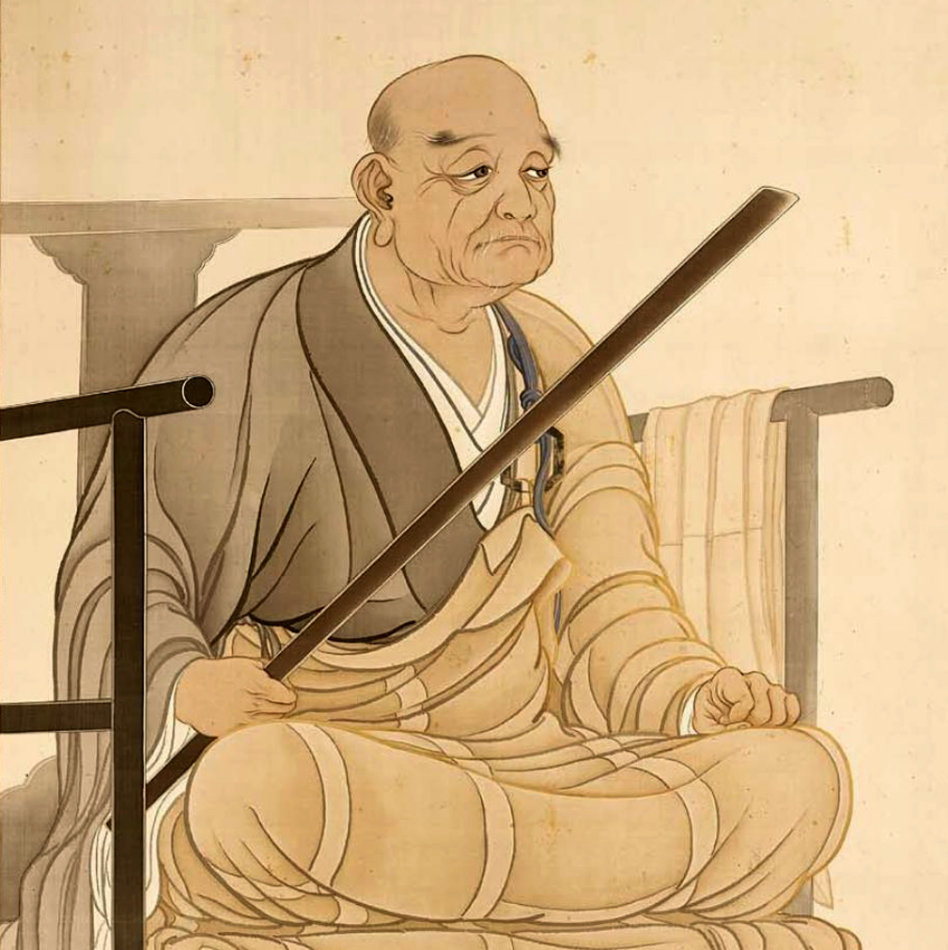
As the title of this section makes clear, with Mazu Daoyi (Jp Baso Doitsu 709–788), who was a second generation student of Huineng, a major turning point within the development of Chan/Zen took place in the 8th century. Bodhidharma had told us that “there is no such thing as the mind.” Now, Mazu is telling us that “our mind, as it is, is the Buddha.” Even though Mazu’s affirmation of the “mind” may appear to echo Yogacara’s “mind only,” school, Mazu’s “mind” is miles away from any multi-layered system built on top of an unconscious storehouse of karmic seeds. Yet, when equated with the Buddha, mind is given an ultimate dimension on a paar with sunyata, making it possible for Mazu and his disciples to shock their students into awakening through the use of shouts, blows and insults!
According to recent research,” Nishihira argues, “one can see a great divide between Zen pre-Mazu and post-Mazu.” For him, “this means that the de facto starting point of the Zen sect that continues today is the Zen of Mazu. To be exact, “What we call the Zen tradition is actually one that has discarded the transmission of the early Zen sect and has been reorganized according to the standpoint after Mazu.”
To the question “What is the Buddha? Mazu answered: “sokushin ze butsu,” meaning “the mind, as it is, is already the Buddha.” Then, to someone who objected that this did not make sense, Mazu answered: “The mind that does not understand, is itself, Buddha. There is nothing special aside from this. Not understanding is being confused, understanding is being enlightened. In being confused, one is a sentient being; in being enlightened, one is a Buddha. Apart from sentient beings, there is no Buddha. It is like the hand becoming the fist, and the fist becoming a hand.”
Ascetic Practices Are Not Necessary: Ordinary Mind Is the Way
Then, Mazu asserted that “there is no need for spiritual practices in search of the Way. Just do not be stained by filth. Being stained by filth means distinguishing between life and death, deliberately managing, or intentionally seeking the Way. If one seeks the true Way, the ordinary mind, as it is, is the Way.” That, no doubt, would have come as a shock to a traditional follower of Indian Mahayana teachings.
Nishihira comments: “This is the famous byojoshin ze do. The ordinary mind (byojoshin) does not deliberately manage or calculate. It does not distinguish from right and wrong, … what is necessary and unnecessary, what is mundane or holy … Mazu does not distinguish at all. Everyday life, in its entirety and as it is, is precisely the Way.” In Mazu’s words: “Right now, as you walk, stand, sit, and sleep, responding to each situation as it happens, these are all the Way.”
Is Ordinary Mind Mushin?
Now comes the question we have all been waiting for: “Is Ordinary Mind the same as mushin? In other words, is mushin already a taste of the transformative experience of awakening? Suzuki holds that, for Mazu, mushin is not the same as “ordinary mind,” because, as the opposite of ushin (having-mind), mushin remains a product of the discriminative function. He writes: “As long as no-mind/no-thought are thought of in contrast with having-mind/having-thought, it must be said that neither is ordinary mind. Ordinary mind is everything as it is, beyond all opposition. Therefore, putting it logically, it is contradictory self-identity (mujunteki jikodoitsu).” Elsewhere, Suzuki contrasts “byojoshin ze do (ordinary mind is the way) and mushin ze do (no-mind is the way) … a phrase from Sikong Benjing (Jp Honjo), one of Huineng’s disciples. According to D T Suzuki, while as an experience of Zen itself it is the same as byojoshin ze do, the word mushin contains the logic of negation, with traces of the philosophy of the Perfection of Wisdom remaining.”
A restoration of the original vitality of Zen
But, Nishihira asks, “if that is the case, this kind of teaching is rife with the danger of merely affirming the status quo. Spiritual practices and the like are unnecessary … If this is the case, how can we distinguish this from indulging in peaceful laziness?
Mazu himself had been aware of this danger. Side by side with “Mind itself is Buddha,” he wrote “No mind, no Buddha” (hishin hibutsu).” Nishihira explains that “it should first be understood that this is a dissimilation in order to bring life to the teaching of “Mind itself is Buddha.” The two statements mutually dissimilate themselves from each other … By continuously surmounting one another, they are both always alive and working. Through the mechanism of mutual overcoming, ‘affirmation of the self as it is’ and ‘thorough self-denial’ both try to take up the original vitality of Zen.”
Nishihira concludes the chapter with the following lines: “Looking on one hand at the affirmative vector of accepting everything (as it is represented by the ordinary mind of Mazu), and on the other hand, the vector of negation which heads toward nothingness (represented by the mushin of Bodhidharma), the history of no-mind in Zen thought repeatedly restored its original brilliance through the intense recursion and reversion between these two extremes.” This is also what Ueda Shizuteru, a disciple of Nishida Kitaro and Nishitani Keiji, later described as “a dialectically nondual process, a movement of ‘I, negating myself, am myself’. It is ‘a moment in the process of the true self that breaks open the karmically driven closed circuit of ‘I am I’ and enables the self to be itself by way of not being itself. The true self, for Ueda, is realized as the dynamic entirety of this circling movement between self-negation and self-affirmation” (Bret Davis).
Sources:
Nishihira Tadashi – The Philosophy of No-Mind – Experience Without Self
Bret W Davis – “The Contours of Ueda Shizuteru’s Philosophy of Zen” in Tetsugaku Companion to Ueda Shizuteru (2022)