
Dogen writes: “Flowers fall even though we love them; weeds grow even though we dislike them.”
Shohaku Okumura explains that we are rarely neutral in the way we look at things. Both flowers and weeds are plants that go through their natural cycle of growth, blooming and withering. Yet, he comments, “since we enjoy flowers, we love it when they bloom, and since we don’t like weeds, we are unhappy when they appear … The world we live in is the world we create based on how our mind encounters the myriad dharmas. We cannot prevent our mind from creating our world as it does, but it is possible to realize that the world of our creation does not reflect true reality. Practicing with this realization and letting go of rigid belief in the narratives and preferences of our minds is, again, opening the hand of thought.”
Okumura says that it means retrieving the pure experience that precedes “naming.” He writes: “When we see a flower, the flower is really there and we may think, ‘This flower is now in front of my eyes. It is very beautiful, but it will wither and fall someday’.” But “as we see the flower there is only the flower blooming; there is no falling … Or we may think, ‘This flower is here but it is empty, impermanent; there is no fixed substance to this flower … What Dogen teaches is that at the actual moment of its blooming, the flower is just a flower. He doesn’t say, ‘We should know that the flower is empty,’ because the flower is actually empty even when we don’t say so. For Dogen, when we see a flower and think, ‘This flower is empty,’ we separate ourselves from the flower. Prajna is not a way of thinking or understanding; it is the flower itself, and the flower is revealing actual emptiness. This is why Dogen’s formula refers to: ‘Form is nothing but form, emptiness is nothing but emptiness – one hundred blades of grass, ten thousand things’.”
Dogen says that things “do exist and they are themselves prajna. Prajna means ‘wisdom which sees emptiness’, but prajna is not a function of our minds but rather the reality of each thing as it is.” When we translate prajna by wisdom, we should remember that wisdom does not mean “knowledge.” It means the pure experience of the presencing of all things prior to “naming and thinking.”
Here Dogen echoes the Sixth Patriarch Huineng’s teaching found in the Platform Sutra, here reformulated by Red Pine as follows: “Prajna means ‘before knowledge’, and knowledge, (that is, the conceptual, dualistic knowledge elaborated by the intellect), according to Mahayana, is just another name for delusion. Hence, prajna is our original mind, our mind before we know anything, before there is a person who knows or something known. This non-dual nature is our original nature, our buddha nature.”
Dogen is using poetry to give his text the concrete feel of things as they are before they are processed by the thinking mind. We usually think of the self as subject and the myriad things as objects. But this common way of understanding our lives is not necessarily true. “Our desires and aversions and all the things happening within us and outside of us are in reality the manifestation of one real life: Buddha-mind or the Buddha’s life … According to the Buddha Dharma, this is not reality. The reality is that the self is part of the myriad dharmas; we are part of nature and the world. The myriad dharmas are everything, including the self. When we say ‘all dharmas’, the self is already included. If we leave ‘all dharmas’ we cannot live. If fish leave the water or birds leave the sky, they will die. It is the same with us … This is an important point because our basic way of thinking is based on separation between subject and object. We think, ‘I am the subject and everything outside of me is an object’. But this is not the actual truth.”
Wisdom as presencing, knowledge as naming
To overcome the stance of the subject looking at all things as objects, we need to allow all things to “presence” to us as prajna. Okumura’s translation of Dogen’s well-known formula is:
“Conveying oneself toward all things to carry out practice-enlightenment is delusion.
“All things coming and carrying out practice-enlightenment through the self is realization.”
Another translation of Dogen’s formula by Kazuaki Tanahashi, which may be easier to remember, reads as follows: “To carry yourself forward and experience myriad things is delusion. That myriad things come forth and experience themselves is awakening.”
“Practice-enlightenment” is the translation of the Japanese “shusho,” “shu” meaning self-cultivation or practice, in this case the practice of “just sitting”, and “sho” meaning confirming, witnessing or verifying.
“Conveying oneself toward all things” means “to take our distorted ideas and desires and move toward the world trying to find truth or reality.” This is what we do when “we try to capture reality with our minds, abilities, will power, and effort. We try to become enlightened in order to put everything under the control of the self so that our life is stable and peaceful.” In the mode of conveying oneself to phenomena, we see ourselves as going out into the world to make it fit into a pre-existing set of concepts, as scientists do. Dogen says that this only leads to delusion and confusion.
In the reverse mode – “All things coming and carrying out practice-enlightenment” – “the subject of practice is not the personal self but all beings. To practice is to awaken to the self that is connected to all beings, or the ten thousand dharmas … [The] myriad dharmas are themselves Buddha Dharma, and the reality of all dharmas is the Dharma body of Buddha – the dharmakaya – or Buddha itself … In other words, it is not “I” who practice, but rather Buddha carries out Buddha’s practice through me. It is rather the myriad dharmas, or all beings, that carry out practice through our individual bodies and minds.”
Okumura ends the chapter with: “By letting go of our thoughts, of our consciousness, we actualize the self that is connected with all dharmas. This is not the self awakening to reality, but zazen awakening to zazen … Zazen practices zazen … This is the meaning of Dogen Zenji’s expression ‘practice and enlightenment are one’. It is through this practice that universal and interpenetrating reality manifests itself. This is the meaning of genjokoan in my understanding.”
Source:
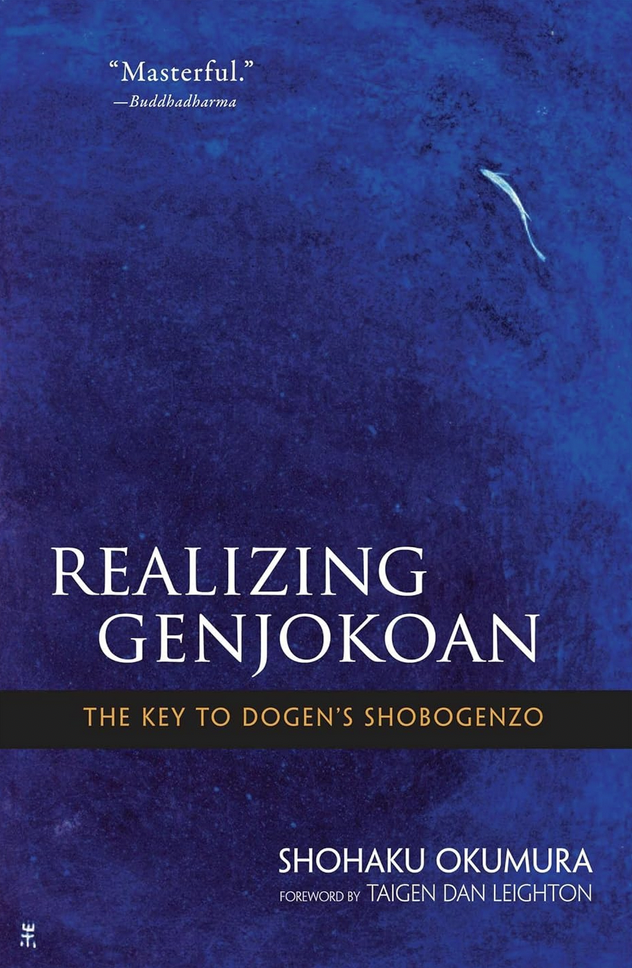
Shohaku Okumura – Realizing Genjokoan – The Key to Dogen’s Shobogenzo