Chinese have not been drawn to seek ‘a unitary and isolated term thereby able to be hypostasised [set as an underlying, fundamental state or substance that supports all of reality]. It has no more considered the atom to be a prime element that it has regarded ‘God’ to be an isolated creator: it has thought about ‘Heaven’ but in correlation with Earth, not apart from it. If the virtue of Heaven lies in its ‘initiatory’ capacity in the ancient Oracle of Change, it is because the Earth, at the same time and correlatively, applies its ‘receiving’ virtue. The Tao itself isn’t a monist term since it is only the regulated alternation of one and other, of yin and yang’ (François Jullien –“From Being to Living, p 61)
Contrary to what Westerners widely believe, “meaning” and “coherence” are not synonyms
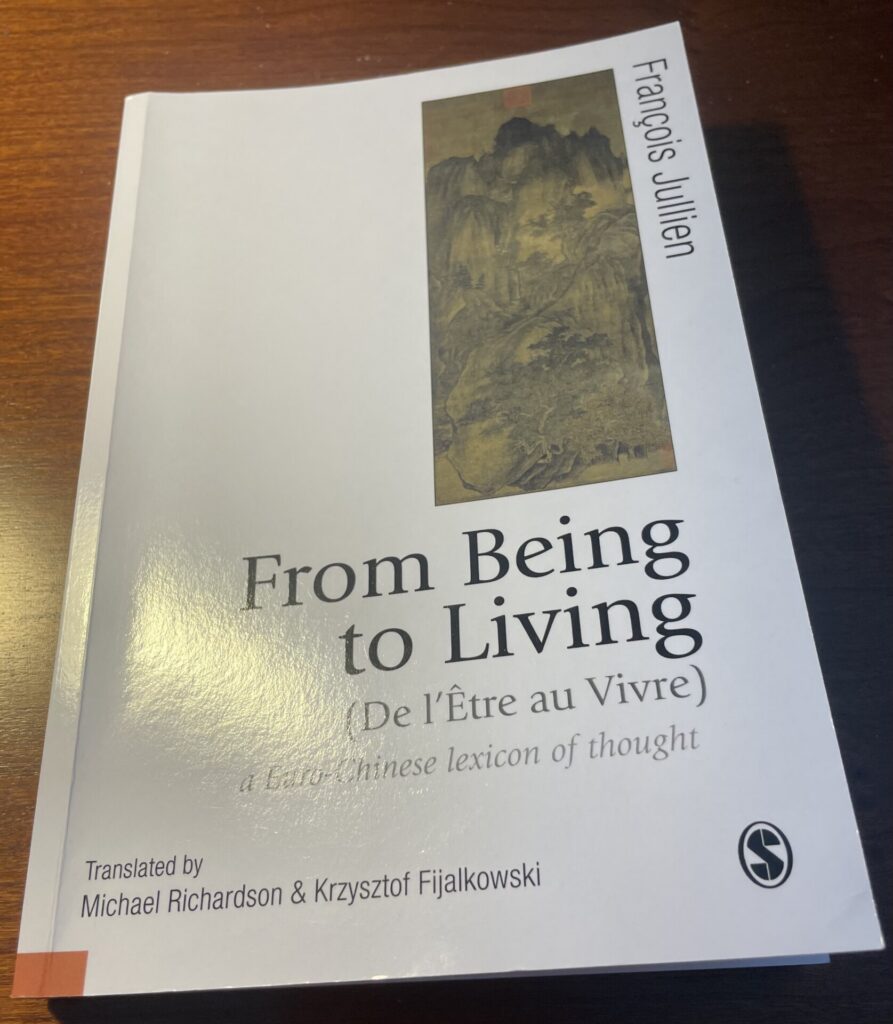
Even Freud, Jullien argues, believed that Sinn and Zusammenhang (meaning and coherence) were synonymous. So, before embarking on an analysis of what “coherence” represents for Chinese thinkers, we need to examine the reasons why the quest for “meaning” has been so unrelenting in the West. Jullien’s hellenistic training enabled him to return to the classical Greek roots of Western culture, particularly to Parmenides, Plato, and Aristotle. He writes: “The logic of Meaning is what we know best as the founding relationship of ontology. This begins with the reciprocal exclusion of contraries, between ‘being’ and ‘non-being’, or ‘truth’ and ‘opinion’, in Parmenides. It is then articulated through the Platonic theory of the communication of genres, … and finally it leads to the institution of the principle of non-contradiction, entailing in its wake that of the excluded middle as the axiom on which all discourse, logos, rests, and that anyone who wants to eliminate it still assumes as soon as he speaks.”
As a reminder, the principle of non-contradiction and that of excluded middle are two of the three laws of reason formulated by Aristotle (384-322 BCE). The first states that “it is impossible for a proposition to be both true and false,” and the second affirms that there is no middle ground or third way between truth and falsehood. [The third law is that of identity, which states that a thing is identical to itself.] Non-dualistic Asian philosophies reject the validity of Aristotelian laws of non-contradiction and the excluded middle beyond purely practical issues. Jullien explains further that for Aristotle, ‘to speak’ is ‘to state’ and to ‘state’ is to ‘say something’, legein ti: there’s always a ‘something’, no matter how indefinite it might be … So, to ‘state something’ is, at the same time, to ‘mean something’, somainein ti, which to be a meaning can have only one sense. Anyone who doesn’t respect this protocol of the word excludes himself from humanity.”
Although Heraclitus (c. 535 – 475 BCE) is routinely quoted as having elucidated what the West calls the “coincidence of opposites” when he argued that the world was held together by ”opposing forces dependent on each other,” his views were dismissed from mainstream European philosophy, so no equivalent of the Buddha’s doctrine of dependent co-origination, or the Chinese Huayan doctrine of “the interpenetration of all phenomena,” was able to develop in Europe.
Heraclitus: the coincidence of opposites before the birth of ontology
Still, Jullien remarks that Cicero wrote “the world is so coherent.” The word “coherence” comes from the Latin co-haere, meaning “hold together.” As hinted above, Jullien identifies Heraclitus as having been “the first in the West … to preclude ahead of time the development of the ontology that rested on the exclusion of contraries. By opening contraries up to one another without mediation, associating them opposite one another without even co-ordinating them, he explicitly took it upon himself to allow the fundamental coherence of things to come forth in his words in a way that ordinary discourse, that of signification, … only occults (an occultation that metaphysical discourse only ratifies): ‘God is day night, winter summer, war peace, satiety hunger’, he pronounced (fr 17). ‘Day night’, and not ‘day and night’… they must be kept correlated… Day-night, winter-summer, war-peace, satiety-hunger: strictly (selectively) speaking, there is no ‘meaning’ in them, but a coherence of opposites is maintained in an active state at the level of the word.”
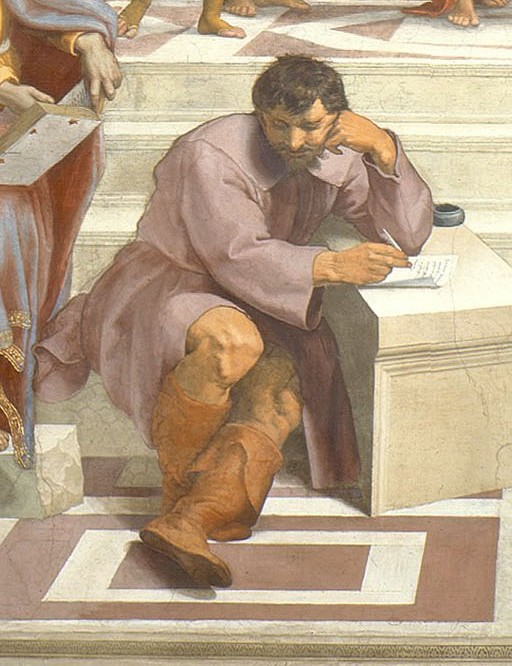
In his native Ionian island of Ephesus, the home of a famous temple dedicated to the goddess Artemis, Heraclitus had, in common with other Ionian philosophers, searched for an arche, as the underlying principle of reality. But, while others sought it in such elemental substances as water or air, Heraclitus saw it as fire, in other words, energy, reminiscent of Chinese qi, and he is well-known for having stated that “everything flows” (panta rhei). So, he, like the Chinese, saw reality in terms of change and harmony. This is not to say, of course, that Heraclitus found these ideas in China, but both he and the Chinese inherited them from similar earlier, pre-literate, native cultures.
Jullien is interested here in the contrast between the de-correlation of opposites carried out by Aristotle, the tutor of Alexander the Great, king of the militaristic kingdom of Macedonia, which then ruled over the whole Greek world, and the earlier iconoclastic figure of Heraclitus who, barely a century and a half earlier, had taken refuge in the mountainous solitude of Ephesus. In contrast to Aristotle’s principle of de-correlation of opposites through the law of non-contradition, Heraclitus had been “constantly signalling towards a con-joint of the world in various indirect ways. The contraries support and reveal each other mutually-contrastively: sickness put health to the test, as injustice does for justice. They go together, as do ‘mortals’ and ‘immortals’ collapsing into one another in the same way as ‘hot’ and ‘cold’, or the ‘living’ and the ‘dead’. While one pulls upon the saw, the other presses forward, and the one doesn’t go without the other; the movement is one beneath these opposing actions, and this goes against the unilaterality in which language ordinarly maintains us, and therefore goes against its native partiality. Indeed, as Heraclitus says, it is a matter of ‘what is opposed co-operating’ … it isn’t just an opposition.”
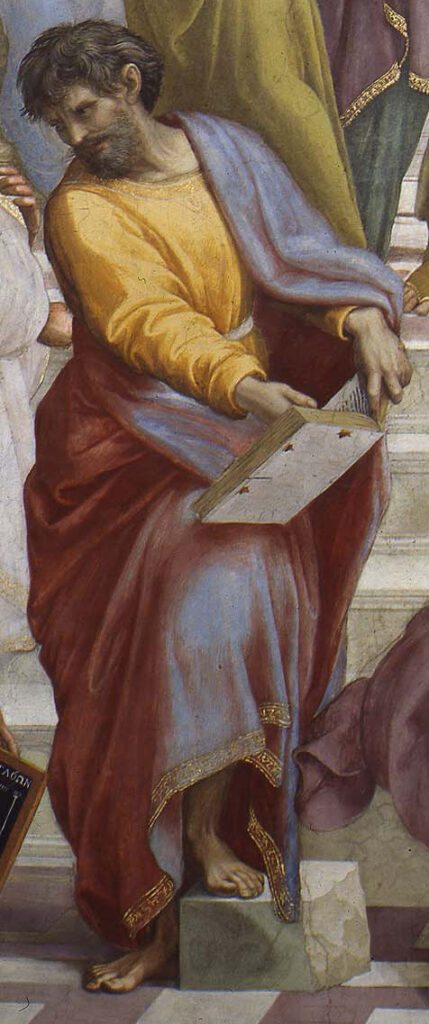
Jullien proposes the word “comprehension” as characterising the view held by Heraclitus in contrast to that expressed by the slightly younger Parmenides (c. 515 – 450 BCE) about the ‘disjunction of ‘being’/‘non-being’, from which Aristotle drew the principle of non-contradiction …‘Com-prendre’, is literally ‘to take with (cum; cf in Greek suniemi, a word privileged by Heraclitus) … But this com-prehension of co-herence is inevitably destined to be rejected by the semantic function when it is no longer understood … while Heraclitus, in following the path of non-disjunction, and consequently of de-exclusion, thereby widened the divergence from the logic of meaning, he has still been read and judged from the perspective of meaning, which has meant that this choice of meaning, definitely settled by Aristotle, has subsequently European culture, allowing ‘logic’ alone to subsist. This is why Heraclitus is called the ‘obscure’, skoteinos, as we find his words unintelligible.” It can be said that, in the short period between Heraclitus and Parmenides on one hand, and Aristotle on the other, roughly between the 5th and the 4th centuries BCE, because Aristotle chose to follow the disjunctive view of Parmenides instead of the comprehensive view of Heraclitus, classical Greece rejected the views which saw the very genesis of the non-dualistic “correlative” Chinese way of thinking. In Jullien’s words: “In setting out as a rule, and from the perspective of logos, the fact that ‘the word means something and means only ‘one’ that the meaning might have (or be) a unity, Aristotle established the word’s vocation as being to express the stable unity of things, thefore to speak in terms of ‘being’, and he instituted it ‘onto’-logically … Phenomenology itself struggled with it and was therefore most often condemned to endless arrangements that never lifted it up beyond this initial perspective, established as it was above all by (European) language and its grammar’. Yet,’ Jullien argues, ‘the interest in thinking through a principle of coherence is that the unitary it contains is not the supposed unity of meaning and, behind this, of essence, but that of a “holding together” that operates from the very fact of the internal relation, without there being any need for the support of Being and ‘substance’ … It’s the fact of creating a relation alone that then, but its own virtue, makes its force of correlation ‘relate’, and it does so in a com-prehensible way, one that is therefore to establish a rival rationality of signification. There is no further need for the invocation and imagination of the base and of the ‘sub’ (‘sub’-stance), of the ‘behind’ or the ‘beyond’ (of metaphysics) of support and foundation. Relationality possesses enough effectivity in itself to secure an intelligibility of what is existent. Con-sistency would therefore be opposed to essence, as coherence is, to meaning, or comprehension to separation.”
Chinese thought is a thought of coherence rather than meaning: it examines the con-sistency of things rather than enquiring into their essence and definition.
From the very structure of its language, which Jullien calls ‘parataxical’ [i.e.,placing short, simple sentences, clauses, or images side-by-side without using subordinating conjunctions to show their relationship], and very lightly regulated grammatical construction, the characteristic of the Chinese language was already to privilege what is stated by correlation (what is called, in an inadequate way ‘Chinese parallelism’), instead of engaging in the singularisation of discursive meaning’. Chinese think in terms of ‘coupled’ and ‘paired.’ Seen from the standpoint of Chinese thought, ‘the logic of meaning, as European thought-language for its part has developed it, is, inversely, constitutive … We find constitutive logic at the start of European physics as well: bodies are composed of atoms, by way of prime elements, stoicheia, as words are composed of letters, something Lucretius had already noted (whereas, as with the Chinese ‘five agents’, the world may be understood from correlated factors, wu xing). The same thing goes in painting … whose language was inspired in Europe by a compositional form of geometry’ while ‘Chinese pictorial language is essentially correlating, one feature calls upon another through opposition-compensation (the ‘full’ calls upon the ‘empty’, the ‘dense’ calls upon the ‘thin’, what lies ‘at rest’ calls upon what has been ‘raised up’), and when a ‘mountain’ is painted, ‘water’ accompanies it to give the landscape con-sistency’. In his book Living Off Landscape, Jullien explains that, “instead of the unitary term landscape,China speaks of an endless play of interactions between contrary factors that pair up, forming a matrix through which the world is conceived and organized, the vertical and the horizontal, high and low, immobile and impassive (the mountain) and what is in constant motion, forever undulant and flowing (the water), etc.”
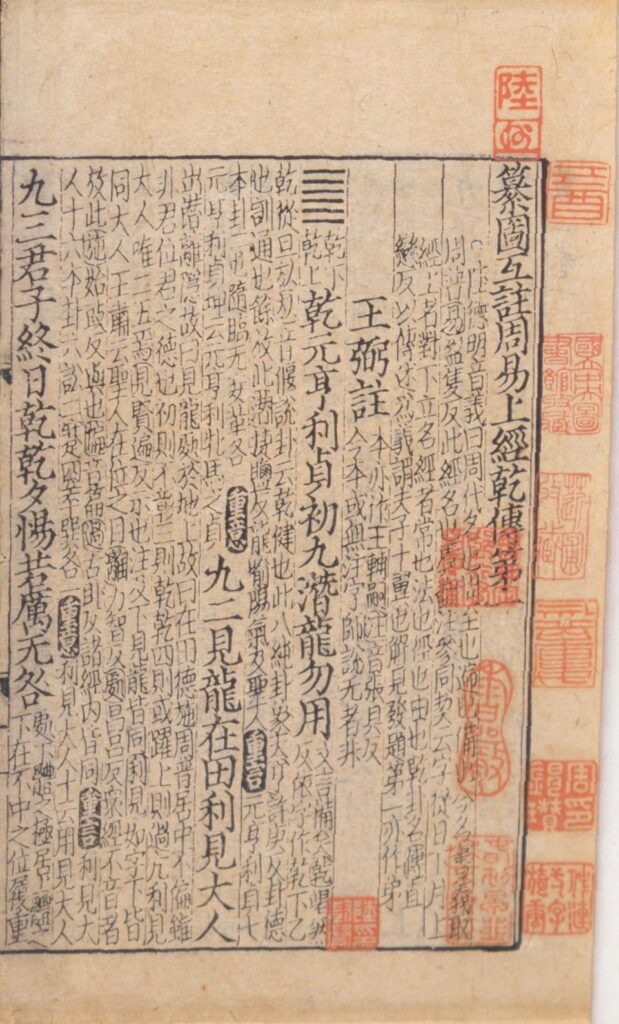
printed book of the I Ching (Yi Jing)
Because of their resonance with these correlations, Chinese have not been drawn to seek ‘a unitary and isolated term thereby able to be hypostasised [set as an underlying, fundamental state or substance that supports all of reality]. It has no more considered the atom to be a prime element that it has regarded ‘God’ to be an isolated creator: it has thought about ‘Heaven’ but in correlation with Earth, not apart from it. If the virtue of Heaven lies in its ‘initiatory’ capacity in the ancient Oracle of Change, it is because the Earth, at the same time and correlatively, applies its ‘receiving’ virtue. The Tao itself isn’t a monist term since it is only the regulated alternation of one and other, of yin and yang.” In the Book of Beginnings, Jullien gives the most convincing illustration for the correlative nature of the Chinese worldview: “In the Oracle of Change (Yijing), composed of successive layers during the first millennium BCE, and regarded as a foundation for the Chinese culture, sixty four hexagrams combine ‘two factors in correlation, yin – – and yang —, simultaneously opposite and complementary and holding all reality.” Its first ‘sentence’, as it were, is formed only out of yang lines, evoking the capacity of Heaven; the second is formed only out of yin lines, evoking the capacity of Earth … Forming a pair, with the six yang lines facing the six yin lines, these two initial figures comprise the total stock of the lines composing the series – or the energies invested – and represent the polarity of the whole. The first embodies what I will translate as the initiatory capacity, Qian, and the second, as the receiving capacity, Kun: as counterparts, they form the double door through which the process of things endlessly passes.”
“Li” as reason, an “operative art” illustrated by the veining of jade
Jullien ends the chapter with the well-known association of “li,” which Jullien translates as ‘reason’ which, in China, is not “just theoretical and speculative but implies an ‘operative art’ in itself. Far from referring to the expression as well as to the construction of an argument, as Aristotelian logos does, the written form of this term corresponds with the veining of jade. In order to be able to carve it, the lapidary needs to follow its conformation with his chisel; As hard as jade is, it is enough to find an intrinsic reason (li) in its layers in order to have no problem in turning it into a piece. This is what is called reasoning, li … This ars operandi will therefore elucidate the internal coherence within the lineaments of the slightest situation encountered. The situation owes its consistency to this and it is best to adapt one’s conduct to it in a comprehensive way. For what is the veining of jade that favours the splitting if not the unobtrusive vein, or internal fibre, by which this materiality is gradually organised in a correlative way and so structures itself? A veining of the stone, or a branching of the branch, or a texture of the leaf or the skin: in each case, the lines of separation are so many lines of force or of life whose twin network reveals a consistency in which these ‘branching out networks’ for ‘reason’ (tiao-li).’ Isn’t it the very logic of life in what today’s Western scientists describe as a self-organising universe?
Jullien concludes: “Therefore, far from claiming ideally to erect an order from a preset plan, or an optimum calculated and projected as an imperative, the Chinese thinker reveals an internal arrangement proceeding by coherence and making opposites ‘hold together’. He does this by following only those various fissures and lineaments according to which the compactness of things is allowed to be penetrated: hence he co-operates (with the process of things) rather than constructs (by composition) …The li [“reason”] is the configurational motif (wen) of the advent of things and the Tao is that by which all things occur.” This is why Hanfei said that “The Tao is what makes things happen through the li.” Whereas for Aristotle, there are two levels of “being” – the perceptible and its ground, in China it is a question of a before and an after of the same Process that continually – that is, without any metaphysical break – goes back to its ‘source’ (yuan): any advent of existence is configured according to its veining or the internal fibre as it is formed by correlation, to which it owes its coherence, allowing us to communicate directly through it with the great Regulation of the world.”
Sources:
François Jullien – From Being to Living, a Euro-Chinese lexicon of thought (2020-Original in French De l’Être au Vivre 2015)
François Jullien – Living Off Landscape or the Unthought-of in Reason (2018 – Original in French Vivre de Paysage)
François Jullien – The Book of Beginnings (2015 – original in French Entrer dans une pensée, ou Des Possibles de l’Esprit 2012)