
“The biblical account … leads to man: alone created in the image of God, he is given dominion over the rest of Creation, which finds its end in him. That the world is conceived with a view toward man is even more pronounced in the Yahwist account, in which God makes the the garden of Eden for him” (François Jullien – The Book of Beginnings, p 45)
Sinologist and hellenist François Jullien says that “it is not that European thought and Chinese thought are different in kind from one another in the sense that they represent differences of sensibility. Rather, over the course of their different histories, European thought and Chinese thought have taken divergent paths based upon concepts that were established in ancient times and continue to condition, if not determine, what it is possible to think in different contexts … The point of divergence – lies in what has been given priority.” (Introduction to From Being to Living). In the Book of Beginnings, Jullien goes back to the origins of Chinese thought in the Yijing which he examines in parallel with the origins of Hebraic thought as laid out in the Old Testament, and the origins of European thought in Greece. A first text was dedicated to the Yijing.
See https://buddhism-thewayofemptiness.blog.nomagic.uk/the-yijing-world-as-process/
Here we will focus on the creation narrative found in the Bible in parallel with the yinyang dialectical processual nature of the Yijing.
The First Sentence of the Yijing: “Initiatory Capacity” (Qian)

As a reminder, in The Book of Beginnings, Jullien first focuses on the very first sentence of the foundational text of each of the three traditions, which, he believes, has shaped the culture to an extent few of us are conscious of. As a reminder, in the case of China, the first “sentence” of the Yijing “is formed only out of yang lines, evoking the capacity of Heaven; the second is formed only out of yin lines, evoking the capacity of Earth … Forming a pair, with the six yang lines facing the six yin lines, these two initial figures comprise the total stock of the lines composing the series – or the energies invested – and represent the polarity of the whole.
Jullien proposed to translate the first hexagram, i.e., initiatory capacity (Qian) as follows: beginning (yuan)/expansion (heng)/profit (li)/rectitude (zhen). “Or, just as good: ‘to begin – to expand rapidly – to profit/to turn to good account – to remain sound (solid)’. Such an opening sentence … does not construct; it is content with simultaneously unbinding and binding. Each successive term takes over from the preceding one and deploys it; it proceeds from it, renews it, and carries it further.” In other words, it is “the successive stages of an unfolding … it less has a meaning, strictly speaking, that it develops a coherence. In today’s scholarship, this would be referred to as a process.
The First Sentence of the Old Testament: “In the beginning God created heaven and earth”
In the King James translation, the second and third sentences read:
“And the earth was without form, and void; and darkness was upon the face of the deep. And the Spirit of God moved upon the face of the waters.
And God said, Let there be light: and there was light.”
Jullien points out that the Bible and the Yijing (Classic of Change) are “the same age” and “carried the same weight in each civilization.” There is a parallel there, but, at the same time, it is clear that the authors of these two foundational books did not see eye to eye as to what the word “beginning” meant. The Chinese saw it as the initiatory capacity of a process, which they took to be taking place from an indefinite past to an indefinite future. The Hebrews and ancient Israelites saw it as the divine intervention of a creator God. Jullien sees in the latter the introduction of a “rupture” that is lacking in the Yijing. He writes: “Such a beginning, we calculate, is an irruption without precedent that likewise, in this block of primordial history, remains unreconcilable with all that follows, isolating itself from what follows, even if it plays a fundamental role in it. There it is, suddenly, abruptly, looming up, this beginning become event, and it is toward that fracture that it is aimed. In face of which we can begin to perceive how the beginning evoked in the opening of the Classic of Change is of a different nature: it is not considered from the point of view of the discontinuity that it could introduce but from that of the release it activates or, a better way to say it, that it ‘initiates’ and that, from there, can expand and develop. Thus if we are to enter into Chinese thought, we first of all have to make this differentiation: to conceive of what I will call the initiator (the notion of ji in the Classic of Change) as opposed to the event” (TBOB, 40).
“Creation” versus “Initiation”
On the Chinese side, “To initiate does not signal a break-in … rather, an interaction is subtly produced, an incitement occurs; an orientation evolves and begins to make its way … the beginning evoked does not detach itself but engages.” In Genesis, “this other beginning sets in motion – and most important, in an imperceptible fashion – an operativity. The Genesis beginning opens a way of thinking of time (and, first of all, the framework of the week); the Chinese beginning, a way of thinking of processes (claiming only unfolding and duration).” A factor that contributed to this contrast is that unlike Indo-European languages and Hebrew, “Chinese is not conjugated; it is expressed, as it were, in the infinitive … Thus the indexation or temporal localization, as well as the assignation to a subject, are not necessarily indicated” (TBOB, 41). Would the West’s central focus on the Self go back all the way to the concept of a Creator somewhere in ancient Babylon?
“Intervention by God as subject” versus “no need to posit God”
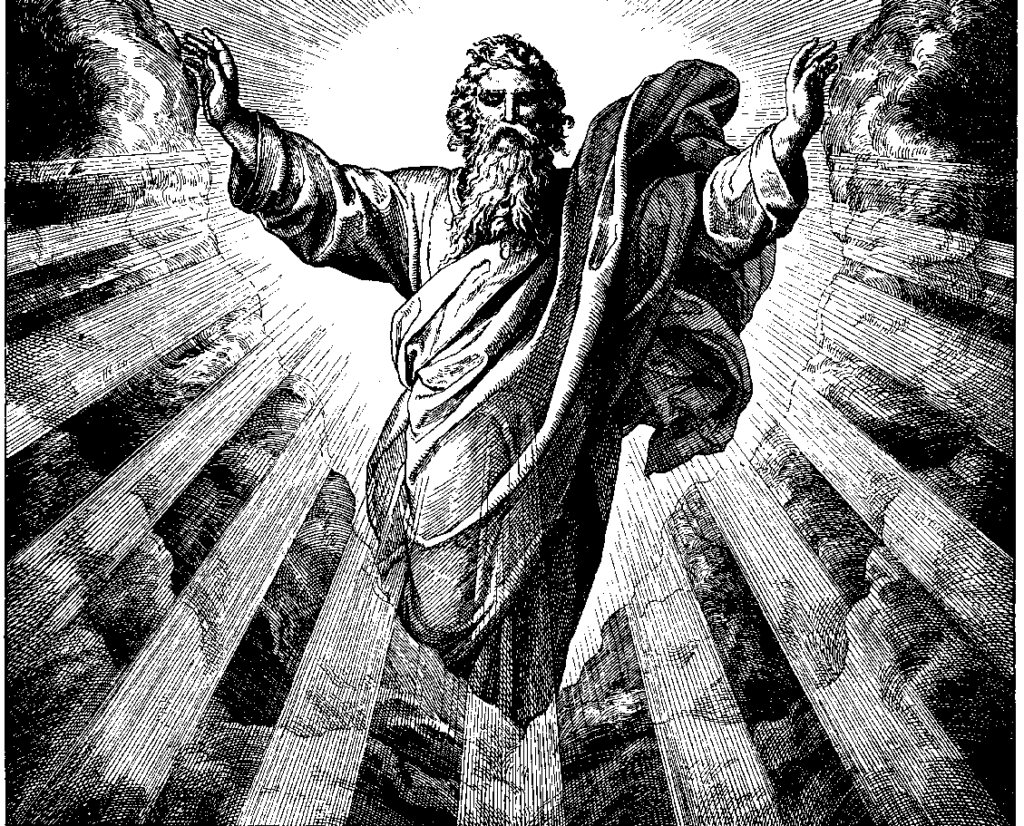
Jullien explains: “Because the biblical beginning is conceived as a break-in, it is perceived as intervention; it makes a Subject (of the creation) suddenly appear, Elohim: “In the beginning God created heaven and earth.” As such, he is posited as the Other and remains external to and uncontaminated by what he makes, ‘creating’ the world but not dependent on it”.His spirit (breath) ‘hovered over the waters’ but … does not enter into the play of interactions, … he projects his sovereign will as he verifies the results of it afterward each stage: ‘and God saw that it was good’.” Jullien can now say that “as a result, we can read better, by contrast, what was understood on the Chinese side: if there really is a celebration of the initiatory Capacity, from which what makes the world endlessly proceeds, it is no longer necessary that as Subject emerge, that an Agent be distinguished.” Again, the Chinese language, this time, its grammar or rather, lack of it, plays a part, as “it does not distinguish between active and passive voices.” And of course, when one thinks in terms of processes, no external subject is required for any particular event to take place. In Jullien’s words, “Nothing, consequently, can suddenly rise up separated from the course of things; no instance is isolated. If there is an absolute, it is not dissociated from the world but it is in the ‘way’ of it, the tao, borne along at full speed: no Will presides there, but what makes up its viability is continually ensured. China had no need to posit ‘God’” (TBOB, 41).
Creation as rupture from chaos versus deployment in an internal mode as regulation
Given the parallel roles the two texts played in their respective culture, Jullien asks once more: “On either side, wouldn’t the concern be the same: To make a world appear, a Weltordnung, to be renewed in the community or society? Attention is thus focused, for both sides, on the specifications: ‘The beings, according to their category, flow [into] their actualization’, says the Chinese; and God created the beings ‘according to their kind’, the biblical side repeats.” So, whereas, on the Chinese side, “beings, i.e., the ‘ten thousand things’, flow out of the Dao, a process involving both Heaven and Earth (rather than directly from Heaven (Di) which could be regarded as a deity), in the Genesis, the new order is established progressively, as light, which God summons in the third verse, causes discrete shapes to emerge out of the darkness, the initial chaos evoked in the second verse – what we would now refer to as the activity of differentiation. Jullien points out that “this darkness is nothing but a vestige, unespurgated, drawn from the old cosmogonic resources; otherwise it would be illogical: since the order of Creation is affirmed by rupture and something like break-in, it must necessarily detach itself from an earlier disorder, a mumbo-jumbo of the unformed. It could not otherwise make an event that could be announced.” Jullien can now conclude that, “With all this in mind, we can more easily take measure of what, in contrast, makes the processive order so original on the Chinese side: it is not brought from Beyond, not introduced, but neither is it progressive: rather, it is deployed in an internal mode, sua sponte, which could be called “natural.” In short, it is not a matter of introduction but of what we must think of as “regulation” (TBOB, 43)
“Light contrasted with darkness” versus “vast light throughout the process”
From these contrasting views, Jullien identifies a divergence in the role of light in the Bible, where “the light comes to oppose the darkness, even if it then combines with it to establish an alternation” whereas in the Yijing, “the light accompanies all unfolding in its continual transition, from the “end” to the “beginning.” The commentary on the first hexagram of the Yijing talks about a “vast light” which “illuminates the course of things without allowing shadow; it does not have to liberate from negative powers, like a weapon brandished upon encountering them. It does not have to save from the darkness”(TBOB, 42-43).
“Heaven as a the dome of the firmament” versus “Heaven as a bottomless Fund of Process”
Additionally,“in the Bible, heaven is reduced to being no more than a solid surface, the dome of the firmament separating, on either side, the waters that will form the ocean from those that will fall as rain. Whereas, in China, ‘Heaven’ becomes the first term establishing our confidence in this continuum issuing forth reality-viability (tao, the ‘way’, both terms say at once). ‘Heaven’ which prevailed over the idea of a Lord above, or Shangdi, until it was edged out at the end of Antiquity, comes to name this bottomless Fund of Process, which, because it does not deviate, is led to renew itself: because the capacity for ‘beginning’ ‘commands’ in it, it is not threatened with drying up, and that is why it is celebrated (TBOB, 44).
“Orientation” versus “regulation”
Jullien writes: “I will turn my intention to this idea of regulation that the Chinese Heaven embodies because that is where, it seems to me, the gap with the Bible is concentrated… Just as process is opposed to progress, regulation is thought of in contrast to orientation (destination), an idea that prevails in the biblical revelation. In the account in Genesis, this orientation takes us from dwelling place to dweller: a world must be laid out, separate from its elements, so that God can then populate it with living beings who are its ornaments and constitute his ‘army’.” He further explains that, in the Classic of Change commentary, “‘each ‘position’ the initiatory capacity occupies comes ‘in its time’; or each of the six lines that it ‘mounts’ like ‘dragons’ in the figure (of the hexagram) equally comes to pass ‘according to the moment’.” Wherever linear progress can’t be found, we usually look for cycles. The deployment which unfolds in the Yijing is not a cycle. “Rather,” Jullien says, “the same ‘harmony’ is maintained throughout the unfolding. What distances this from the Bible is that it is not toward perpective or End … that this process can lead (TBOB,45).
“The biblical account leads to man”
But, not only does the biblical Revelation leads to an End, but this End is man. Jullien writes: “The biblical account, on the contrary, leads to man: alone created in the image of God, he is given dominion over the rest of Creation, which finds its end in him. That the world is conceived with a view toward man is even more pronounced in the Yahwist account, in which God makes the the garden of Eden for him.” This, by contrast, makes us realise that “man” is not even mentioned in the Chinese sentence! Not that he is absent of course, Jullien hastens to say, but “he remains included, and does not stand out in this web of countless knots – warp and woof – as the Chinese metaphor says (jing-wei) – as it weaves the process of the world. Man is immediately part of the ten thousand things, wan wu (the original referent, we will recall, is the plow ox). He is then implicit in the idea of individuation that renders ‘nature’ correct in forming itself into ‘fate’; and finally he is found again in the ‘ten thousand’ of the ten thousand realms or principalities for which, within this regulation of the whole, ‘peace’ is ensured. But he does not, apart from other beings and in isolation from them, give rise to destiny itself …he does not emerge a subject bearing within himself the vocation of the world” (TBOB, 45-46).
Creation sees itself only in relation to the quest for Salvation that it opens
Whereas in China, man is included in the ten thousand things, in the Genesis, as created by God, man is separate from God. And, Jullien says, “With the loss of proximity (to God) comes the simultaneous discovery of access to a responsibility (reverting to man) that sets History in motion, and thus ensues an essential ambiguity in which the human condition is played out. More generally, we know that Creation sees itself only in relation to the quest for Salvation that it opens. It cannot be understood separately from the question of the outcome of the History that it starts, the end shedding light on the beginning, or the eschatological alone effectively accounting for the origin.” The account of the Creation was composed with a view to provide a Meaning. In Jullien’s words: “faith in salvation projected itself onto the beginning in order to better grasp where its potential came from (TBOB, 46).”
The Yijing’s sentence does not explore a “meaning,” it elucidates a “coherence.”
Jullien writes: “Meaning and coherence (Sinn and Zusammenhang) which we ordinarily take to be equivalent … seem to me, in this light coming from China, in fact to be opposites of one another, even to expel and exclude one another, like Revelation and Regulation. Meaning appeals, incites; takes root in the lack, opens onto a beyond, signals toward the absent or the unknown. For this reason it provokes tension, responds to anxiety. Coherence, for its part, is not and does not get excit/ed/ing; it does not want to discover anything hidden, curtails nothing, extends nothing, aims at nothing; it neither awaits nor arouses. It is indissociable from what is traditionally so potent in China but so flatly rejected by our culture: ritual, but only ritual that is properly (truly) functional … Because this ‘co-herence’ literally ‘hold together’, instead of pursuing the rupture and adventurously exploring, instead of setting in motion a History (from Fall to Salvation), it puts in place a mechanism (that of reality-viability, ti-yong); far from responding to a why, it proposes to dissolve the strangeness” (TBOB, 48). If this is still felt by the Chinese today, they must find it hard to understand the “crisis of meaning” which the West is said to be going through at the moment. Given the multiple threats the world is facing today, it should not difficult to find something meaningful to engage with!
In the Bible, this perspective of Meaning finds itself immediately conveyed by the Word … God creates by the word.
From the third line onwards, God calls all things into being:
“And God said, Let there be light
And God saw the light, that it was good: And God divided the light from the darkness.
And God called the light Day, and the darkness he called Night. And the evening and the morning were the first day.
And God said, Let there be a firmament in the midst of the waters, and let it divide the waters from the waters …”
And so on, for six days, after which God rested.”
Was this fairy tale really meant to “explain” how everything around us came into being, or was it simply a story intended to present the week as a division of time into blocks of seven days, including a final day of rest at the end? Jullien does not ask. He accepts the claim that this is a metaphor for the way the things we see came about through naming. And, centuries later, Heraclitus, Plato and Aristotle did indeed equate the being/existence of a thing with the word used to name it. Though they were both Greek rather than Hebraic, and engaged in philosophy rather than in religion, they were so persuasive that, over two millennia later Alfred North Whitehead could write that “The safest general characterization of the European philosophical tradition is that it consists of a series of footnotes to Plato.”
Jullien comments that the efficacy of God’s word “lies in both sorting out confusion and summoning forth existence … and because God makes the world come into being through his word, all man’s word can be understood only as response to God.” The contrast with China’s “silence of the processes” could not be more striking.
What is God in the last analysis if not the Other who speaks to me, to whom I can address myself? The Chinese answer: “the seasons follow their course, ‘beings, so numerous, ‘come to pass’: what need would Heaven have to speak?”
In the end, the representation of God as creator may be rooted in the psychological need to “converse” with the “Other.” In Jullien’s words, “God ‘exists’ insofar as I address myself to him and he addresses himself to me. It is this function that constitutes ‘God’.’” Or “‘God’ merges with this possibility of appeal.” Jullien notes that “we do not see the theme of the ‘interior’ voice penetrating ancient China, voxrather than via, the “way,” the tao of viability” (TBOB, 49).
Jullien concludes: “This definitely separates ‘God’ from the initiatory capacity and its combinatory of lines, in the figure of the hexagram, as markers and vectors of energy. Because Chinese thought clearly knew the demand for an Unconditioned, otherwise called an absolute, they named it ‘Heaven’, but ‘Heaven’, says Confucius, ‘does not speak’, (Analects XVII, 19). The seasons ‘follow their course’, beings, so numerous, ‘come to pass’: what need would Heaven have to speak?” (TBOB, 50).
Source:
François Jullien – The Book of Beginnings (2015 – original in French Entrer dans une pensée, ou Des Possibles de l’Esprit 2012)
A study of the Greek tradition in parallel with the Yijing and the Bible is available on https://buddhism-thewayofemptiness.blog.nomagic.uk/yijing-bible-or-theogony-process-creation-or-generation/