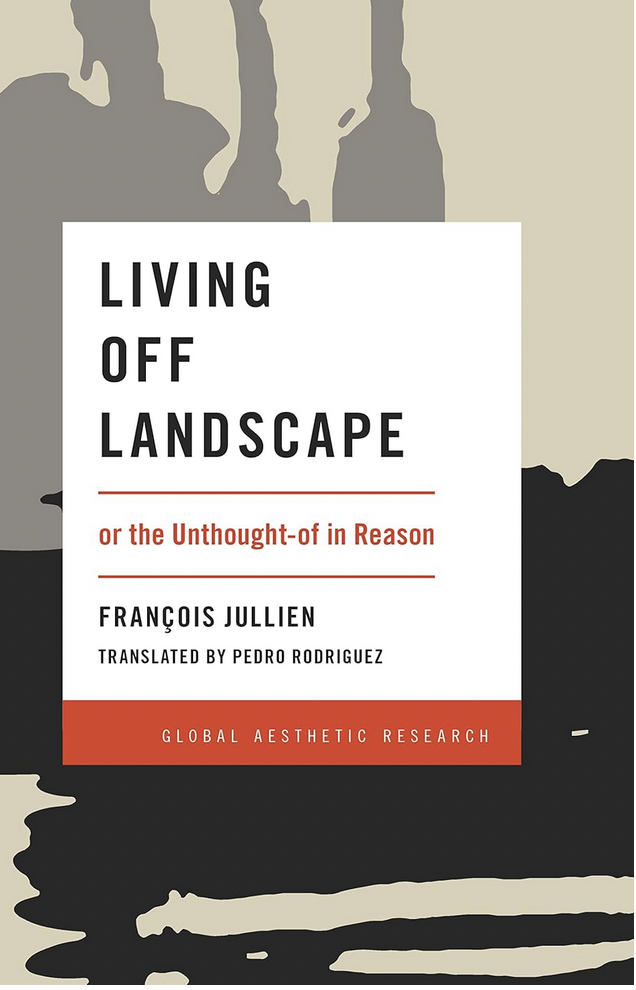
“To say ‘thing’ in Chinese, even in modern Chinese, you utter not a unitary term, not ‘thing’ not a thing you attend to, or ‘make your business’ (and not ‘res’, substance, either), but east-west’, dong xi …” What is primary, what denotes, is the fact of the relation.” (François Jullien – Living Off Landscape p 20).
Landscape as the part of the land that nature presents to an observer versus landscape as a relation
“We can pause before the landscape as before a ‘spectacle’… We can look upon it from a ‘point of view’, take in its harmony and variety, admire its composition … we can also sweep our gaze over the panorama, declaring, ‘How lovely!’ and be on our way” (LOL ix).
“But,” François Jullien adds in the prologue of his book Living Off Landscape, “a landscape can be something else entirely.” He invites us to share the way ancient Chinese have apprehented what we call “landscape,” something we can feel, rather than just look at, an experience rather than a “thing” among other things. He writes: “It can draw us into the ceaseless play of its correlations and stir our vitality with its various tensions. A landscape’s remove [lointain] – its sense of the faraway – feeds our reveries and lulls us into “dreaminess.” In a landscape the perceptual becomes affectual. The physicality of things turns evasive and suffuses with an infinite beyond. The divide between the sensible and the spiritual is sealed at last. Landscape … ceases to be something merely to ‘look at’ or ‘represent’. It hooks into the vital” (LOL x).
“Something to look at” or “represent” is precisely the way the West defines the word “landscape.” In chapter 2 of From Being to Living, titled “Potential of Situation (vs Initiative of the Subject),Jullien defines the landscape as follows: “Landscape is the ‘part of the land’, as the dictionary still says, ‘that nature presents to an observer’, who delineates it according to his perspective so that this horizon modifies itself in step with how he is positioned.” In other words, Jullien adds: “The Subject is in the presence of the landscape, which is external to him and remains autonomous; he is not implicated in it’ (FBTL 8).
Neither the Bible in the West nor India in the East talked about “landscape,” they only talked about “gardens,” and in the West the term only goes back to the Renaissance when it “was developed by painters and for painting” through an exchange between Flemish and Italian masters. “Landscape” became a near tautology for ‘painting depicting a landscape’, and then came to refer to the pictorial genre itself … Landscape painting was … born of a change in the art, but for a long time before then all it did was fill the ‘empty corners’. It was background, decor.” Then, “it was promoted with the boom in representation, only to be cast aside in the 20th century” (LOL x).
“Mountain(s)-Water(s)”: a correlation of opposites
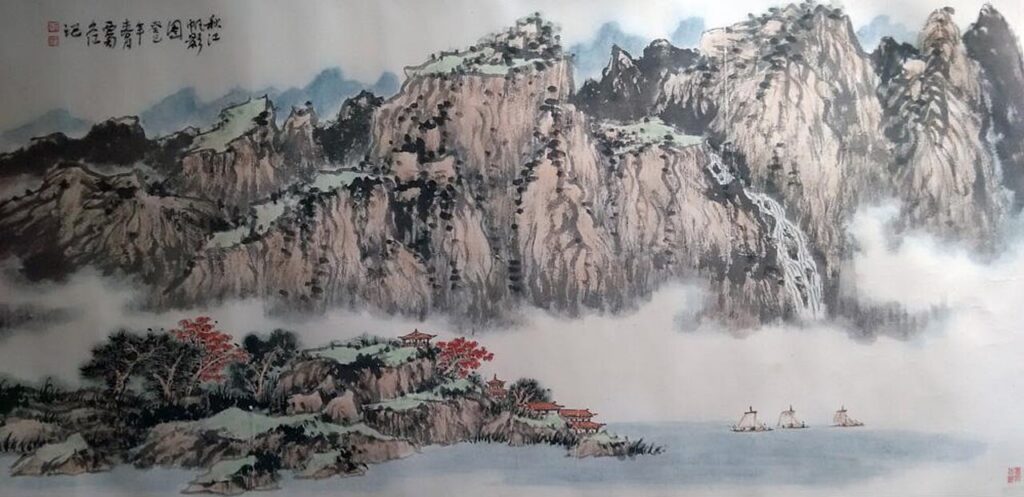
In China, the term dates to antiquity, though it is “as current now, in modern Chinese, as it was then” and “breaks radically with the semantics of the expanse, the view, and the cutoff.” It does not refer to “a portion of the land offered up to an observer’s eye but [to] a correlation of opposites: ‘mountains’ and ‘waters’” (LOL 14).
In more concrete terms: “We have what tends towards heights (the mountain). The vertical and the horizontal, High and Low, at once oppose and respond to each other. We have, too, what is immobile and impassive (the mountain) and what is in constant motion, forever undulant and flowing (the water). Permanence and variance are at the same time confronted and associated” and so on. “We have, moreover, what possesses form and presents relief (the mountain) and what is by nature formless and takes the form of other things (the water) … Instead of the unitary term landscape, China speaks of an endless play of interactions between contrary factors that pair up, forming a matrix through which the world is conceived and organized” (LOL 15-16).
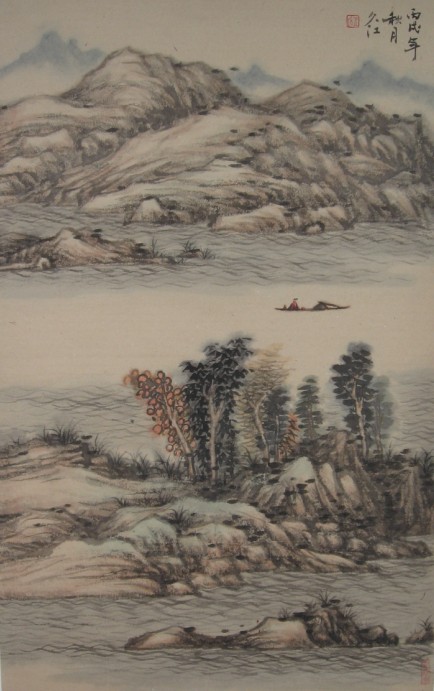
In From Being to Living,” Jullien also contrasts European thought where, from Augustine to Descartes, the self-subject has been a point of departure, with Chinese thought, which instead focuses on the “potential of the situation.” It is this emphasis on the self-subject that has led Europe to privilege the vantage point of the individual, and with it the sense of sight. “Against this monopolizing power of sight,” Jullien tells us, “China offers the essential polarity through which world-stuff enters into tension and deploys. No human-stuff detaches from this. The human remains implicit, contained within these multiple implications, because the vis-à-vis thus established lies within the world; it is between the ‘mountains’ and the ‘waters’ (LOL 16). In other words, the world is not perceived as standing in front of us. Instead, we find ourselves “between” mountains and waters, and all the poles of correlative opposites. The same emphasis on “betweenness” is found in Watsuji Tetsuro, a Japanese thinker associated with the Kyoto School of Philosophy, who put this notion – aidagara in Japanese – at the very centre of his ethical investigation.
Jullien writes: “China’s opposing-correlating ‘mountain(s)’/‘water(s)’ instantly plunges us into the network of factors that give rise to the ‘world’ – through which ‘there is world’ and that keep it soaring [en essor]. We find ourselves immersed in it. There is no ‘nature’ that ‘presents to the eye’, for nature is nothing but the continual interaction between the aforementioned poles and will not be instantiated as a separate agent … The vantage point of no subject casts its partiality over the cooperation of factors concentrated in landscape” (LOL 16).
What advantage might China’s approach to what we call “landscape” provide us over the traditional European approach?
Answering his question, Jullien writes: “The European tradition has only gone in circles, returning time and again to the obstinate semantics of ‘land’/‘landscape’ … We have remained beholden to the semantics of land/landscape and to all that they imply. The semantics are sediment now. They amount to a choice that we do not realize has been made” (LOL 17). As ideas frozen into concepts once and for all, semantics “fold” our understanding in ways that shape our apprehension of, and consequently, interaction with, reality that persists through time and accounts for the divergences between, for instance, Europe and China.
As we engage with Chinese culture, Jullien reminds us once again that “we find a chance to start afresh … We were not expecting this other possibility of thought … In truth, we had never imagined it … It is already ’speaking’ to us, though it costs us a complete reconfiguration, an as-yet-implicit reconfiguration, of our categories … At last we will stop allowing the mind to glide on the all-too-slippery walls of our familiar representations” (LOL 17).
“What lies between Heaven and Earth,” says Laozi, “is it not like a great bellows?”
“Now,” Jullien continues, “with every ‘vantage point’ withdrawn, there is no longer a world spread before me, detaching from the self-subject as a view or a spectacle, at once blocking the extension of my gaze and, by halting it, bringing it into focus. No longer ‘before’, I am now between. Now ‘I’ am integrated. ‘What lies between Heaven and Earth’, says Laozi, ‘is it not like a great bellows?’ The insufflation generated in the ‘interspace’ tirelessly imbues with life. Landscape – ‘mountain(s)’/‘water(s)’ – is the appreciable investment of this life. It immerses us instantly in the play of manifestations of energy, manifestations that both conflict and pair up. All vitality (we might as well call it reality) is there revealed” (LOL 18). Rather than being a “corner of the world, delimited by my vantage point, landscape in China is “always – within its very configuration … – the result or, better yet, the operation of the world in its entirety. Even as it individualizes it is, let us say, ‘cosmic’ … ‘Landscape arises’, Chinese tell us, when it forgets that it is a part and imposes itself instantly as a whole and when we find everything (all manner of things) in it, because everything in it is contrasted and conjoined” (LOL 18).
European thought has from the start, situated landscape within the logic of composition
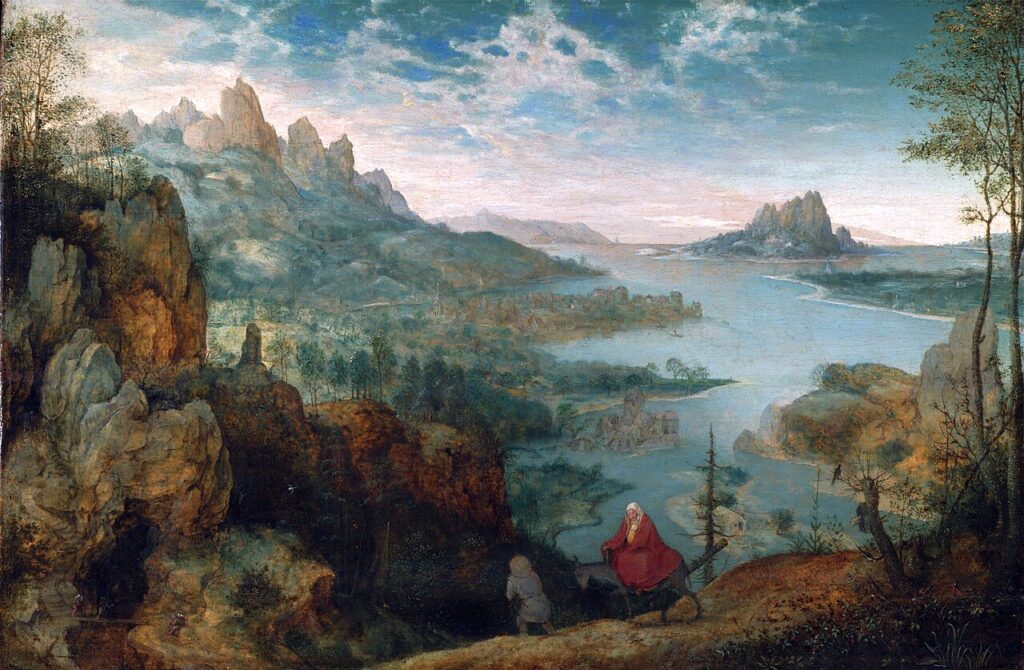
Jullien writes: “By thinking in terms of the paradox where a part is also a whole, European thought has from the start, situated landscape within the logic of composition, which ever since the Greeks has structured European reason with regard to things. The logic of composition exists at every level. All the levels align … The principle is always the same. We organize the field to be explored by detaching and separating it from a whole (showing the singular unit to be a whole) and, to reverse the procedure, by attaching it to and integrating it to with the whole (showing the whole to be a mere part). The two procedures go hand in hand. It is through com-position that we in Europe com-prehend … We have thought it universal because compositional logic is embedded in our language. Its fundamental schema, as the Greeks themselves observed, is the structure of the alphabet (letters, as units, come to compose syllables, words, phrases, and speech), and it has ruled over all knowledge … Such was the method of the mind itself, from Plato to Descartes. ‘Analysis’ divides into constituent parts, and ‘synthesis’ reassembles from these a coherent whole” (LOL 19).
Pairing: to say “thing” in Chinese, even in modern Chinese, you utter not a unitary term, not “thing,” but east-west,” dong xi,” a relation
Chinese do not see things as the ‘solid’ entities they appear to be at first sight, which can be disassembled and reassembled, but instead as “leaning,” as they are at all times “self-actualising” through the texture of the world. So, Jullien says, “logic,” in Chinese thought “proceeds not from composition but from what I have begun to call pairing. Here, ‘the one’ is never without ‘the other’. They are hitched together. Each is the other’s reply. In China to think is to ‘couple’, as the language itself demonstrates. Chinese writing is ideographic and has never known alphabetic composition’. In its brush strokes it alternates and correlates the ‘void’ and the ‘full’, the ‘high’ and the ‘low’, the ‘thick’ and the ‘thin,’ the ‘dense’ and the ‘sparse’, or what ‘tends’ toward, and what ‘turns his back’ (xiang bei) … Statements are made with respect to symmetrical others in opposition-coupling, as we see even in the earliest divinatory inscriptions, on bones and carapaces. As ‘Heaven’ responds to ‘Earth’,’mountain’ responds to ‘water’” (LOL 19).
In the sciences too, coherence has been achieved through pairing. Jullien gives a few examples: “Magnetism may have lingered in its infancy in Europe, but in China it developed early, precisely because the Chinese were so attentive to the phenomena of polarity and attraction. Chinese medicine, meanwhile, neglected anatomical knowledge and instead thought of our physical being as a whole of correlative factors. This whole was explored by the acupuncturist, each point of energy having its responsive counterpart … The philosophy of power, moreover, was in China never based on the composition of a body politic (no demos) but conceived as a correlation between the prince and the people (between father and son), each promoting its virtue with respect to the other in pure reciprocity … Dui, which even in contemporary Chinese signifies ‘just/apt’, or ‘exact’, designates the ‘couple’ or the ‘pair’. It signifies that the one forms a couple with the other; the one finds a partner, and thus also its ‘justification’, in the other” (LOL 20).
“To say ‘thing’ in Chinese, even in modern Chinese (it is one of the first words taught), you utter not a unitary term, not ‘thing’ (causa), not a thing you attend to, or ‘make your business’ (and not res, substance, either), but ‘east-west’, dong xi.” This term – this couple, – rather, exemplifies the essential correlation through which China approaches landscape: “mountain(s)”/“waters” … What is primary, what denotes, is the fact of the relation.Partners emerge in a vis-à-vis. They form an ‘east-west’. A tension is set up. An engendering of ‘world-stuff’ begins. And ‘mountain(s)’/‘waters’ is the ‘landscaped’ manifestation’” (LOL 20).
“Chinese thought achieved its originality when, in Chinese antiquity, it plucked Heaven from its isolation and coupled it with the Earth”
The reader has probably wondered why Jullien has not already mentioned yinyang, which, Robin Wang insists, should be written in one word, because it is how the pairing of the one as two has come to be known. No doubt Jullien was wary of its being misinterpreted merely as the intertwining of two opposite, but independent, forces. Jullien writes: “Yin/yang penetrates so straight to the heart of the exceedingly general logic of pairing that we no longer translate it. From the apex down, a mountain’s two sides diverge, one remaining in shadow while the other is lit by the rising sun (adret and ubac, in the primary sense of the terms), but each remains indissociable from – and indeed inconceivable without – the other. The same goes for heaven and earth, the ‘hard’ and the ‘soft’, the ‘initiator’ and the ‘receiver’ (the first two figures of the Classic of Changes, or I-Ching), the masculine and the feminine, or the prince and the people. The one exists only in opposition to the other and only by virtue of its inseparability from the other. It ‘is’ only in relation with the other” (LOL 21).
This is why the Chinese language “cannot properly say ‘I am’, ego sum’, and thus does not conceive of an insular, let alone solipsistic, ‘I’. It does not conceive of the very ‘I’ that detaches itself in the ‘vantage point’’ (LOL 20-21). This, then, is the way Chinese encountered the notion of no-self, which Indian Buddhists approached, and defended, as the negation of an individual atman (anatman), together with the doctrine of co-dependent origination (all things arising as pairs of opposites) based on the awakened insight of the Buddha. “In the same way, the ‘mountain’ is not thought of, does not exist, ‘in itself’, apart and withdrawn in its essence. The ‘mountain’ assumes – necessarily calls forth – its partner: the ‘water’. Yin/yang speaks to the interaction of factors or ‘capacities’ at work in all polarity (de). ‘Heaven/earth’ denotes the instantiated global framework. Indeed, Chinese thought achieved its originality when, in Chinese antiquity, it plucked heaven from its isolation and coupled it with the earth” (LOL 20-21). Wang says that it is in the Shijing (The Book of Odes), one of the Five Classics, attributed to Confucius, that the words first appear together in the following sentence: “Viewing the scenery at hill, looking for yinyang.”Wang comments that this “indicates that yin and yang in their earliest usage were separate geographical terms used for specifying a location.” She also says that, inasmuch as it is connected with the sun, which provided “a clock for daily routines, [as] farmers depend on it for light, which in turn dictates the daily rhythm of human life. As the Shijing says ‘when the sun is coming out, one goes to the fields, and when sun is going down, one goes to rest’. The steady rhythmic alternation of yin and yang can be seen as expanding from this basic human experience.” So, once again, a central concept of Chinese thought was expressed with terms belonging to the vocabulary of the natural world, something that cannot be found in either ancient India or Greece.
“Mountain(s)”/“waters” does not drift so easily into abstraction and instead keeps us in the “being-there”
On both sides, the Chinese and the European, thought has been shaped by semantics – the words we use – to a point we do not suspect, because we are “‘ensnared’ (imprisoned) in its coherence.” Jullien says: “Each is walled-up – and sits mute – in what it sees as obvious; each finds comfort in its biases.” On the European side, the phonetic writing with its elaborate syntax and grammar has encouraged venturing into abstraction. On the Chinese side, however, Jullien tells us that “‘Mountain(s)/‘waters” does not drift so easily into such abstraction. ‘Mountain(s)’/‘waters’ keeps us in the ‘being-there’ (da sein) of polarized tension and the contrary capacities that pair off therein. Confucius was already drawing a parallel between the two terms. When he says that the ‘wise man’ likes (‘finds pleasure in’) water and that the ‘good man’ likes (‘finds pleasure in’) mountains (Analects, VI, 21) both water and mountains retain their strict sense even as they symbolize. There might be a preference for the one or the other, water or mountains, because of their respective attractions: that is, insofar as they are poles generating an affinity. The ‘wise man’ likes water because his intelligence is supple and fluid, like water itself, whereas the ‘good man’ likes mountains because he is firm and constant, like the mountains themselves. This, Confucius goes on to say, is why the wise man is drawn to ‘motion’ and the good man to ‘calm’. Alternatively, this is why the wise man tends toward joy (in the moment): water is endlessly renewing itself as it follows its course. The good man, meanwhile, tends toward longevity: the mountain, ever stable, is changeless” (LOL 21-22).
When it saw the light of day in China, as early as the start of the fifth century, landscape poetry was conceived – and presented – as a simple connection of “mountains” and “waters.”
Jullien could not end the chapter without mentioning Chinese landscape poetry – Shanshui shi – literally “mountains and waters poetry” which developed in the third and fourth centuries. Quoting four poems word-for-word to respect the effect of continual coupling, he shows that “the idea is less to contemplate than to anchor ourselves in [the landscape] and dwell there” (LOL 25).
One of the examples quoted reads word for word as follows:
Repair – house – leans out over – sinuousness – rivers
Erect – belvedere – lay basis for – succession – summits
Jullien comments: “Rather than consider the landscape from a single, privileged point (the ideal position of a dominant ‘subject’) … and enjoy the widest possible field of vision (the ‘beauty’, we say, of a ‘panorama’), we instead establish two respective and reciprocal positions within the landscape itself. We do it enduringly (we build). These positions in turn oppose and respond to each other, and allow us to envisage the landscape, alternately, from the one or the other: from high to low or low to high, from an overlook onto the river or from a base at the foot of the mountains. Between them immersion takes place” (LOL 25).
The word ‘look’ which is key to the European definition of landscape, is not, Jullien tells us, a unitary verb in Chinese. It is neither neutral nor general. Rather, we utter it differently depending on our position and the manner of our looking. [The] poet … might just as easily say ‘(look) obliquely’ (lai) as ‘(look) with a turn of the head’ (gu), ‘(look) with an opposite turn of the head’ (juan), ‘(look) in contemplation’ (lan), ‘(look) wide-eyed’ (tiao), ‘(look) with absorption’ (du)’, and so on. These are so many different ways of engaging with the world, ways that will not be subsumed under a single concept of vision. ‘Look’ will not be generalized from an attitude, will not be limited to the act of looking. It is behavioral as well … looking will not be separated into a pure faculty of knowledge or enter into a neutral face-to-face with things) which under the tension of a divide, go by the name ‘east-west’ in Chinese. From this ‘east-west’ the poet extends the couple to the landscape, for a complex (‘cosmic’) pairing” (LOL 25).
Turn the gaze – west – one would say – rise – moon
Turn the gaze – east – one wonders – set – sun
In ‘turn the gaze to the west’ / ‘turn the gaze to the east’ we plunge into the clockwork of celestial motions … All landscape apprehended in the play of correlations is the entirety of the world in its vibrancy: not a world that beckons from Elsewhere but a world perceived in the to-and-fro of its respiration. This same tension of living is what Chinese painting captures in landscape” (LOL 25-26).
Sources:
François Jullien – Living Off Landscape or the Unthought-of in Reason (2018 – Original text in French Vivre de Paysage)
François Jullien – From Being to Living, a Euro-Chinese lexicon of thought (2020-Original text in French De l’Être au Vivre)
Robin R. Wang – Yinyang: The Way of Heaven and Earth in Chinese Thought and Culture (2012)
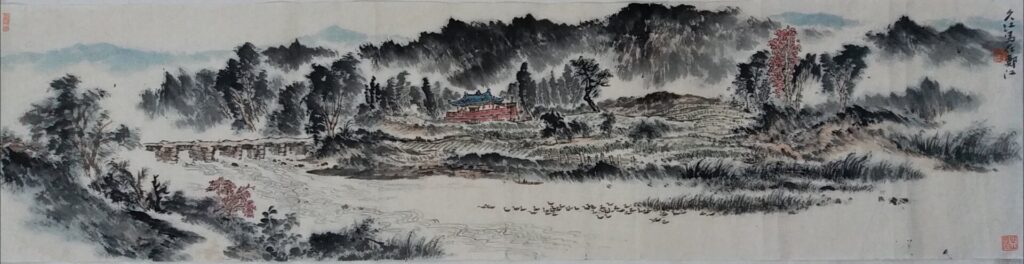
a shan-shui painting created by Uang Chiu-chiang