
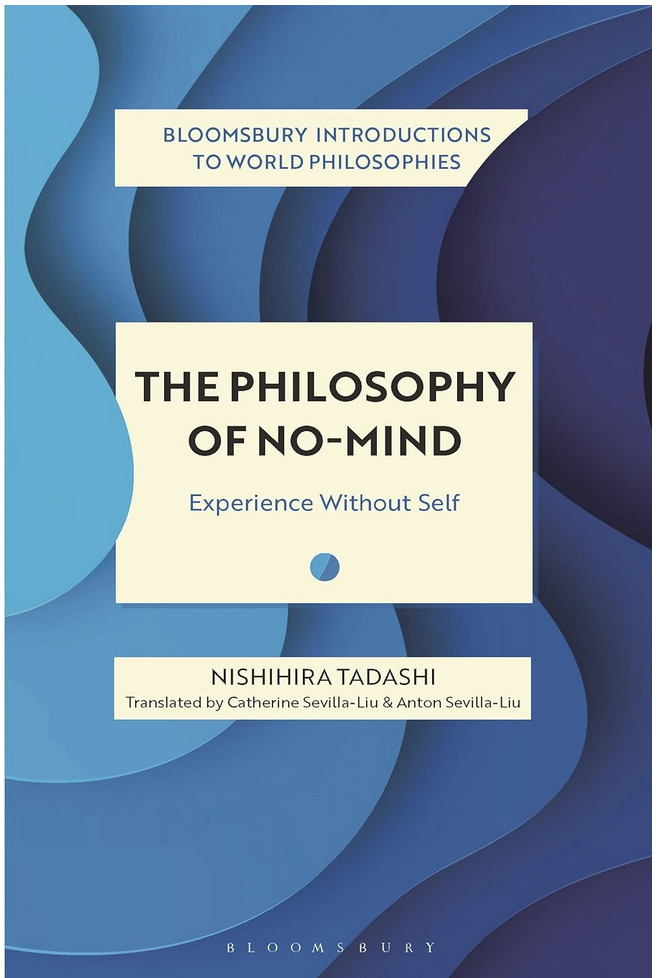
In The Philosophy of No-Mind – Experience Without Self, Nishihira Tadashi introduces “no-mind” (mushin) with the following quote by Kyoto School philosopher Nishida Kitaro:
“’Emptying the self and looking at things’, ‘losing oneself’ (bossuru) within things’, ‘mushin‘, ‘naturalness’ (inenhoni) – all these are states that the Japanese have long aspired to achieve.”
While this could definitely not be said of European and American people, I think it is probably fair to say that, even for those in the West who have a Zen Buddhist practice, i.e. a practice based on direct experience, the word “no-mind” (mushin) is still shrouded in something of a mystery. So what exactly is mushin?
Nishihira explains: “’Onore o munashu suru‘ means to make oneself empty (kara). It means not taking oneself as the center when looking at things, but rather, entering into things. One negates oneself and becomes that thing. This event is called ‘mushin‘, which Nishida took up alongside ‘naturalness’ and spoke of as something that Japanese pine for, long for, … and hold in high esteem.”
Nishida here shares the view his life-long friend D T Suzuki developed in a book entitled On No-Mind, where he describes mushin as close to Zen Master Dogen’s ‘pliant mind’ (nyunanshin), meaning ‘to think, having become the thing’, or ‘to act, having become the thing’. In a note, Nishihira adds that Suzuki was alluding to “Dogen’s response when he was asked after his return from China what he had learned. He answered that he had not learned anything of note but had merely attained ‘a pliant mind’. This pliant mind should mean truly becoming the thing and thinking or acting from this unity.”
Nishihira continues: “Acting, having become the thing” means that one does not take the “thing” as an object, nor divorce the thing from the I, nor place the thing before the I as something that is other than the self. It is not ‘I’ + ‘look at’ + ‘a thing’. Rather, the gap between ‘I’ and ‘thing’ disappears, and I become the thing. The ‘I’ (subject) does not stand independently on the near side, but rather becomes completely unified (ittai, ‘one body’) with the things and acts as one with that thing. It is here at this point that for the first time we learn of the true form of that ‘thing’. When one becomes mushin, for the first time, one sees the true face of the world. Nishida says it is because of this that the Japanese have felt a strong fondness for this state of mind.”
It appears then that even today in the highly westernised country Japan has become, the Japanese still resonate with mushin, and “hold it in high esteem,” and it is easy for authors to be understood when talking about it. This is, of course, not the case when speaking to an audience of non-Japanese, or perhaps, non-Asian readers.
Here Nishihira turns to Izutsu Toshihiko, a prominent scholar in Islamic Studies, who brought up the concept of mushin in an Eranos lecture, where he was addressing an audience of European and American intellectuals:
“The example of a master musician absorbed in playing his harp will be good enough to give at least some idea as to what kind of a thing Zen Buddhism is thinking of when it talks about the ‘no-mind’. The musician is so completely absorbed in his act of playing, he is so completely one with the harp and music itself, that he is no longer conscious of the individual movements of his fingers, of the instrument which he is playing, nor even of the very fact that he is engaged in playing. Because a master musician has become one with the music, he is no longer conscious of the instrument and does not feel that he is playing it. It is no longer that ‘I’ ‘play’ the instrument.” The harp itself plays music, and I am one with this music. ‘Acting as one with something’ is like this state. Play (act), having become one with the harp (thing). The differenciation between the thing (harp) and the I vanishes, and I become the thing – become of one body with the music, and play.”
Musicians themselves sometimes refer to this state as “being in the zone.” Other scholars have suggested that athletes too, are experiencing something akin to mushin during intense periods of training and competition.
There is something paradoxical about this “becoming the music, and no longer conscious of the movements of one’s fingers,” and, at the same time, being “strongly conscious of ‘the self that is one with the music’.” Izutsu explains: “He is so fully conscious of himself as identified with music that he is not ‘conscious’ of his act of playing in any ordinary sense of the word.”
In Nishihira’s words: “Because one is so conscious of ‘oneself as one with the music’, one is not conscious of ‘I+play+the instrument’. In exchange for that consciousness, one is strongly conscious of the self as unified with the music. Therefore, it is not unconsciousness but a special form of consciousness that is different from the ordinary.”
At this stage of his inquiry, Nishihira is happy to describe mushin as “a state of mind, a special state of consciousness.” As both Nishida and Suzuki regarded mushin as “the center of oriental spirituality, Nishihira’s scholarship will continue with an in-depth exploration of the mushin experience, and offer several descriptions in the book’s subsequent chapters.
Source:
Nishihira Tadashi – The Philosophy of No-Mind – Experience Without Self (2024)
Nishihira Tadashi is Professor Emeritus at Kyoto University. He is also the author of Philosophical Investigations into Zeami’s Teaching of Exercise and Expertise (2009), Lifecycle Philosophy and a trilogy on core traditional concepts in Japan, among other works.